This is a strange one. Precious little happens and, in some ways, little is said in David Storey's muted chamber play from 1970. Two men named Harry and Jack – getting on in years, but keeping up appearances in jackets and ties – linger on a patio that's skirted by grass and strewn with autumn leaves. The sun is shining softly. Low-level birdsong is just audible in Amelia Sears's strongly cast production, staged in-the-round in the Arcola's intimate studio space.
The men make disconnected small talk that is mildly comical and unsettling. Speaking of the passing clouds, the duo drift conversationally on to what they did (or didn't do) in the war; how the best musicians have curly hair; their first- and second-hand knowledge of falling off cliffs; religious faith; memories of their parents; where Harry got his leather gloves. We glean they are residents in some kind of mental health institution, not just an old age pensioners' nursing home.
Giving a particularly touching performance, Shepherd has a humorous twinkle in his eye
Paul Copley's Jack mentions that his wife, who has paid a visit, is more delicate than she looks. Mostly he seems affable and well-meaning, pulling a magic trick from up his sleeve, telling Harry (Jack Shepherd)to pick a card. Just occasionally, his eyes freeze over with a look of dark hatred, suspicion or icy competiveness – seemingly out of the blue.
Giving a particularly touching performance, Shepherd has a humorous twinkle in his eye. He's very good on the detailed naturalism of tiny twitches and of long limbs folding shyly around each other. His Jack seems like a sweet gent, politely concurring yet uncomfortable. He is also unexpectedly agonised underneath.
For a while, I wavered between finding the meandering chat refreshingly anti-dramatic and a mite dull – as well as slighty mannered in its broken sentences. Yet it exerts a quiet hold, bringing to mind other works as diverse as Beckett's Godot, Pinter, Peter Gill or David Mamet, Michael Wall’s play Women Laughing (from 1989) or Gérard Sibleyras’ Heroes (translated by Tom Stoppard for the West End in 2005).
The pair of lower-class women whom Jack and Harry later try to court seem, at first, somewhat crudely drawn: cruelly mocking and sexually coarse. However, Linda Broughton's Kathleen wants company for all her cackling laughter, and Tessa Peake-Jones's Marjorie (pictured below) is unnerving, with a glimmer of tenderness under a baleful coldness.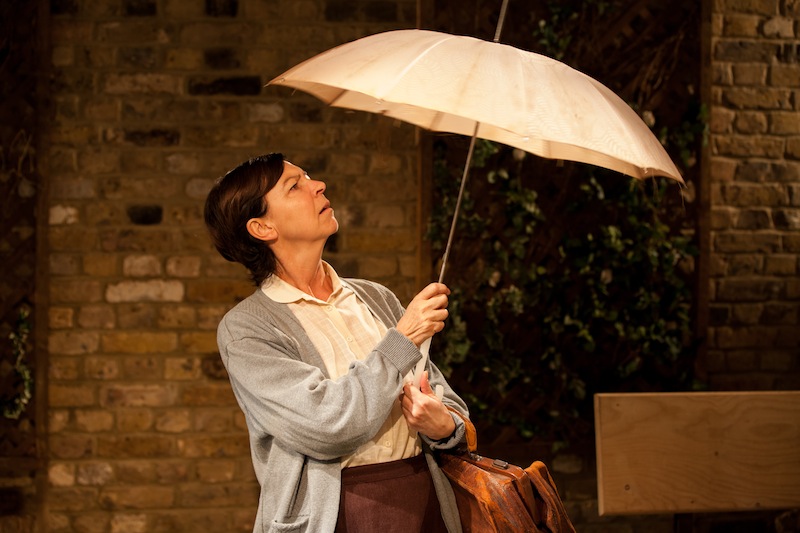
Sears’s production is, in fact, beautifully paced. The fifth character, belatedly entering the frame, is a young man called Arthur, who brandishes the garden furniture over his head like a rampaging psycho. This is intensely weird. It’s also suprisingly poignant as well funny and hair-raising. Joseph Arkley plays Arthur with quivering grief and rage, and a possibly lobotomized, blank stare. Ultimately, we are left with a sense that all these lonely souls are, in some allegorical way, Englishness incarnate – or Englishness of a certain era. The final image is of Storey’s men trying to keep a stiff upper lip but silently weeping.
I suspect this play, though not obviously gripping, may linger in the mind longer than one might expect.
Follow Kate Bassett on Twitter