If ever there was a piece that epitomised the view that villains are infinitely more fun than heroes, it would be Pierre Choderlos de Laclos’s epistolary novel Les Liaisons Dangereuses and its subsequent adaptations. The amorality at play is positively delicious, not least when the culprits feast on each other.
But how does that appeal work, as entertainment, at a time when real-life morality is under more constant, and more rigid scrutiny? Will Christopher Hampton’s celebrated stage adaptation become darker, more powerful, or simply leave a bad taste? I’m not suggesting that this latest production will, necessarily, be viewed through a different lens, though director Marianne Elliott certainly seems to be aware of the question. And it's led to a bit of a muddle, a determined dressing up of the play that has simply diluted its drama – a liaison lite, if you will.
Lesley Manville and Aidan Turner take on the great double act, as the Marquise de Merteuil and Vicomte de Valmont, former lovers, still staunch friends and allies in the common pursuit of seduction, betrayal, revenge, and generally ruining the lives of everyone around them.
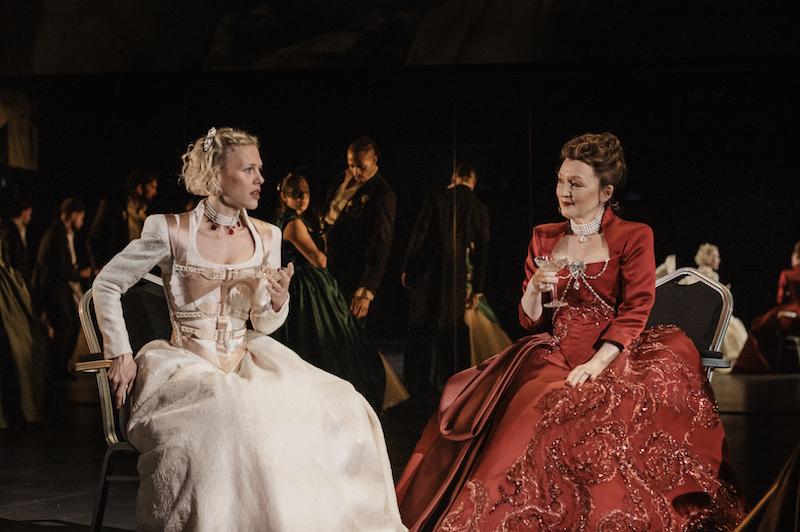
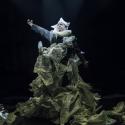
In this moment, they have independent but intersecting projects: the Marquise wishes Valmont to seduce Cécile de Volanges (Hannah van der Westhuysen, pictured above left with Manville), the young, virginal bride-to-be of the man who recently dumped Merteuil herself; Valmont has his heart – well, not his heart exactly – set on Madame de Tourvel (Monica Barbaro), who is married, exceedingly virtuous and yet, with her husband away, vulnerable to his nefarious intentions. With both potential victims staying at the home of Valmont’s aunt, they are, in a horrible way, served on a plate.
Hampton’s take on this study in amorality is sweetened by fantastic dialogue, cynical humour and wicked subterfuge; it’s also been a springboard for some brilliant performances in the past, whether Alan Rickman and Lindsay Duncan in the original production of the play, in 1985, or John Malkovich and Glenn Close in Stephen Frears’ film version in 1988.
The stars here are more than adequate to the task, if not definitive. Manville, who played Cécile in the ’85 production, is an older than usual Marquise and plays her age to advantage. Interestingly, in her recent, magnificent performance as Jocasta in Oedipus, Manville alluded to the fact that she was older than her husband by calling him “baby” while climbing sexily all over him; here, the Marquise’s growing jealousy of the women in Valmont’s crosshairs is accompanied by the tinge of an older woman’s insecurity (made explicit by one dialogue-free scene introduced by Elliot to contrast the Marquise and Cécile).
Manville also, inevitably, delivers her character’s speech on her self-creation into an arch manipulator with chilling aplomb. When the Marquise declares her favourite pursuit as “cruelty” or that “love is something you can use” or that her key to success is to “win or die”, anyone with any sense would run in the opposite direction.
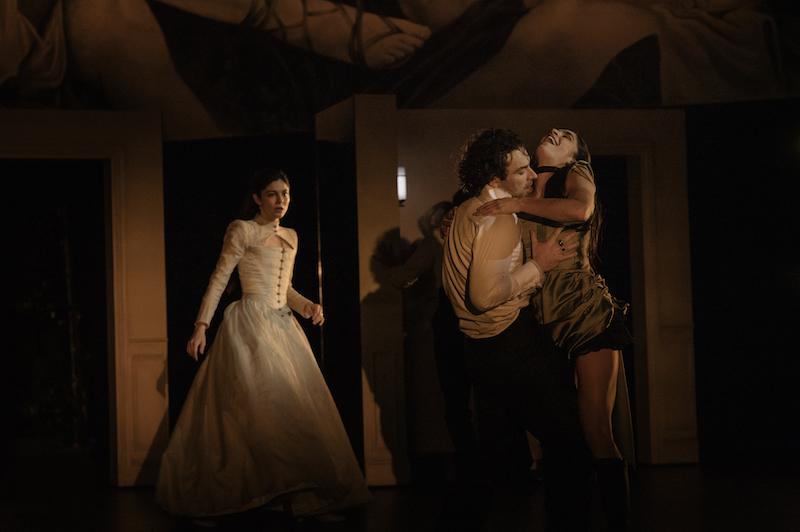
Turner is even more entertaining, and feels like the chief ballast in what is, in truth, a slightly stuttering evening; that said, the tone he’s chosen feels slightly awry. Turner lacks the innately reptilian quality of Rickman, Malkovich and Dominic West (who starred with Janet McTeer in Josie Rourke’s fine, 2015 production at the Donmar). So instead, he plays Valmont as more of a jolly cad out to cause mischief rather than serious abuse; there’s less a sense of him reeling Tourvel in, than allowing her in on the ruse and hoping she’ll just play along for the fun of it. While engaging, the approach denies the piece some edge; it also jars uncomfortably with Valmont’s rape of Cécile, the first sign that the heart of the play is unequivocally black, and one which Elliott doesn’t shy from.
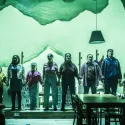
Hannah van der Westhuysen is very good as Cécile, particularly when suggesting that the young woman may be taking on the oppressor’s mantle from the Marquise. And Barbaro, the American actress of Top Gun: Maverick and A Complete Unknown fame, making her stage debut, is very affecting as Tourvel, especially when capturing the frisson where moral conviction meets uncontrollable passion. She also has some of the presence of Michelle Pfeiffer in the same role on screen (Barbaro pictured above left, with Turner and Lucia Chocarro).
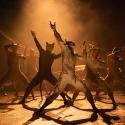
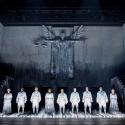
Elliott, whose fantastic CV includes Angels in America and The Curious Incident of the Dog in the Night-Time at the National, eschews pre-Revolutionary France for a period more vaguely modern. Designer Rosanna Vize lines the Lyttelton stage with mirrors, reflecting the audience and allowing this preening society to constantly regard itself; on the walls above, a band of erotic drawings; a giant chandelier, which might have been modelled on the 1990s Reichstag dome, adds to the abstract quality of the scene, heightened by the swarm of dancers that constantly invades the action – men dressed in elegant tuxedos, shirts open to reveal their chests, the women in exquisite, richly coloured gowns.
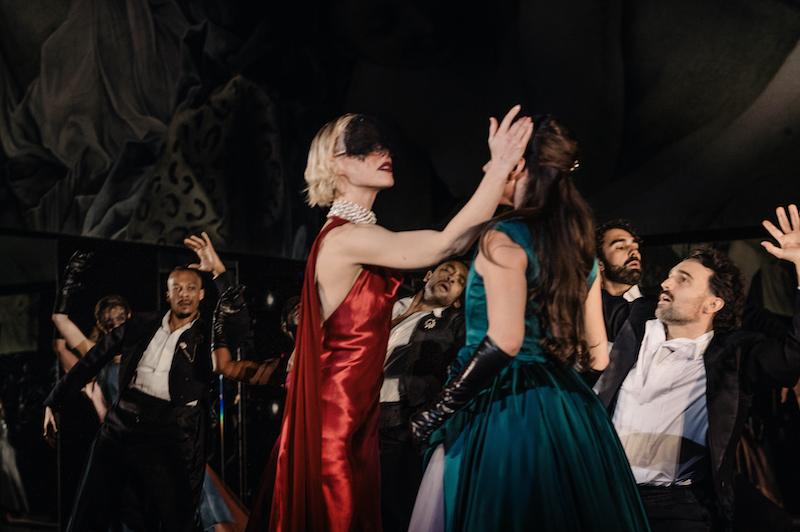
This stylisation is where the chief problem with the production lies. It is awash with dance, the scripted scenes interrupted by these self-consciously louche and postering performers. Their choreographed moves – sometimes dragging in the main actors – are meant to accentuate emotional beats or the general air of dissolution. Sometimes it works, particularly when involving Barbaro, illustrating Tourvel’s torment, or her physical flight from Valmont’s seductions; but more often these long passages of dance – however sumptuous – feel like tiresome distraction, denuding the play of its momentum, intensity and, yes, some of the discomfort that makes the source so rewarding.
It is notable that while too much time is spent on spectacle, the characters’ ultimate fates feel rushed; as Manville's shamed Marquise is driven off stage in a moment of very contemporary cancellation, how one would have loved a moment of pause, a theatrical close-up, to allow a great actress to work her own magic.