Science rocks. In the theatre, this is a subject that offers to provide powerful experiments in metaphor. Most recently, in Nick Payne’s Constellations - and most classically in Tom Stoppard’s Arcadia, Michael Frayn’s Copenhagen and Charlotte Jones’s Humble Boy - the world of quantum mechanics, cosmology and chaos theory suggests ideas about the randomness of our daily lives. And there is nothing quite so random as love.
In the appealingly titled Mathematics of the Heart, Dr Paul MacMillan – a bearded boffin from Middlesex University – has a problem. He is a professor of chaos theory, and his specialism is storm patterns, but he is taken aback when it rains. And other aspects of his life seem equally difficult to predict. His father, who was a mathematician more eminent than his son, has just unexpectedly died, and his brother, the aptly named Chancer, is occupying the spare room of his flat.
Can Paul cope with his father’s legacy?
At the same time, his girlfriend Emma, a 38-year-old solicitor, is finding it difficult to get Paul to commit. Her biological clock is ticking. She doesn’t share his flat and, at the start of the play, comes over and is surprised to find Paul with Zainab, a twentysomething PhD student who looks stunningly attractive. But Emma doesn’t have to worry; Paul’s head is in the clouds. Things only begin to hot up when Chancer, a rangey, reggae-loving free liver and loafer, decides to make a move on Zainab.
Set in Paul’s London flat, the story playfully begins with Paul and Emma opening the biggest of several boxes of his father’s possessions. It contains a build-it-yourself blue boat. It is a symbolic legacy, which evokes Paul and Chancer’s childhood, and it also sets a challenge. Will Paul, who has no skill at handicrafts, be able to construct it? Can he cope with his father’s legacy? How will Emma react to life with a boat?
Kefi Chadwick’s finely written play, which was acclaimed on its first outing at the Brighton Fringe Festival last year, is basically a study of sibling rivalry, with a vivid contrast between the brainy Paul and the more earthy Chancer. The one is lost in abstract intellectual pursuits while the other is grounded in more bodily functions. Delightfully, Chancer is part of a band; he likes to rock and is definitely a ladies' man. But, in this conflict between two brothers, both behave as schoolboys; both remain in the shadow of their dead father.
 In what is a story of emotional storms, the science metaphors occasionally glow like a bright star in a cloudless sky; at other times the main thrust of the evening is naked emotion. Feelings of love run rings around reason, and words prove less than adequate to reconcile lifelong conflicts which burst their scabs and bare their scars. Meanwhile, the boat metaphor is grounded in solid wood – a vessel that is built and unbuilt in front of our eyes – and feels more resonant, summoning up ideas about fathers, family and childhood adventure.
In the end, the plot doesn’t quite feel strong enough to avoid the shallows of treacherous metaphor, with ideas about numerology, double pendulums and ships in bottles coming fast and fluently. Yet, for once, I felt that the drama should have been longer, been given more room to breathe beyond its 95 minutes. Still, there is much that is delightful in director Donnacadh O’Briain’s spirited production, which includes an actor playing Paul’s subconscious and a stage manager who helps out on stage. Some of the boat building is a bit slow, but the acting is uniformly excellent.
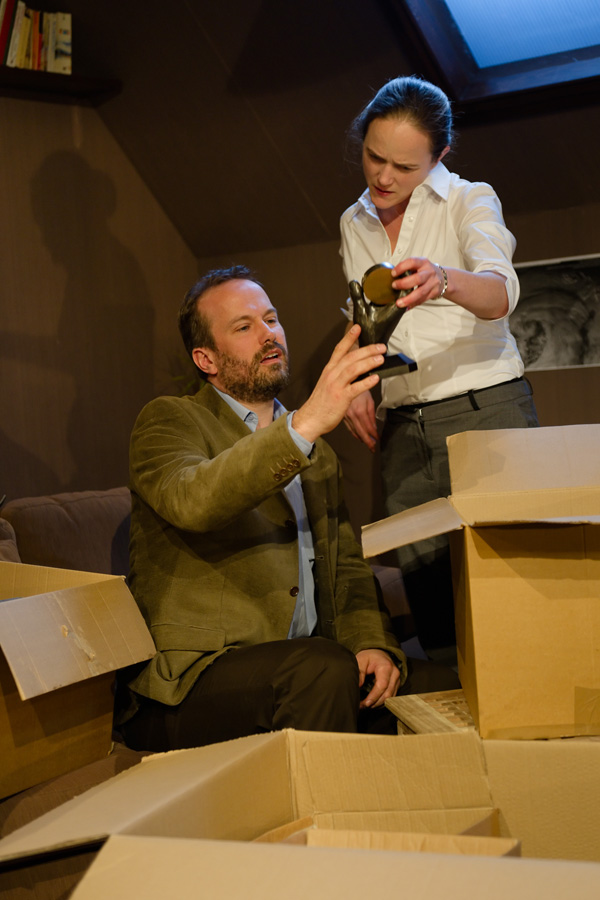
Mark Healy’s serious and repressed Paul (pictured above right with Isabel Pollen) contrasts beautifully with Mark Cameron’s freewheeling, extroverted Chancer, while Isabel Pollen’s efficient but needy Emma and Bella Heesom’s bubbly and bright Zainab are both just right. Signe Beckmann’s solid design and Philip Stewart’s evocative soundscape give Chadwick’s story of conflicted human hearts a touch of magic. Maths was never this much fun at school.