The Bush Theatre is becoming a garden centre. Earlier this year, the venue staged Coral Wylie’s Lavender, Hyacinth, Violet, Yew, which featured an abundance of plant life, and now it’s the turn of talented novelist and screenwriter Danny James King, whose Miss Myrtle’s Garden has Wylie aptly listed as its botanical consultant.
Directed by incoming artistic director Taio Lawson, it is a study of loss, love and ageing set initially amid the weeds and neglected plants of 82-year-old Miss Myrtle’s garden. She is the widow of Melrose, both being Windrush Generation migrants who have outlived their children, but not their grandson, Rudy.
When Rudy, a 31-year-old teacher at a Roman Catholic school, and his boyfriend Jason, an aspiring stylist, find their London rent is unaffordable, they move in with grandma Myrtle, whose neighbour Eddie is a 75-year-old Irishman with a love of drink. As he helps out by tending the unkempt garden, he encourages the young men to get interested in nature. But soon it becomes apparent that Myrtle is having problems: increasingly forgetful, she is suffering from dementia. As she keeps up a chatty relationship with the ghost of her late husband, Rudy and Jason have to decide how best to look after her. 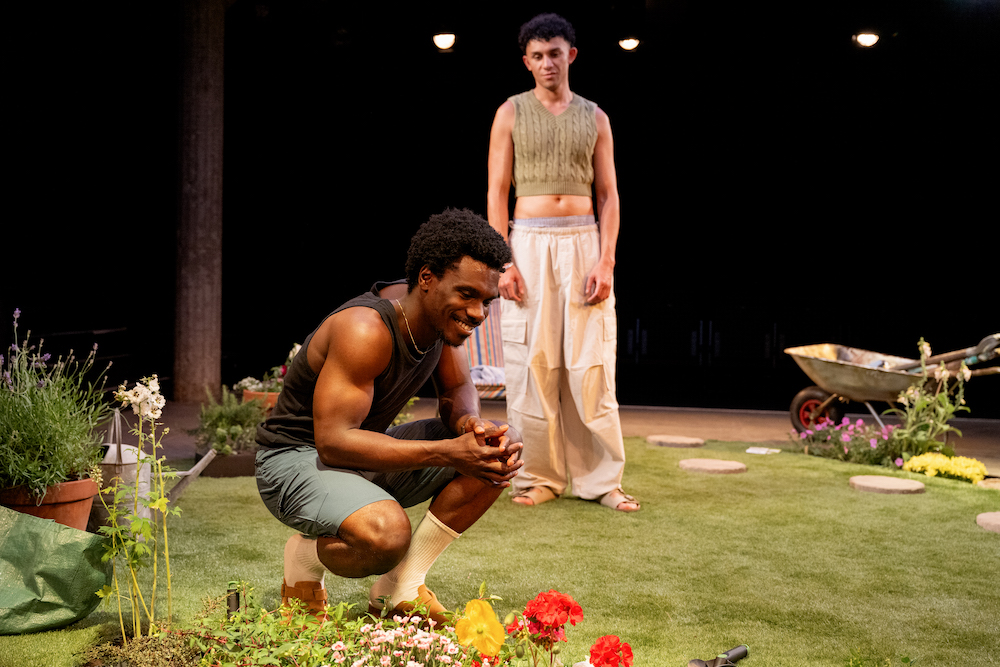 This play – part comedy, part meditation on loss – is all about character. Myrtle, described in the stage directions as “very alive behind the eyes”, is a wonderful creation: she is proud, dignified and an expert at the acid putdown. Rudy, a “bookish type”, and Jason, “resting bitch face”, are a contrasting couple. For while Rudy is worried that his grandmother will disapprove of his sexuality and so is secretive about it, Jason is much more proud of being gay – he wants to openly celebrate his black queer identity. As the outsider, and only white character, Eddie has a “weathered, kind face”, and humorous personality to match.
Of course, Myrtle – the dominating titular character of the piece – has the central role, specialising in a theatrically hilarious brand of critical comments, being always in the right, defending her status and putting relatives and strangers in their place. If the figure of an older woman suffering from dementia is now quite familiar in our culture, she is written with great sympathy and specificity. For example, as a West Indian, she is not prejudiced against Jason for being gay – she just can’t accept that he has Nigerian heritage. Her conversations with the ghost of her husband are touching and full of wisdom.
The play engages with contradictory feelings about the past. The younger generation, like Rudy for example, want to know more about the lives of their grandparents, about the old world. But talking about this is, for Myrtle, a painful subject, and she’s not willing to indulge her grandson. Being a widow means loneliness, and there are a couple of tender scenes in which she dances with the ghost of her dead husband, as well as a joyful flashback scene. In the end, she has to bear her grief with dignity – it’s all she’s got left when the feckless side of Melrose is finally revealed.
At one point, a character remarks that “plants are not like people”, and although there are some good comments about the therapeutic and practical knowledge that comes from gardening, this is mainly a play about people. I have to say that I think the plotting is weak, and the ending rather inconclusive, with some of the material about queerness oddly old-fashioned. Surely those tropes of the coming-out speech and the female relative who knew you were gay all along are more 1980s than 2020s. Like many a debut, there is some weeding to be done on the script. In this play, you have enjoy the characters and forget about the story, which is woefully predictable.
Nor is it helped by Lawson’s uneven direction. Although he gets very sincere performances from the cast, and designer Khadija Raza’s flowering garden is a delight, the evening is punctuated with Dan Balfour’s ear-splitting sound effects that clash with the gentler emotions portrayed on stage. In the title role, Diveen Henry has great comic timing and perfectly portrays both the power of the matriarch and the confusion of dementia. Michael Ahomka-Lindsay’s Rudy and Elander Moore’s Jason (pictured above) show their tangled love with conviction, while Gary Lilburn’s Eddie and Mensah Bediako’s Melrose add to the show’s emotional complexity. These pleasures, however, were spoiled for me by the weak plot and the overwrought soundscape.