

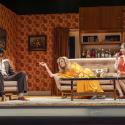
King Charles I famously declared that Much Ado About Nothing should be renamed the "Beatrice and Benedick play". So it’s not difficult to imagine him – or indeed any fan of romantic screwball comedy – relishing Chelsea Walker’s elegant, sorbet-hued production in which Pippa Nixon’s flinty Beatrice and Ken Nwosu’s jocular, easy-going Benedick strike sparks from the off.
Sometimes it takes a while for the banter to ignite in a Much Ado production, but Nixon’s wiry physicality and waspish delivery means that every insult lands with perfection. When the Messenger observes that Beatrice is clearly annoyed with Benedick, “The gentleman is not in your books,” her stinging response, “An he were, I would burn my study” gets a huge laugh as opposed to the more customary ripple of amusement.
Yet the glorious swoop of their acidic romance is offset by a portrayal of the “love” story between Hero and Claudio as something much more disturbing. In many productions the chief problem seems to be that the younger lovers are verbally less interesting than their older, more cynical counterparts. Here, however, we find ourselves appalled by the “slut-shaming” of a girl who is initially so idealised that Claudio doesn’t even dare to woo her himself. There’s no love-at-first-sight cuteness here, more a sense of society’s betrayal of a young woman whose attempts to express herself are smashed down at every turn.
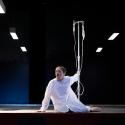
Walker’s production deliberately assigns Assa Kanouté’s dignified Hero (pictured below) more lines than the play itself does, making us invest in her more deeply. It’s a clever reinterpretation, which shifts Much Ado from being escapist entertainment – in which even the darker aspect of the plot is down to a villain-engineered misunderstanding – to a real psychological problem play. Where certain readings of the text might attribute Claudio’s denunciation of Hero to a mixture of naïveté and gullibility, here we see the full hypocrisy of a man who can only see women as virgins or whores. As Claudio, Joshua John is good at conveying his character’s youthful impetuousness, but after he’s slammed Hero’s face into the wedding cake before storming out, it’s impossible to feel any joy at their eventual reconciliation.

From an intellectual, and indeed a feminist perspective, I found this extremely interesting, but from an audience member’s perspective it seems to set up a tonal imbalance for the production which veers between the effervescent and the chilling. Yes, it puts into context Beatrice’s shocking instruction to Benedick to “Kill Claudio” (an instruction greeted with cheers by the audience on press night). Yet while the customary villain Don John – a convincingly psychologically twisted Joseph Potter – carries a good chunk of the blame for what happens to Hero, he cannot be the only emotional scapegoat for what happens here.
In contrast to the darkening of the mood for this doomed romance, there's a determinedly luminous sense of joy in other aspects of the production. Sami Fendell’s elegant white-staircase-dominated set provides ample opportunity for the acrobatics and slapstick in the scenes in which Beatrice and Benedick “overhear” that they are attracted to each other. Richard Katz – a stalwart of Complicité productions – is a superb Dogberry, transforming the cock-ups and malapropisms into a verbally ingenious highlight.
The vogue for animal heads on the clubbing scene brings a fun, surreal twist here – as it did in Jamie Lloyd’s ebullient production at Theatre Royal Drury Lane last year, the RSC's production at Stratford-Upon-Avon, and indeed at the Regent’s Park Open Air Theatre production of Sherlock Holmes this year. A sequin-clad Hero briefly becomes a lamb, while Adam Long’s Don Pedro is all too appropriately a wolf as he woos her on Claudio’s behalf.
Yet the staging of Hero’s mock funeral scene towards the end brings us back to the dark heart of this production, as a cellist plays directly above the raised coffin, and the cast members perform a slow ritualised dance, dressed in black clothes and sunglasses. Even though we know it's a charade, we feel once more the bitter undertow of this comedy. The rich, gleefully mischievous chemistry between Nixon and Nwosu means it’s impossible not to rejoice when King Charles I’s favourite characters are finally united in marriage. Yet when Hero’s wedding veil is lifted by her uncomprehending groom, it’s hard to feel much beyond sadness that – for her character at least – the difficulties of love are far from over.










Comments
Much Ado as dark comedy
I've always thought that the play was a potential tragedy - what if Claudio's slurs had caused Hero's death? So I think I'd like this production.