Intimacy is a mixed blessing: Richard Twyman’s close-up exploration of sex and violence in his production of Othello for Bristol’s Shakespeare at the Tobacco Factory takes the audience on a gripping emotional journey, but one that is at times almost beyond close for comfort.This is theatre in the round with a vengeance: the low-ceilinged space, with the audience seated within feet of the stage, in a 360-degree embrace, leaves no room for escape. Twyman has accentuated the sense of claustrophobia – because yes, intimacy can feel stifling – with a mixture of one-directional vertical top lighting and the sometimes flickering light of fluorescent tubes that are attached to the four pillars that contain the magic space in which the tragedy relentlessly unfolds.
For years, Shakespeare at the Tobacco Factory presented exquisitely intelligent productions by its founder Andrew Hilton, with a tightly-knit company of actors who returned season after season. Then Hilton started to bring in other directorial talent: a Hamlet with Jonathan Miller, and last year a Romeo and Juliet directed by Polina Kalinina. This lively production was characterized by fizzing teen spirit, aimed at a younger audience no doubt, but marred by a reliance on stylistic shock and awe rather than the fiercely intelligent dedication to content that had always characterized the company’s best work.
The clash of cultures at the heart of the play is slowly revealed
This Othello has the force of youth – Norah Lopez Holden’s Desdemona is at the start at the drama no more than a child, albeit witty and smart – but with Twyman, the form suits the dark tragedy perfectly, as if there were no style imposed. There is extraordinary lighting and sound design, perfectly choreographed movement, all of which take the audience deeper into the abyss that opens up as Iago, the master of these horrific manipulations, starts to pull the strings that will throw the play’s characters into deadly disarray.
Mark Lockyer’s Iago is a tour-de-force: it's a dark and awe-inspiring pleasure to watch this tortured soul shape the lives of others as if malice were a source of constant and necessary gratification. Under Twyman’s lens, the play might be called “Iago”, for although the production starts with the marriage of Othello and Desdemona (an orientalising scene, spoken in Arabic and added as a kind of prologue), this is very much Iago’s story. He’s a kind of trickster, the playwright’s shadow, a dark mirror of the Bard, who knows how to play with his fellows’ basest instincts and most shattering vulnerabilities.
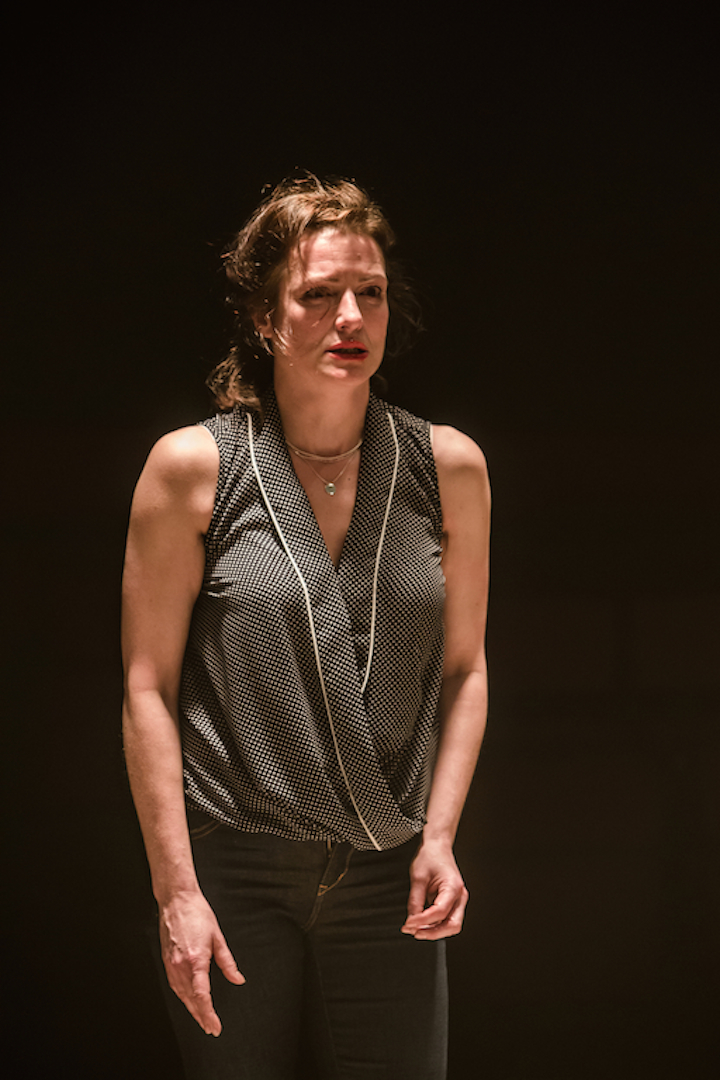
There is a telling “Rosebud” moment, not in the original text, when Twyman has Iago recoil in something like disgust when Emilia (Katy Stephens, pictured below) tries to kiss him. For a revealing instant, we become aware of the character’s probable impotence, and perhaps misogyny. Lockyer plays the dance of nuance that haunts Iago with dazzling deftness. He holds the ring in a production that highlights with tremendous force the inescapable connections between sexual passion and violence. Sexually hamstrung, he sublimates his weakness through power games. The presence of politics in the play is central – for this is war between Venice and the Ottoman Turks, with men jostling for power, and using women as objects of pleasure, powerless in the midst of the struggles for supremacy that animate the male of the species.
 Abraham Popoola’s Othello is well played as a foil to Iago’s machinations. He's a force of nature, torn between the unbridled passion and innocence of a man whose culture has not been tempered by the hypocrisy of princely courts and a desire to fit in. The full force of the clash of cultures that lies at the heart of the play – a very contemporary one, as the production makes clear through the use of Arabic language and music – is slowly revealed, Othello’s child-like qualities, mixed with jealous fury, making inevitable the horrific outcome that Iago has dreamt into existence.
There's a strong performance from Piers Hampton as Cassio, whose fate as pawn-par-excellence he conjures with great intelligence and sensitivity, while the hapless Roderigo is well brought to Geordie life by Brian Lonsdale. The production’s strength lies as well in the way in which the characters are seen to grow: Lopez Holden’s Desdemona from mischievous and slightly sex-crazed teenager to a woman who faces her fate with a maturity that comes all too late; and Katy Stephens’s Emilia, from world-weary cynic to passionate defender of the truth, in the face of her husband’s horrific treachery.
Twyman has managed to highlight the deep humanity that lies at the heart of the play and the well-knit company expresses this with great power. Violent ends in Shakespeare can misfire, as in a cheap horror flick. But here, as the full logic of Iago’s work unfolds, the level of emotion is almost unbearable, and the extreme closeness that the space affords brings us, the audience, to the edge of the abyss and beyond.
- Othello plays at the Tobacco Factory, Bristol until 1 April and then touring: Exeter Northcott Theatre (9-13 May) and WIlton's Music Hall, London (16 May-3 June)
- Read more theatre reviews on theartsdesk