Such is the USA administration’s overwhelming saturation of the news cycle that, even with the comforting presence of an ocean between, it’s hard not to find Talking Heads’ unforgettable lyric relentlessly buzzing through your brain on repeat – “And you may ask yourself, "Well, how did I get here?”.
It is the mission of The American Vicarious theatre company to “... create art that challenges us to confront the gap between America’s ideals and its lived realities”. Guys, there’s never been a better time.
Almost three years on from their electrifying Debate: Baldwin vs Buckley recreated the celebrated 1960s Oxford Union clash between the two public intellectuals (how quaint that term sounds now), the Brooklyn-based company are back in London, delving deeper in time to discover an answer to David Byrne’s insistent question.
It’s likely you won’t have heard of Kate Chase, but you probably hadn’t heard of Alexander Hamilton either, so that’s no impediment to drama once a brief slab of exposition has set the scene. She was the daughter of Salmon P Chase, not, as I would have guessed from that name, one of Hank Hill’s neighbours, but Abraham Lincoln’s Secretary of the Treasury and the man for whom the Manhattan bank was named – find him on a credit card ad near you soon.
It’s 1864 and civil war rages with Chase, an ardent abolitionist, keen to recruit negroes into the Union Army, a move resisted on pragmatic grounds by President Lincoln. Chase doesn’t think much of the backwoods lawyer from Hicksville Illinois with the spendthrift wife, and fancies running against him for the Republican nomination, but the money man is no political operator. However, his daughter is.
Kate Chase is young, beautiful and extremely sharp, knowing exactly of whom to make an ally, exactly how to do it and exactly what it will cost. As a Washington DC hostess, she is planning a dinner party in pursuit of gaining endorsements for her father, whilst also brokering her own marriage to a wealthy, but dull, senator to secure campaign funding. She’s also reading Dickens’ narrative of the doomed love affair between Estella and Pip. It's hardly good for the soul, that combination on the To Do list. She burns with ambition to see her thrice widowed father in The Oval Office, with her fulfilling the role Eleanor Roosevelt would play 70 years later. No spoilers now, but there’s a reason you’ve heard of FDR’s wife, but not of Kate Chase.
Thomas Klingenstein writes in whole sentences, trusting his audience to deal with conversations dense with ideas and high on passion, often bottled up, with the exception of one extraordinary coup de théâtre scene brilliantly staged by director, Christopher McElroen. You might need a decent sleep the night before to deal with 100 minutes all-through of genuinely chewy material, but you need that for Ibsen or Strindberg too, and the rewards here are comparable.
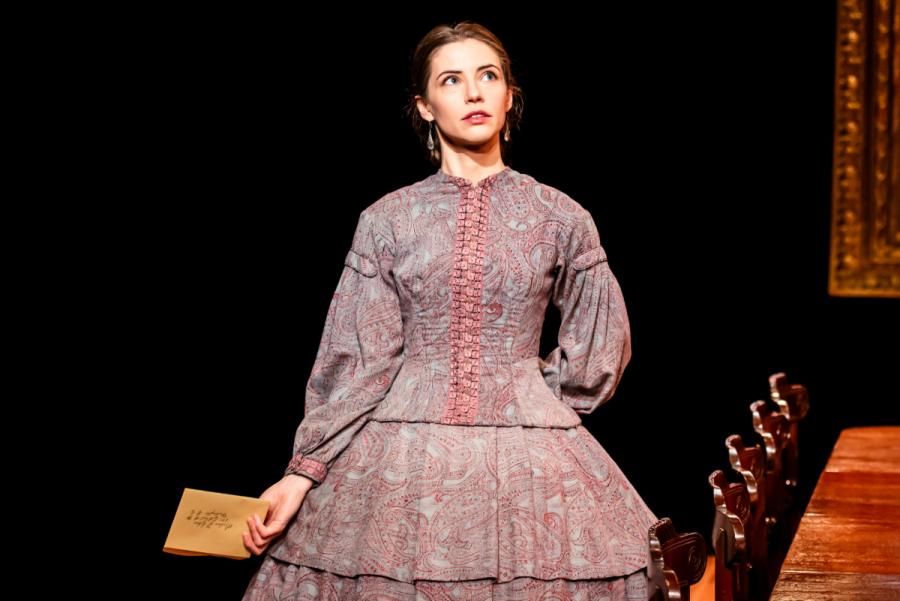
Wallis Currie-Wood (pictured above) plays the eponymous heroine (and if that isn’t a case of nominative determinism, I don’t know what is) with steel in her eye and an intelligence that can manage everyone and everything, except her own ambition. This flaw takes a tragic turn when she refuses the oblique advances of John Hay (winningly played by Tom Victor), a poet and the personal secretary to Lincoln, as well suited to her as her fiance is not. Seldom have I felt that gut-wrenching ache of empathy for two people whom you know should be together but are doomed to be apart. I’ll be lucky to see a love affair portrayed with such sensitivity again this year.
The other man in her emotional life, her father, is Hay’s opposite in personality, Darrell Brockis often glowering out of a portrait frame that hangs over the set on to which video and still images are projected. Though he mellows towards the end, Chase's protective respect for his daughter is fatally mediated without empathy or emotional intelligence, bringing her down as much as it does him. It was the second gut wrench of the evening to read of Kate’s fate in later life, things turning out even worse than expected.
The cast is rounded out by Christy Meyer as the widow, Carlotta Eastman, who tries her very best to steer the headstrong Kate away from the same kind of bad political marriage she made, and Haydn Hoskins as General McClellan, who lusts after Kate and then teaches her a valuable lesson in the fragility of political affiliations.
In one sense, things have changed since 1864 – women have the vote most pertinently – but in another sense not much has. The USA has never elected a woman as president and neither the Republicans nor Democrats have much of a track record in even nominating women to the ticket.
Though very different in many ways to Kate Chase, Alexandria Ocasio-Cortez is also young, beautiful and extremely sharp, with political ambition driving her inexorably up the greasy pole. Please America, don’t throw away another opportunity to send a woman blessed with so much to The White House, instead favouring yet another mediocre (at best) man. Come 2028, I fear they will do exactly that and I’ll be left thinking "Well, how did they get there?” Again.