To watch Cynthia Erivo delivering her stunning, technically complex one-woman performance of Dracula is not unlike watching a top athlete gunning for gold at the Winter Olympics – with the exception that this is infinitely more exciting. Over the last week, dissatisfied audience whispers led to headlines that the Oscar-nominated actress was struggling with the lines needed to play the 23 characters. Yet in a virtuoso press night performance she slayed doubters like a vampire hunter administering a stake to the heart.
Kip Williams’ adaptation is the third in his gothic cine-theatre trilogy that also brought us Sarah Snook’s Tony Award-winning The Portrait of Dorian Gray. Here he deftly uses film to heighten the psychologically claustrophobic, darkly hallucinatory – and occasionally – spikily comedic tone of Bram Stoker’s Victorian original.
The evening begins with Erivo walking onto the stage in a dark vest, trousers and shaven head, before lying down in front of the screen so she is presented as starkly as a figure on a mortuary slab. Then her screen image starts to heave and writhe, before splintering so that it feels as if we’re witnessing an out-of-body experience, in which numerous versions of Erivo struggle to break away before vanishing into the darkness.
It’s a brilliant way of evoking the heated interior world of a novel which is deliberately written as coldly and rationally as possible, as each narrator tries to disprove the otherworldliness of what they are witnessing. Verbally Williams stays faithful to the quasi-scientific form in which the evidence is presented in letters, diary entries, and newspaper articles. It’s down to Erivo to subvert proceedings so that we feel the narrative’s full power as it ramps up tensions till it tightens like a knot around the throat.
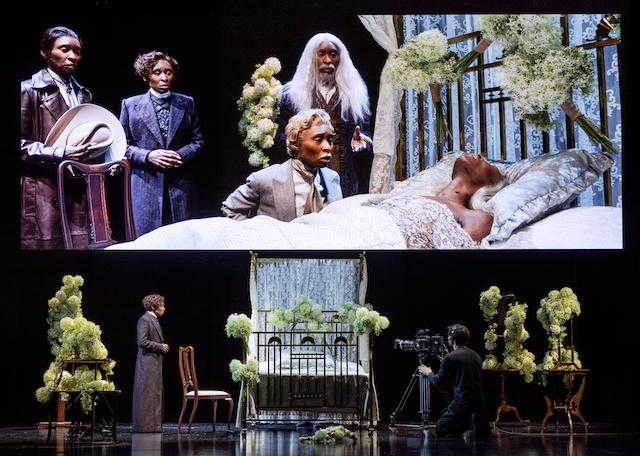
Between productions like Paranormal Activity and A Ghost In Your Ear, we’re currently observing a strong preoccupation with combining technological effect and theatrical intimacy to produce the maximum fear factor. What’s interesting, then, about Dracula is that for all its fiendish technical intricacy, it owes a huge amount of its allure to Erivo’s abilities as an actor to navigate the thin line between terror and desire.
Switching costumes and wigs throughout, she begins as dweebish solicitor Jonathan Harker, making his way eastwards across Europe towards the badlands of Romania. In his buttoned-up, deliberately wooden delivery, there seems to be little room for intrigue, but the close-ups on Erivo’s face allow for moments of wide-eyed shock that send flickers of disturbed laughter through the audience.
Then, while physically Harker is alone on stage, on screen we see Erivo as both Harker and as a burgundy-bewigged Dracula, marking the latter out with a voice as smooth as coffin-wood. The use of the close-up once more heightens the sense of stealthily escalating fear. When Dracula talks to Harker as he is shaving, the camera zooms in on the solicitor’s shaving cut like a vampire’s eye engorged by bloodlust.
Some audience members have complained about the screen effects eclipsing Erivo’s performance, but from my perspective – sat in the Royal Circle rather than the stalls – the balance worked well. As the evening progresses, so do the levels of virtuosity, as the on-stage Harker is assailed by three female vampires. At one point we can see Harker lying alone on a couch while on screen a female vampire lowers herself on top of him, at another he is framed by the teeth of the women waiting to devour him. Form and content intertwine compellingly as Harker struggles to work out what’s happening to him in three dimensions and what’s merely a figment of his imagination.
Throughout Erivo maintains her abundant onscreen and onstage gravitas to transition from sinister to seductive, from brittle dignity to bamboozlement. She brings a more subtly comedic tone to proceedings as she portrays Mina, Jonathan Harker’s wife, and her obsession with the free-spirited Lucy, whose three suitors – including a surprise Texan – shuffle around her like besotted fools. With another actor, the moment where the blonde Lucy, now a vampire, floats through the air before returning to her grave could be absurd, but Erivo imbues the scene with suitable menace. By this point she is also playing the zanily flamboyant vampire hunter, Van Helsing, his flowing white hair and beard accompanied by a suitably missionary zeal.
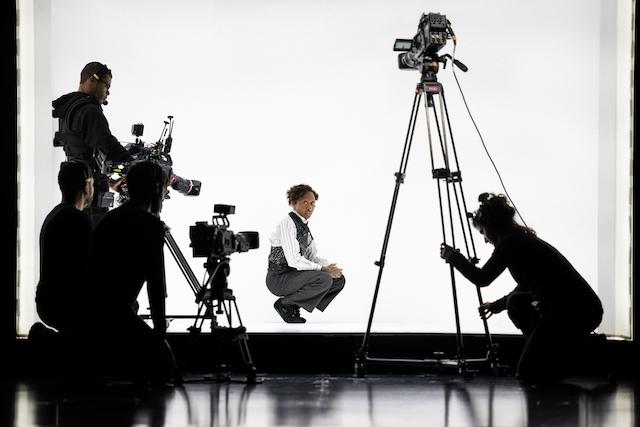
Craig Wilkinson’s kaleidoscopically complex video design dazzles without stooping to trickery for trickery’s sake – not least in a fantastic montage in which Erivo appears before us as different film versions of Dracula ranging from the original Nosferatu to more camp cape-and-teeth versions. Marg Horwell’s costumes provide considerable entertainment value at the same time as her cleverly economic set acts as a vaulting horse for the imagination. Jessica Dunn’s stylish sound design ranges from Grieg, Chopin, and a little light Mozart to throbbing club music. A hauntingly elegiac original song composed by Clemence Williams gives us a tantalising sample of Erivo’s singing voice towards the end.
At two hours and five minutes it might seem a little of a long journey to the play's close. Yet you feel this is a real example of theatre as an extraordinary feat, a testament to Erivo’s muscular determination, work ethic, and undeniable star power and Williams’ tireless inventiveness. Tickets are selling so fast, however, it may well be that you have to sacrifice your grandmother to get one. A tactic which, on several levels, could come back to bite you.