With controversial documents – WikiLeaks and the David Kelly toxicology reports – once more hitting the headlines, Iraq is ever with us. As are its ghosts. Canadian playwright Judith Thompson’s Palace of the End, winner of the 2009 Amnesty International Freedom of Expression Award, now at the Arcola Studio in Hackney in a spare, eloquent revival by Jessica Swale, figures three of them. It is a painful reminder of the human cost of a desperate and degrading period in their, and our, history.
Any accounts from Amnesty or the Medical Foundation for the Care of Victims of Torture tells you that the most horrific human-rights abuses were committed under Saddam Hussein's regime. Thompson’s three-handed meditation (presented at last year’s Edinburgh Fringe) keeps the Saddam experience until the end, in the portrait drawn by Nehrjas al Saffarh, a fictional Iraqi mother and wife who watches her son being tortured, in the "Palace of the End", in front of her, by Saddam’s Baathist police.
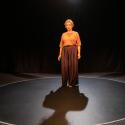
Imogen Smith’s proud, elegant witness describes these events with almost unbearable composure. It is she who also reminds us that it was American support that brought Saddam to power before another US decision ordered that he should be ousted, the repercussions of which provide the first two monologues in the triptych.
In this unravelling scenario, it is in the, by now, infamous events in Abu Ghraib and the photos that emanated from it that open proceedings. In what is clearly based on the young female American soldier, Lynndie England, Jade Williams gives us a podgy, heavily pregnant West Virginian whose patriotism and desire to be accepted by male colleagues form the apparent motive for her appalling behaviour.
Unrelieved, harrowing tales of cruelty can be hard to take in the theatre. Thompson’s portrait, however, cleverly backtracks, insinuating how our young soldier’s already desensitised aptitude for bullying and worse - which, under the distortions and pressures of military conflict, developed into full-blown sadism - were grown and incubated in her own backyard of small-town America.
It’s hard to say which is the more shocking to listen to: the mindless mundane cruelty in this suburban existence or the later, gruesome humiliation of the Iraqi prisoners, in the name of gaining information. Justifying her behaviour, she spits out, "They was monsters in the shape of human beings. They was prisoners of war."
Twas ever thus in conflict; dehumanisation. But Thompson’s portrait is remarkable, both for its psychological insights into cruelty born of educational limitation and the voice she finds for her character, fixated at once on not being thought ugly - "I am not an ugly girl and I am definitely not, nor have I ever been, a feminist. I hate feminists, man, now feminists are ugly" - yet delighted at becoming a "celebrity", the subject of thousands of internet comments, no matter how insulting.
Filling the sandwich between our young American and the Iraqi mother, Thompson adds David Kelly. Here the story and the ghost take on their English twist: Kelly the modest scientist, found on Harrowdown Hill, in a sense "hounded" to a death still, to this day, unresolved as to whether it was suicide or murder. Kelly is still with us. Thompson’s play, originally begun five years ago with the opener as a solo piece entitled My Pyramids, has grown in length and resonance.
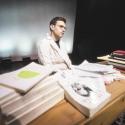
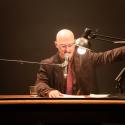
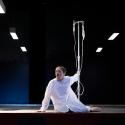
Robin Soans’s realisation of this enigmatic character, beautifully drawn by Thompson, is, as ever with this performer, rich and nuanced, the climactic point arriving as he recounts the murder of a beloved Iraqi antiquarian friend and his family by American forces. When Kelly, according to Thompson, hears of this violation, he snaps. "I blew myself up." He decides to tell the truth, speaks to Andrew Gilligan. The rest is history.
Palace of the End is a tale of repercussions. It is one, too, of consequences evoked literally through a daisy chain of images and words, carried on from one character to another.
Both the female soldier and the Iraqi mother, towards the end of their accounts, "soar" and "fly". Kelly, settling under his tree, awaiting death, with cut wrist and pills, can "see the whole world from here" as can Nehrjas al Saffarh as she begins her story.
Nehrjas means Daffodil. "A woman", she tells us, "is never called after a tree. Only a flower. Because the purpose of a flower is to attract a bee. And the tree, the tree stands alone. Do you see the tree outside my window? Ah, isn’t that a beautiful view? I can see the whole world from here."
- Palace of the End is at the Arcola Theatre, London E8, to 20 November