"I can add colours to the chameleon," Richard III remarks of himself early in his anguished, marauding ascent to the throne, and the description could equally apply to the electrifying actor, Ralph Fiennes, who is London's latest hedgehog/dog/toad/bottled spider (pick your animal imagery of choice).
Marking his third London stage appearance in 16 months, Fiennes may be older than most modern-day Richards but he cuts more deeply as well, his Almeida return coupling flashes of the charm this actor brought last year to Man and Superman with liberal dollops of the gathering psychosis in which Schinder List's Amon Goeth trafficked all too well.
The result makes for a restlessly exciting evening in which director Rupert Goold seems to conjoin two of his defining Almeida productions - King Charles III, the faux-Shakespearean history play, and American Psycho, the musical portrait of a contemporary killing machine (transferred this spring briefly to Broadway). There's an elastic modernity to a Richard III that combines sworplay and guns, mobile phones (in passing) ad a framing device involving the exhumation of this monarch's famously bent spine from beneath a Leicester car park in 2012.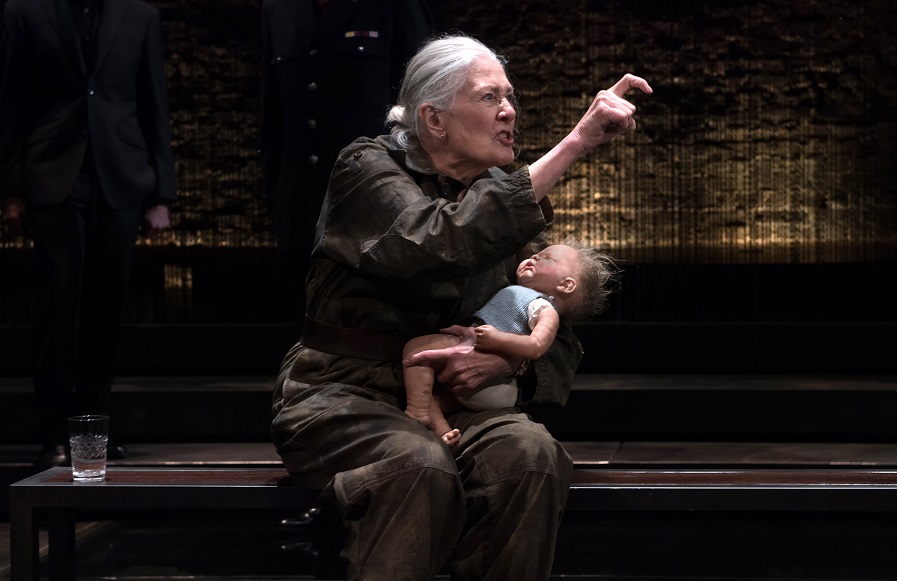 And although Fiennes - pivoting his body toward us, the character's defining curvature visible through his tight-fitting shirt - seems to throw away possibly the most famous opening speech in all of Shakespeare, don't be fooled. If he downplays the overture, so to speak, the actor is present and then some through every one of the set pieces and interactions that follow, Fiennes memorably paired with a haunted, hateful Queen Margaret in the form of Vanessa Redgrave (pictured above). The two played mother and son in Fiennes' 2012 film of Coriolanus and feed off one another to stirring effect here, Redgrave clawing at the air with imprecations while clutching a plastic doll that Fiennes' Richard briefly grabs at to chilling effect.
The convention with Richard of recent years (most amplfied by Mark Rylance at the Globe in 2012) is to turn the third longest role in the canon into a deranged stand-up comic, but Fiennes is having none of that. To be sure, he catches at the mordant comedy and quick wit of a character whose biting tongue finds a contrast in the actor's sad, pained eyes, but the more startling passages posit Richard struggling to contain what passes in these circumstances for composure. (I liked the suspended crown that marks out the higher reaches of Hildegard Bechtler's design - although Richard's first action, upon reaching the throne at last, is to discard his crown and place it beside him.) 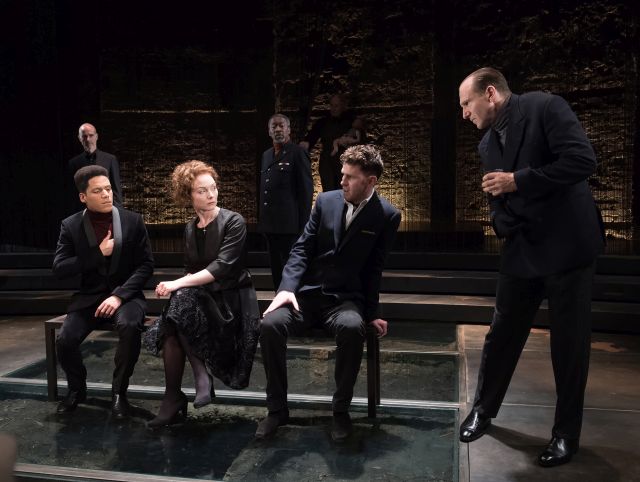 There's a brilliant moment when Finbar Lynch's saturnine Buckingham refers to Richard's "effeminate remorse", only to be met with a stare from Fiennes that could turn an onlooker to salt. Possessed of a temper less easily contained the further his misdeeds mount, this Richard lets roar at the hapless Hastings (James Garnon): Hastings' reply - "woe" - might easily be read as "whoa!" Any mention of the feminine, meanwhile, sits unwell with a monarch who makes apparent his scalding contempt for womankind, like some better-spoken Donald Trump locked in perpetual combat with a sector of society that he can have only via coercion: cue a wooing scene late on between Richard and Elizabeth (Aislin McGuckin, pictured above centre), that culminates shockingly in a rape.
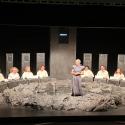
The action is staged above and around a pit from which Richard's remains are disinterred and into which the character in defeat finally tumbles. Goold's production is markedly less tricksy than one might expect from the director of a Stalinist Macbeth and a Merchant of Venice set in Vegas. Utilising the audience where appropriate (Richard near the end asks various playgoers at the front whether they might be Tyrrell), Goold pulls us into the actions of an anti-hero from whom you in any case can't look away. You leave the theatre aware that the "blasted sapling" that is Richard's gloved right hand is as nothing next to a misshapen psyche whose poison turns inward and then downward into that pit.