Russia.
It’s impossible to be ambivalent towards that word, that country, indeed that idea, one so very similar to our own, yet so very different. You feel it in Moscow, where I spent a week exactly 40 years ago. Like London, it is a vast city, imperial in ambition, a true believer in its past and present, but then, as now, uncertain of its future. It is also not like London at all, crowded with strange buildings, cold beyond description, peopled by frightened men and women. There’s an irony in the fact that I learned more about my own home in seven days spent 1800 miles away than I did in seven years in SW17. You can never really leave Moscow behind.
Eleven years ago, I saw a Three Sisters that attempted to replace the Russian capital with the UK’s, replace the 19th century with the 21st, replace the general with the particular. It did not work. It is the play’s anchoring in the heart of The Bear that provides the specificity that sharpens its knives that carve into the universal human condition. That we bounce between these awkward multiple Russian names and a litany of almost insupportable evidence of the price of simply being alive, gets us through the evening without running out, tearful, to confess one’s own complicity. The trigger warning this play, any Chekhov play really, needs is that the mirror it holds up to your soul is still there even when you close your eyes - and for a long time after.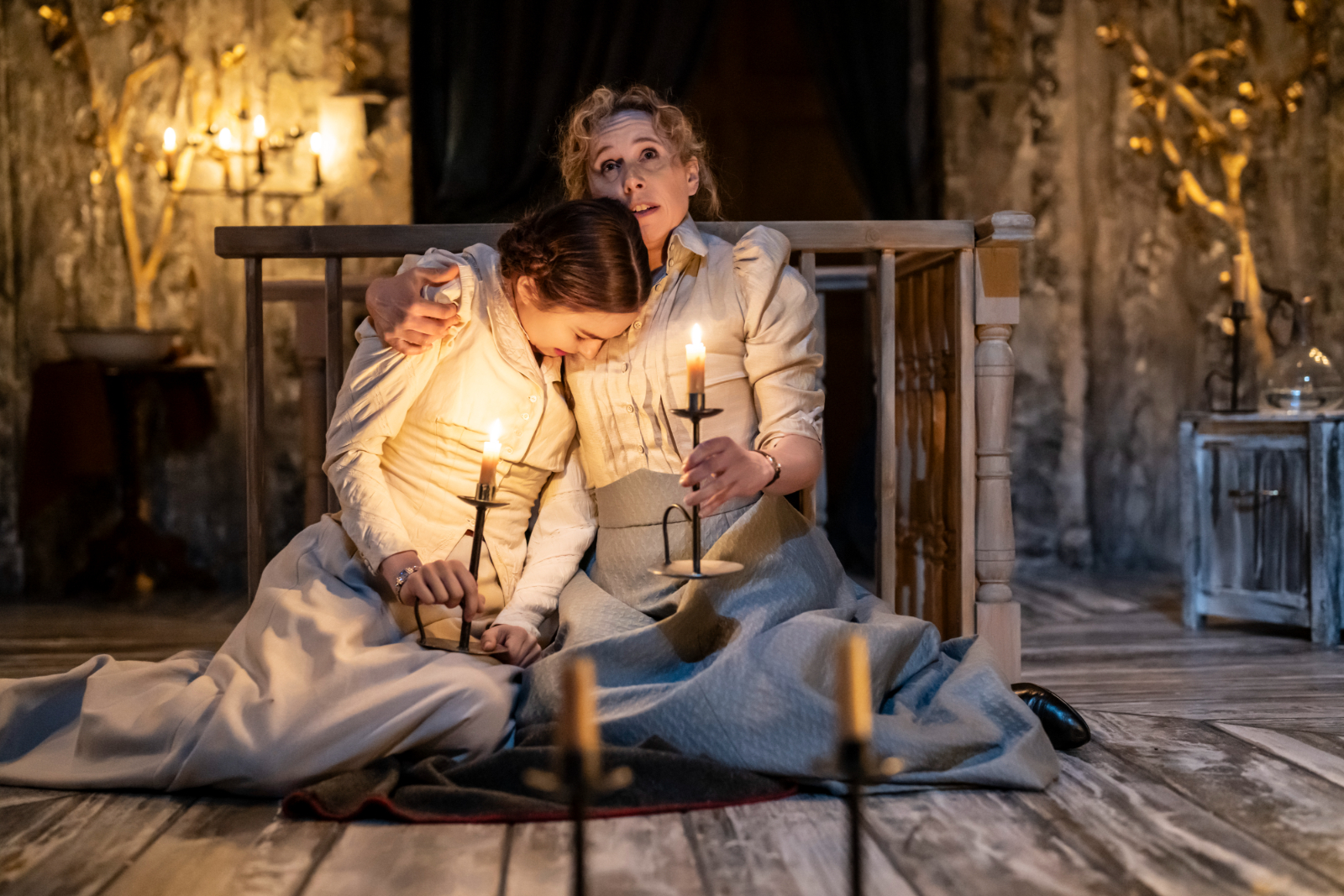 This new translation by Rory Mullarkey finds a language that continually knocks you off balance with its otherness, but also jars with the contemporary phrase when it fits. Where exactly are we?
An answer comes from an unexpected source. Oli Townsend’s beautiful costumes wrench us back to a time and place, the comforting exoticism of bias cut gowns and dress uniforms placing distance between us and them in this intimate space. Then Natalya will say something or Masha will look at Vershinin and the matrix glitches and you’re up close and personal, staring at yourself again - and you don’t like what you see, even as you acknowledge its truth.
Director, Caroline Steinbeis, makes the very wise decision to let the text speak for itself. That the production comes with no intrusive vision, no imported agenda, no contemporary judgement shouldn’t be a rare delight, but, these days, it certainly is. So it’s over to the actors to deliver on this rawest of raw materials, fittingly in a venue, named for and suffused by, the writer who asked more of his actors than any other, before or since.
Laughter rings round the house in the opening scene. My heartrate subsides a little and I permit myself an internal whisper, “They get it”. Michelle Terry’s Olga (pictured above with Ruby Thompson) is conversational and funny, but the woman who never found love is already in “If you don’t laugh, you’d cry” territory far too young, even in rural Russia where life was so often nasty, brutish and short. There’s a callback to that attitude late in the play when she finds her limit and stands up for her ageing servant, Anfisa (Ishia Bennison) and then rescues her. Like her sisters, she does have a backbone and, like them, she deserves so much more.
Especially Masha, at 23 years old already regretting her teenage impetuosity in marrying the pompous pseudo-intellectual schoolteacher Kulygin - what would our lives be like if we all paid the full price for our youthful follies? Shannon Tarbet catches Masha’s sullen sardonic wit that suddenly blooms - “I’m staying for lunch” - when Lieutenant Colonel Vershinin rides into town, and she glimpses that cruellest of sights, the life I never led. It’s quite a feat amongst these three but Masha has the most to lose, the ideal man (Paul Ready wonderful in his almost unconscious seduction as the military Muscovite) unattainable; the anything-but-ideal man (Keir Charles, also impressive) a husband who is just too nice, too decent, to allow her the comfort of hating him.
Irina is childish, immature, coddled by Olga in particular, but she knows her heart and she knows it cannot settle for the wrong man in the wrong place - Masha is her living warning after all. Almost all the air goes out of Ruby Thompson’s little sister over the four years or so timeframe, as she comes to terms with a life as the wife of the infatuated Baron, Michael Abubakar perhaps a little too winning, a little too charismatic as the ill-fated, unloved spouse. He can’t help it, but neither can she.
There’s time for Stuart Thompson and Natalie Klamar to be gruesome in their own ways as the feckless and arrogant brother Andrei and his viciously narcissistic wife, Natalya - characters who could sustain a full length play of their own. Peter Wight makes the cynical waster, Chebutykin, as irritatingly hard to like as ever and Richard Pyros has the look of a serial killer as the misfit (and likely actual serial killer) Solyony.
Chekhov’s first outing in Shakespeare’s home could have been an overreach or an uncomfortable shoehorning of one genius on top of another, as unedifying as Jagger and Bowie’s hideous “Dancing in the Streets” collaboration. Instead, by cleaving so closely to the unparalleled source material, it is a triumph, provoking, as Chekhov must, a nervous glance over your shoulder on the way home to see who's following you. It turns out to be yourself.