Theatre is in the very bones of this bold adaptation, with the Lyric gifted a cameo role: past productions are fleetingly pastiched in a flashback to the era of the venue’s foundation. Laura Wade and Lyndsey Turner translate the vividly immediate first-person narrative of Sarah Waters’ 1998 novel into a world coloured by the experience of their heroine, whose coming-of-age story is sparked by the stage: make-believe illuminating the truth of her sexual identity. Music hall vocabulary creates a stylistic framework for this episodic, picaresque tale, but there are too few glimpses behind the curtain in a show more dazzling than affecting.
Like fellow spirited adventurers Moll Flanders and Nell Gwynn (the latter currently inhabiting the Globe), Nancy Astley (Sally Messham) rises from humble origins, selling oysters rather than oranges before making her name as a vaudevillian male impersonator or “masher” alongside all-consuming first love Kitty Butler (Laura Rogers, pictured below). Chameleonic Nan embodies multiple roles – cross-dressing rent boy, bruised and bruising plaything of socialite Diana (Kirsty Besterman), feminist activist – on the road to self-acceptance. There’s a dash of Moulin Rouge!, too, with Turner’s flamboyant use of contemporary pop songs (rearranged by Michael Bruce) – wittily deployed, if occasionally distracting.
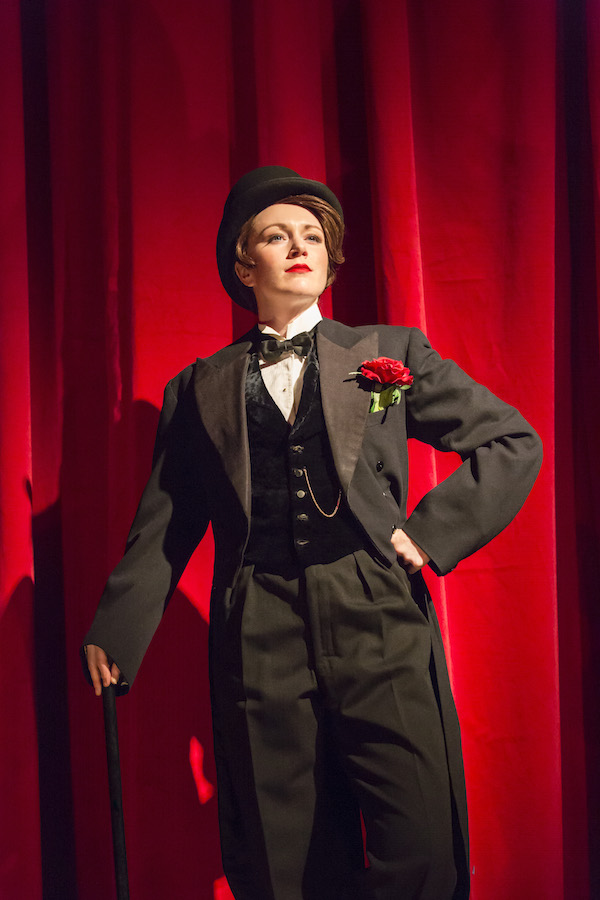 Nan’s interior life is externalised via comic skits, acrobatics, puppetry and Lizzie Clachan’s arresting designs. The cumulative effect is playful pantomime with eloquent visceral flashes. The rose that Kitty gives Nan multiplies, subsuming her dressing room; while Nan’s family merge with the blues and greys of their Whitstable backdrop, Kitty stands out, emblazoned in scarlet. Their journey to London is evoked by a chorus of sound effects; Diana’s snobbish Piccadilly club is starkly monochromatic, a museum where Nan is exhibited; depressed and rejected Nan hangs among Smithfield’s animal carcasses (which double as xylophones); and an end-of-pier cut-out provides glory holes for her work as a Soho “renter”.
Instead of the titillation of Andrew Davies’ 2002 TV version, Nan’s sexual experiences become Cirque du Soleil aerial displays, with effective contrast between dreamy, tender, entwined silks and perilous swinging from a cold, hard metal trapeze. Yet the life-affirming message about being yourself rather than changing to fit in or hiding behind artifice means a deflating shift from roller-coaster razzmatazz to right-on domestic contentment. Waters’ rather less nuanced treatment of class and politics is exposed, despite Wade’s timely rallying cry for socialism to embrace sexual equality.
David Cardy’s ever-present MC is a genial, fourth wall-breaking addition, but highlights a distancing from Nan’s psychology, and the replacement of a gay woman’s voice with that of an older, straight man is problematic. Better to trust in Messham’s assured performance: her mesmerisingly sensual description of eating an oyster – that “queer” creature which exhibits both male and female characteristics – is a showstopper.
Besterman offers a Diana as sleek and predatory as her huntress namesake, Adelle Leonce a gutsy portrayal of “good” campaigner Florence, and Ru Hamilton a caustic rent boy, while Rogers is stronger communicating Kitty’s fear of discovery than her star power. Judicious editing would help tighten a sprawling, near-three-hour show, but there is mischief and vivacity aplenty in this affectionately anarchic reading.