French playwright Florian Zeller’s 2011 four-hander about infidelity and the deceptions it entails, translated by Christopher Hampton, returns 10 years after its UK premiere at the Menier Chocolate Factory. A lot has changed in the personal communications world since its debut, but the play soldiers on with just a few appearances by early mobiles and no sign of social media.
Does that matter? It makes the play something of a period piece, but its illicit liaisons are not dependent on technology. And at its heart is not so much deception as self-deception and the language we use to blank it out. It offers a theatrical game rather than intellectual inquiry, and director Lindsay Posner serves it up accordingly as a satisfyingly funny entertainment for grown-ups. Zeller may be a fan of Pinter, but Betrayal this is not.
The setting is Paris, in a series of well appointed spaces — a hotel room, two living rooms, the locker room of a tennis club, a doctor’s surgery and another hotel room. Scene changes are achieved swiftly so that the pace never lags. More importantly, this allows the vocabulary the two couples use about themselves and others to be deployed in the likelihood that we will remember a key detail or phrase, where it was used previously, and know why it's a hand grenade. Pistachios, for example, repeatedly have a walk-on part, as does losing at tennis: all part of the web of deception ensnaring the four characters.
Zeller's plot is both relentless and clever, while not deviating that far from the standard mechanisms of farce. Person A conceals something from Person B that B already knows, which ultimately gives B more information than A realises; and because the intel has come from Person C, without A’s knowledge, A is at the tail end of this donkey.
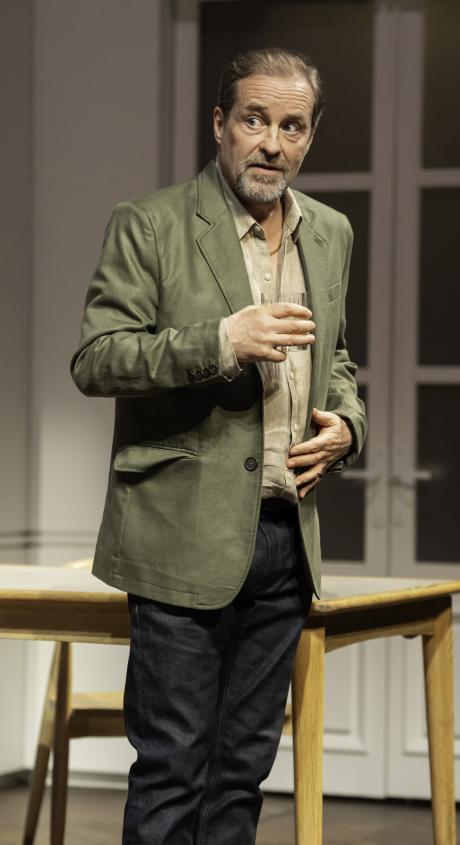
Person A is Michel (Stephen Mangan), a seemingly successful bourgeois who believes he is in charge of his life, guiding his bubbly mistress Alice (Sarah Hadland) in the matter of what, preferably nothing, to tell her husband Paul (Ardal O’Hanlon, pictured right) about their months-long affair (Michel doesn’t know how many months, typically). Paul happens to be Michel’s "best friend of 20 years", a fact Michel brings up on numerous occasions, usually to accuse Paul of betraying him, not the other way round. With each iteration of the phrase, the degree of Michel’s wonky worldview becomes clearer and increasingly comic.
Language teeters on the brink of Lewis Carroll absurdity in Michel’s mouth. “We’re both married,” he says to Alice, “especially you.” When she suggests varying their routine, which is to have sex in the same hotel between Michel’s meetings (Alice’s appointments with patients are given second billing), and to spend more time with each other, he concedes: “We could go to a different hotel -- but not for a two-day weekend.” This contorting of language is potentially a serious issue, but here it’s projected as comedy.
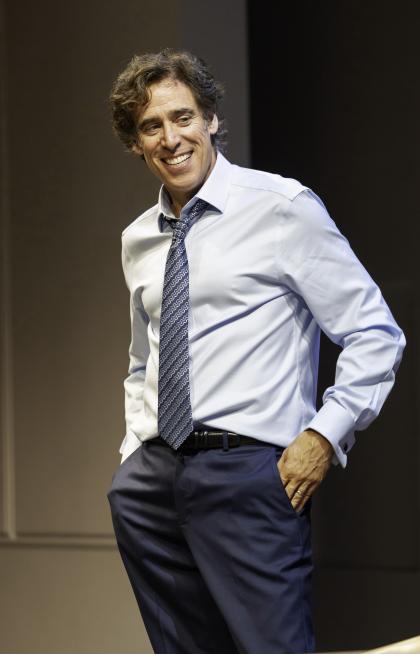
Too much detail about the plot will spoil the fun, which is about navigating its twists and turns alongside, if not ahead of, the characters. The twists keep on coming, to the last piece of dialogue. I watched knowing what the denouement was going to be. So I didn’t laugh out loud when O’Hanlon delivers hammer-blows to the flimsy structure that is Michel’s sense of things, though I can see why people new to the play actually cheered and applauded in delight when that happened.
This is a very “British” Zeller, helped by the sparseness of local references in the text. (Chartres and Bordeaux are mentioned, but never cinque à sept, the time-honoured French term for regular assignations that even the British have heard of.) Perhaps that’s what Zeller wants: a play about duplicitous adult behaviour with universal appeal.
Mangan is another version of his standard ruffled professional, loquacious and borderline obnoxious, but redeemed by being funny. He's more scheming Guy Secretan from Green Wing, all bounce and cheekiness, than you imagine your average Parisian bourgeois might be. This is especially obvious when he has to improvise a phone conversation with Paul, posing as Alice’s elderly aunt, and comes up with a weird cockney version of Sybil Fawlty. But his sheer energy is compelling.
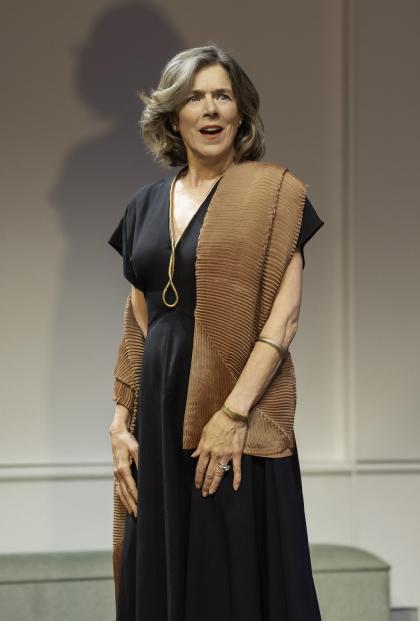
Paul — Michel’s “best friend for 20 years!” — is secretly his chief opponent, a cool head and master of timing. He too seems an unlikely resident of central Paris, though it does seems feasible that a big Swedish company is headhunting him. He’s wily and tough behind his avuncular twinkle. The two women draw shorter straws. Dee’s Laurence (pictured below) is an elegant, smooth-talking metropolitan, skilled in innuendo and nuance, but sidelined for much of the action. And Hadland, with her genius for absurdist comedy (not least in the brilliant TV series Mangan wrote, Hang Ups), gets little of that to play with.
This uneven focus seems to stem from Zeller’s fascination with the blustering egotism of Michel, who can concoct a slight out of any situation and judge it heinous, though not when he is doing it himself. His wife seems to believe infidelity is acceptable if it’s discreetly done. How much of the real truth can a marriage take? There would be no couples left, Michel suggests to Alice, if they were totally honest at all times. In the final scenes, accepted values have been dizzyingly turned upside down. Michel promises, apparently sincerely, to be a “better liar” though feels aggrieved that Paul — “my best friend for 20 years!” — has manipulated him. He clearly is more concerned about his tennis prowess than anything else, including his infidelity; and social faux pas rank higher with him than moral decay.
It will be interesting to see how the new version of Molière’s Le MIsanthrope at the National by Martin Crimp fares in a contemporary setting. There are some unexpected parallels between the two plays, notably the value of honesty in social interactions. Molière’s protagonist, Alceste, ultimately turns his back on his social circle, disgusted by what he sees as their insincerity; Michel, on the other hand, ends the play firmly in its embrace, one of its key practitioners.
- The Truth is at the Apollo Theatre until 12 September
- More theatre reviews on theartsdesk