Infidelity, hypocrisy, disillusionment, betrayal – and yet this is by far the lightest of French playwright Florian Zeller’s current London hat trick. Premiering in 2011, and thus sandwiched chronologically between the bleak pair of The Mother (2010) and The Father (2012), it takes a comparatively sunny approach to the fracturing of trust and deconstruction of the moral ideal of truth.
Michel (Alexander Hanson) is married to Laurence (Tanya Franks) and also sleeping with Alice (Frances O’Connor), wife of his best friend Paul (Robert Portal, pictured below with Hanson). Michel is a firm believer in dishonesty as the best policy – not telling their respective spouses about their affair, he argues, is really an act of love. But that strict adherence to lying by omission is rocked when he learns that he’s far from the only deceiver in the unknowable quartet.
There's a coolness that better serves the ideas than the people used to explore them
The Betrayal comparisons are inescapable. Like Pinter’s immaculate work, Zeller’s dissects a male friendship alongside marriage, throws up a series of revelations that cast new light on previous scenes, and – instead of squash – enlists tennis to signify both bonding and uneasy rivalry. But, lacking Pinter’s devastating reverse chronology or the immersive dislocation of Zeller’s other work, this is a relatively straightforward study of duplicity that, in Christopher Hampton’s witty translation, entertains and provokes more than it moves.
Here, the power shifts that accompany knowledge gained, stored and disclosed become darkly funny fare. Hanson is excellent as the serial (but terrible) liar, producing blustering outrage when accused or presented with new information, overcompensating furiously in an attempt to feign innocence, and compartmentalising to an impressive degree. He’s cuckolding Paul, while simultaneously fuming that his friend was unceremoniously fired – don’t those employers have any decency? His wife unpicking a dodgy alibi is treated as a gross violation of trust, as he clings to the moral high ground, but a wonderfully excruciating whisky-fuelled confrontation illustrates how ill-equipped this proud dissembler is to handle the truth of others’ pretence.
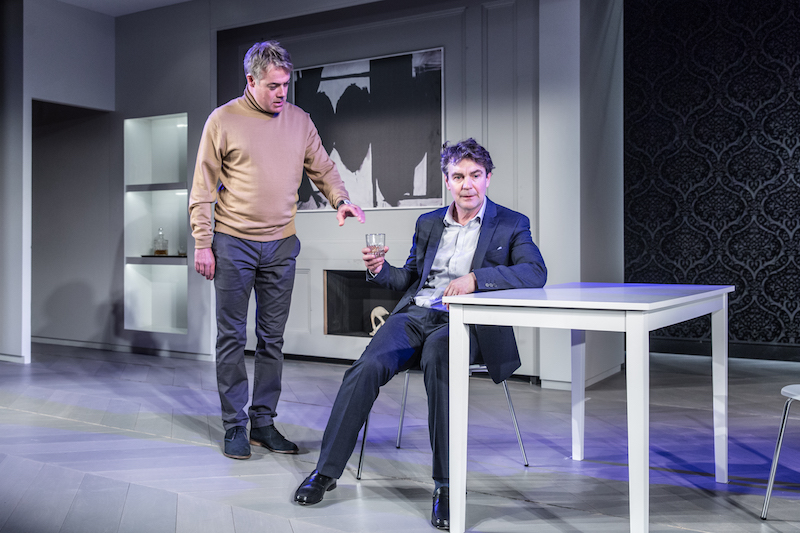 Portal’s stoic Paul offers a superb contrast to the unravelling Michel, though a quiet speech hints at the grief and loneliness that comes with the loss of friendship. Franks’s Laurence is effectively inscrutable, and a surprise provider of real desolation. However, O’Connor’s Alice is slightly too composed, her warring desire for Michel and mounting guilt at cheating on Paul described rather than fully conveyed.
Zeller continues to illustrate a talent for teasing out the strangeness of everyday speech, repeating innocuous phrases to reveal a hollow insincerity. The familiar beats of covert affair and marital tension are also subverted until their absurdities become apparent, though the side effect of this wry, postmodern approach is emotional distancing that limits the play’s impact. It’s a problem Lindsay Posner’s crisp production can’t quite overcome, resulting in detachment from the pain and passion at the core of the tale. Like Lizzie Clachan’s sleek monochromic design, there’s a coolness that better serves the ideas – the complex relationship between honesty and intimacy, and our labyrinthine motivations for telling or withholding the truth – than the people used to explore them.