I hadn't thought this one through very well. As someone who was put off horror films by a window crashing onto a hand in one of the Amityville movies at least two decades ago, watching Time Shift: Dear Censor last night, which promised to show some of cinema's most notorious scenes, was probably unwise. Happily, standards of gore, violence and sex have dropped so fast in the past 20 years that what was censorable in 1991 is PG now.
A compact history of the British Board of Film Censorship (it became the less finger-wagging Classification in 1984), made with extensive access to its letters archive, Dear Censor showed the tensions at play within the organisation as film-makers strove to make art and money - rarely at the same time. Some chief censors, such as John Trevelyan, seemed to trust that art was being made, and his clever co-option by film-makers such as Ken Russell, who let him advise on the script of Women in Love, neutralised his authority. (In one brilliant anecdote, Trevelyan used to come into the office and ask, "Who's fucking who today?") Others were victims of their time, driven out for liberal attitudes.
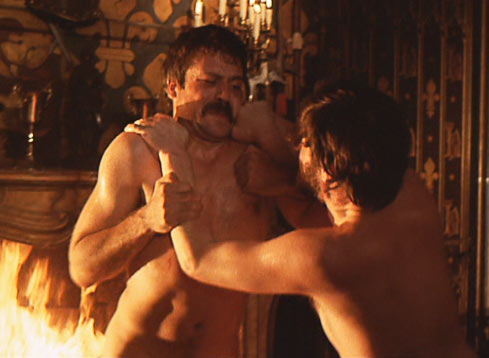 There is a chicken-and-egg paradox in the existence of the BBFC: what comes first, the censorship or the attitudes of the public? Or, put another way, should the BBFC try to lead public taste or reflect it? This was the dilemma which recurred throughout the programme: from the letters of complaint received, clearly certain segments of the public were not ready for the word "fuck" in Ulysses, the full-frontal male nudity (always more dangerous than female nudity) in Blow-up and Women in Love, the rape in Straw Dogs, the kicking of a tramp to death in A Clockwork Orange, most of which we got to see. But then many people have never been ready for those.
As made clear by the greater permissiveness over the decades - even if an amusing flurry of letters flew about over how dark it should be in Women in Love (pictured above) to stop us seeing Alan Bates's penis - the censors were not immune to public tolerance, but they seemed to wish to slow it. This is no bad thing - we do not allow the public to see anything just because they wish to - but in retrospect it looks like stuffiness. If you choose to argue that society has indeed become debased by watching sex and violence - and many do (I recall especially the coverage of "video nasties" in reference to James Bulger's killers) - then you have much on your side.
It wasn't that the nuns in The Devils were having an orgy that was offensive so much as the licking of the statue of Christ
One of the most shocking things in a programme full of shockers - Michael Winner talking about making a film in a nudist camp was nauseating - was what was considered offensive. We assume it is sex and violence (although I fail to understand how sex is as corrupting as violence), but one of the chief complaints of Outraged from Tunbridge Wells was blasphemy. It wasn't that the nuns in (him again) Ken Russell's The Devils were having an orgy that was offensive so much as the licking of the statue of Christ. This is one public bugbear that continues to bedevil us (pun intended): although not a film, Jerry Springer: The Opera was vilified for having Jesus in a nappy.
Under the reign of James Ferman (1975-99), the pace of acceptance accelerated. Dear Censor ended in 1991 because letters thence are still private, but it was a tantalising moment: Natural Born Killers was to come, as were Reservoir Dogs, Pulp Fiction and plenty of other films which would have made poor John Trevelyan sputter. Although the programme did not make a judgment on what came first, it seems that for most of its history, the BBFC has been trailing the public, and that's no bad thing - let it be slower than over-eager and release onto us what we're not prepared for.