The fountains have been switched on at Somerset House, and I watched a group of tourists giggling as they picked their way through the water jets. They obviously hadn’t noticed the cheerful sound of running water coming from the edge of the courtyard, which encourages you to descend some narrow stairs down to the light wells that illuminate the lower floors of Somerset House.
Loud gurgling and trickling noises conjure vivid images of babbling brooks and mountain streams tumbling headlong over glistening boulders – of water in its natural state, in other words, which is a far cry from the grid of synchronised jets spurting prosaically onto the cobble stones. These riotous cascades were recorded at Teddington Lock by American sound artist Bill Fontana, who has been harvesting noises for his installation River Sounding from numerous points along the River Thames including the estuary, the end of Southend’s mile-long pier and the whistle and bell buoys that bob about in the channel beyond.
Broadcast through strategically placed speakers, the recordings fill the tall, narrow space with an evocative soundscape that takes one back in time to when life moved at a more leisurely pace. A distant ship’s bell answers the chimes of historic chronometers in the National Maritime Museum and also the clock at Somerset House, as it strikes the quarter hour, triggering memories of warm afternoons spent snoozing on riverbanks or splashing about in streams.
As you descend to the lower level, though, the mood changes. The former coal holes resonate with the repetitive pounding of mechanical movement while, on video, you see the huge beam engine at Kew Steam Museum and the turbines that power the opening of Tower Bridge; in another bay, a lonely whistle buoy surfs the waves while emitting eerie warnings to passing ships in the gathering fog.
The most striking image is projected onto the brickwork of the vaults beneath the courtyard. Painted red, white and blue, the steel struts of Tower Bridge form the shape of an eye. Fontana’s lens focuses on the pedestrians walking back and forth and the traffic sliding by; attached to the underside of the structure, though, his microphone picks up the vibrations of wheels thundering overhead like trains rumbling along the tracks. Your eyes tell you that your vantage point is on the bridge, but your ears imply that you are hidden beneath the span like Billy Goat Gruff, spying on the world overhead.
The metal cables of the Millennium Bridge may not be very exciting to watch on video, but in response to the wind and rain and to footsteps, boats and trains, they pulsate with ethereal twanging and strumming sounds. You may remember these uncanny vibrations from Fontana’s Harmonic Bridge installed four years ago in Tate Modern’s Turbine Hall, when he created a symphony of such oscillations transmitted live from the bridge outside.
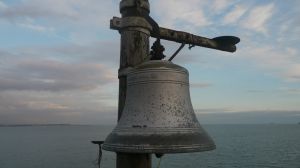 Here, as you venture further into the vaults, the metallic murmurings gradually give way to much deeper, more resonant and more pervasive sounds. You begin to feel them in your guts and to realise that the whole building is vibrating in response to deep rumblings that were recorded from the hull of HMS Belfast as it ploughed its way through the water. This subterranean realm is known as the Dead House and set into the walls are plaques commemorating courtiers from the 17th century, when a Royal Palace stood on this spot. The presence of the dead and the sight, in the Stygian gloom, of a skull and cross bones cast a melancholy spell that stays with you even after you emerge into the daylight, so the fog horn sounds infinitely more forlorn and the ship’s bell seems to toll with maudlin finality.
Fontana’s installation takes you on a mental, emotional and physical journey. Returning to the upper air and the playful sounds of gurgling streams produces an almost physical sensation akin to being in one of Bill Viola’s slow-motion videos, ascending through water and surfacing into sunshine. And looking down on the light wells you have just left, it is easy to envisage them immersed in water and to recall the time when the Thames flowed into Somerset House and Admiral Lord Nelson’s ships floated through its Great Arch to sail downstream to the naval dockyards at Greenwich. Such is the evocative power of sound.
Broadcast through strategically placed speakers, the recordings fill the tall, narrow space with an evocative soundscape that takes one back in time to when life moved at a more leisurely pace. A distant ship’s bell answers the chimes of historic chronometers in the National Maritime Museum and also the clock at Somerset House, as it strikes the quarter hour, triggering memories of warm afternoons spent snoozing on riverbanks or splashing about in streams.
As you descend to the lower level, though, the mood changes. The former coal holes resonate with the repetitive pounding of mechanical movement while, on video, you see the huge beam engine at Kew Steam Museum and the turbines that power the opening of Tower Bridge; in another bay, a lonely whistle buoy surfs the waves while emitting eerie warnings to passing ships in the gathering fog.
The most striking image is projected onto the brickwork of the vaults beneath the courtyard. Painted red, white and blue, the steel struts of Tower Bridge form the shape of an eye. Fontana’s lens focuses on the pedestrians walking back and forth and the traffic sliding by; attached to the underside of the structure, though, his microphone picks up the vibrations of wheels thundering overhead like trains rumbling along the tracks. Your eyes tell you that your vantage point is on the bridge, but your ears imply that you are hidden beneath the span like Billy Goat Gruff, spying on the world overhead.
The metal cables of the Millennium Bridge may not be very exciting to watch on video, but in response to the wind and rain and to footsteps, boats and trains, they pulsate with ethereal twanging and strumming sounds. You may remember these uncanny vibrations from Fontana’s Harmonic Bridge installed four years ago in Tate Modern’s Turbine Hall, when he created a symphony of such oscillations transmitted live from the bridge outside.
Here, as you venture further into the vaults, the metallic murmurings gradually give way to much deeper, more resonant and more pervasive sounds. You begin to feel them in your guts and to realise that the whole building is vibrating in response to deep rumblings that were recorded from the hull of HMS Belfast as it ploughed its way through the water. This subterranean realm is known as the Dead House and set into the walls are plaques commemorating courtiers from the 17th century, when a Royal Palace stood on this spot. The presence of the dead and the sight, in the Stygian gloom, of a skull and cross bones cast a melancholy spell that stays with you even after you emerge into the daylight, so the fog horn sounds infinitely more forlorn and the ship’s bell seems to toll with maudlin finality.Fontana’s installation takes you on a mental, emotional and physical journey. Returning to the upper air and the playful sounds of gurgling streams produces an almost physical sensation akin to being in one of Bill Viola’s slow-motion videos, ascending through water and surfacing into sunshine. And looking down on the light wells you have just left, it is easy to envisage them immersed in water and to recall the time when the Thames flowed into Somerset House and Admiral Lord Nelson’s ships floated through its Great Arch to sail downstream to the naval dockyards at Greenwich. Such is the evocative power of sound.
- Bill Fontana: River Sounding is at Somerset House until 31 May
- Check out what's on at Somerset House