Pablo Picasso is the presiding genius of 20th century art, the most influential artist in the modern period, lauded for his protean inventiveness, originality, individuality and overwhelming productivity. In 1934 poet Geoffrey Grigson declared that he was all the history of modern art, in 1942 the artist Jankel Adler observed that “Picasso, the greatest innovator of the twentieth century, has knocked on the door of every painter’s studio in the world”. Too true: his ghost is still present amongst art’s practioners and its audience.
It is in the shadow of this colossus that Tate Britain's new exhibition unfolds, selecting seven British artists from the scores available who have been consciously influenced by the master. Some 60 Picassos covering all periods, shown in Britain and/or purchased by British collectors, are also on view (although for reasons either financial, or due to a failure of public nerve, significant numbers in both categories are now in European or American collections). Many of them are in intimate dialogue with the work of the anointed seven British artists, four of whom not only absorbed Picasso's art but knew the man himself. (Pictured below: David Hockney, Artist and Model, 1973-4)

There are several surprises: first, the relatively tame, even charming small Picassos from the turn of the last century, which were readily collected: rooftops, a race course, even a flowery still life of 1901, the last purchased for the Tate in 1933 with the help of that pioneering charity The Contemporary Art Society. Second, the masterpieces we do have on public view. GIven a gallery of its own, The Three Dancers, 1925, is the climax of the show: it was thought by Picasso to be second only among his work to Les Demoiselles d’Avignon (Museum of Modern Art, New York).
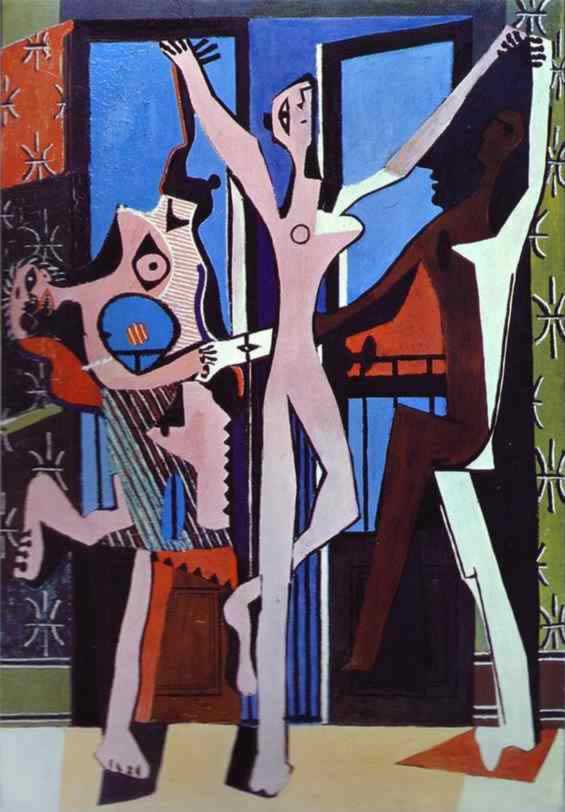 The negotiations in the 1960s for The Three Dancers (pictured left) were led by Roland Penrose, collector, artist, friend, amanuensis and the author of the first major biography of his idol in English. It is from Penrose’s collection that another undoubted masterpiece also entered the Tate: The Weeping Woman, 1937, refers not only to Dora Maar, the savagely intelligent mistress of the late 1930s, but also the painful suffering of the Spanish Civil War, .
Penrose had a long and highly emotional relationship with Picasso, and as the curator of the sensationally successful 1960 Tate retrospective – seen by half a million people – pointed out that it was Picasso who persuaded the world of the validity of art as the powerful emotional medium that we now take for granted. Nude, Green Leaves and Bust, 1932, on loan to Tate from a private collection, is one of the huge, swooning, possibly post-coital studies of the warmly pink and naked Marie Therese, the very young mistress of the early 1930s. The undoubtedly great works, encompassing cubism, classicism and late transcriptions from, for example, Velazquez's Las Meninas, cover his entire career; a number of bagatelles provide the welcome opportunity to pause and catch a breath.
We are so accustomed to the timidity and reticence that for much of the past century characterised both British art and British public collecting that the genuine surprise is how several British artists more than hold their own. Henry Moore met Picasso in Paris with a group of leading surrealists, invited to the studio to watch Picasso at work on Guernica. But the influence was acknowledged from the 1920s, and the terrific selection on view pits Moore’s magnificent Reclining Figure, 1936 (pictured below), carved in elmwood, against an almost identical pose in Picasso’s classicised La Source of 1921 (see main image).
 There is a poignant shared sensibility; Moore’s tiny bronze, Three Points, 1939-40, has a spiky emotional expressiveness prefigured in Picasso’s Standing Nude of 1928. Francis Bacon credited his visit to a Picasso exhibition in Paris in the 1920s to opening his mind to the possibilities of painting. Bacon’s terrifying distortions of the 1930s and 1940s are seen as directly related to the telling twists of the human figure at which Picasso was so adept. David Hockney’s playful posthumous homages are welcome light relief.
The intertwining and interplay of artists, their art, and the ways in which art reaches the public has never been more intelligently visible, nor the distance between genius and talent.