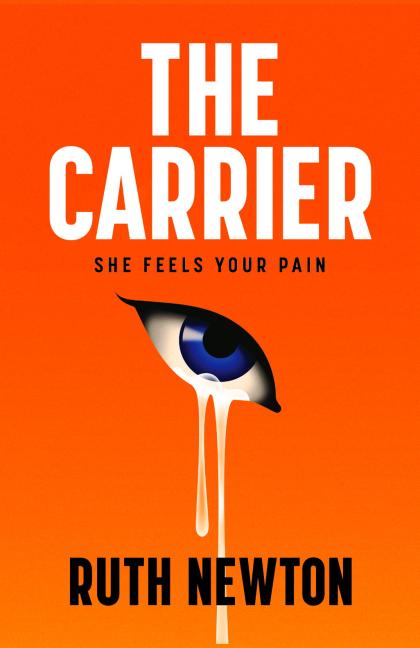
Ruth Newton’s The Carrier asks a simple question: if you could offload your negative emotions (grief, heartbreak, jealousy), would you? The answer is complex, nuanced, and thrilling. Set in a close-to-the-bone dystopia, a company – Eudemonia – purports to do good by offering emotional relief: there are others who can feel for you – for a price.
Viv, a loyal Eudemonia employee, slowly unravels the dark heart of such a practice, in a story that gracefully reinterprets that infamous second-wave feminist mantra: the personal is political. In her richly detailed sci-fi world, Newton puts the value of pain at stake.
Before writing The Carrier, Newton worked as a campaign producer, working with charities and NGOs. Shortly after the publication of her first book, which won the Jericho Writers’ Friday Night Live competition, we sat down to discuss its origins, its aims, and why the story has particular vibrancy in the contemporary socio-political landscape.
Jack Barron: Tell me about the genesis of the book.
The idea for The Carrier came to me on a long drive for work. I was stuck behind a lorry that said 'International Transport' on the back, and I misread it as 'Emotional Transport.' I started imagining what it would be like if emotions were cargo: where would they be going and where would they have come from? This musing eventually grew into The Carrier, a feminist thriller, where people can pay to outsource unwanted feelings to a subclass of women to feel on their behalf. We follow Viv, a loyal employee of the pharmaceutical company offering this service, as she learns the deadly cost of outsourcing feelings.
Ruther Newton: This is your debut novel. Tell me about the writing process. What did you discover? What difficulties and felicities?
The fortunate lorry misreading happened when I was writing a different manuscript that wasn't working. It was a very different style of story, following a woman in her late twenties who is forced to return home to face some uncomfortable truths. Looking back, some of the themes of emotional labour and the difficulties of expressing emotions were in there, but the story felt flat and lacked plot points. Adding a speculative, or sci-fi element to my writing was incredibly freeing, and I found I was able to articulate myself better because I was rid of the insecurity that readers might conflate the protagonist's story with my life.
Adding a speculative element also came with challenges, though. At first, the idea seemed quite simple, but when I really started to interrogate how the service would work, I found I was tying myself in knots. My editor suggested I write "a guide to Expression" that lays out exactly how the process of outsourcing works in granular detail. This was helpful, but far too much information to add to the novel without making the plot drag. From there it was a rigorous filtering exercise, working out how much the reader needs to know vs what serves the plot. It was tempting to put everything in, because I'd spent time and energy working it out, but I had to remind myself it's a story, not a scientific paper.
JB: What are your main influences? I’m thinking of the rich history of dystopian literature, but also authors you admire for style and maybe cultural/literary reference points (such as Eudaimonia being named after a platonic sense of fulfillment).
RN: When I was in the early stages of writing The Carrier, I wanted to avoid the dystopian classics in case I ended up imitating them, or became intimidated that my idea didn't hold up in comparison (someone had told me to never compare your first draft to a final draft, and I think this is excellent advice!) But once I was confident in the idea, I turned to the likes of Margaret Atwood and Kazuo Ishiguro, as well as more recent works like Blue Ticket by Sophie Mackintosh. I also watched shows like Black Mirror, Severance, and The Last of Us and read lots of non-fiction about the impacts of trauma on the body. The Body Keeps the Score by Bessel van der Kolk was very influential for The Carrier.
JB: The book centres on a world in which people can – and indeed want to – offload difficult feelings and affective states to make their lives easier. This is of course a cautionary tale. Can you say more about what you think regarding emotion as a source/catalyst/inspiration for social change?
RN: There's a quotation from one of the Carriers that sums up how I think emotions can be a catalyst for social change. She says:
I understand why people crave Relief, just turn on your phone and you can witness a genocide in real time, or a famine unfolding. Or take a walk around London and count the folks slumped in shop doorways, sleeping in the day because it’s safer than night. It’s exhausting, but muting our response isn’t the answer. We need outrage for action, and sadness for empathy. Our grief tells us what’s worth protecting, and our shame guides us to do better. They say Expression is progression, but it’s the opposite. Denying our feelings denies the hope of change.
Despite this, I still use all manner of distractions to numb my feelings sometimes, but I'm trying as far as possible to recognise my emotional response to the multiple crises we are facing and, where possible, use it as fuel to contribute to making a change.
JB: Can you say more about the role that women and the idea of the feminine play in the book and its wider social critique?
RN: Historically, women have been socialised to facilitate other people's emotion, often fulfilling the role of peacekeepers and mediators, all the while being rewarded for keeping their own emotions under control. The trope of the hysterical woman exists, but not the hysterical man. I think we're still feeling the impacts of this today. Anger is broadly more acceptable for men, often seen as a mark of passion or leadership. In comparison, it's often seen with a woman as a sign of losing control.
The notion of emotional labour is particularly prescient today because women are taking on more roles than ever. The cost of living means that most households require two incomes, especially if there are children. On top of that, women usually perform much of the unseen or emotional labour, like tracking family events, scheduling appointments and being available to support other people's mental wellbeing.
JB: Why is it important to have the main character, Viv, who works in Emotional Transport, begin the story as part of Eudaimonia?
RN: I think most people can relate to working a job that doesn't completely align with their values; we all need to earn a living after all. Having Viv be a loyal employee at the start of the novel meant I could explore the motivations and rationales people use to justify working for a company that has questionable morals. In some cases, it could be they truly believe in the service, or they believe their position is too low down the ladder to make any significant change. Or, their circumstances outside of work are too precarious that they cannot afford to question their employer. I am interested in what the tipping point is for people; what do they have to witness to change their mind and take action?
JB: The book is punctuated by notes from the Carriers themselves. How important was it to include these voices? What do they tell us?
RN: This was important because I wanted to show that women, like any section of society, are not a monolithic group. Their individual experiences shape their opinion of Carrying. Some genuinely seem to like it, or feel it's a better option than a previous situation they were in. Others feel like it's their only option and they're willing to take the risks that are becoming apparent over time. Their points of view allowed me to add nuance to the story, and explore the grey areas of modern progress. There is a parallel here with the likes of AI; in the right hands, it can solve complex problems and empower us, or it can be an exploitative, extractive tool that damages us and our environment.
JB: Can you tell me more about the activist sub-plot? Why was it important to include this side of things?
RN: I've been working as a producer for climate campaigns for the last seven years, and have been inspired by organising groups across the sector. I wanted to show that even in the face of powerful corporations benefitting from exploitation, ordinary people are resisting in innovative ways. I was also interested in how activists are perceived and how the media portrays people who stand up for social justice.
By having this sub-plot in a commercial thriller, I'm hoping it'll reach people who don't consider themselves activists, but who might consider what they think is worth defending in life.
JB: Finally, why do you think now is the right time for a book like The Carrier? (I’ve just read an article about a Japanese company that will carry out the difficult conversations in, say, quitting your job for you.) And, if indeed you’d describe the book as dystopian, how do you see the role of dystopian fiction in the contemporary social landscape?
RN: Now feels like the right time for The Carrier because we're starting to feel the impact of a culture of outsourcing more and more. Whether that's the erosion of our high streets because we're ordering everything online, or the decline in critical thinking skills as we become more dependent on AI. Outsourcing emotions feels particularly dystopian to me, because we risk losing social skills that are vital for cohesion and enjoying life. I think dystopian fiction can wave a red flag to readers and ask them to question the road they are heading down, and to consider course-correcting where possible.
- The Carrier by Ruth Newton (Penguin, £18.99)
- More book reviews on theartsdesk