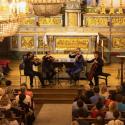
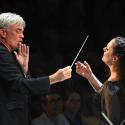
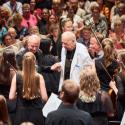
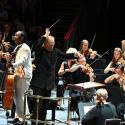
The B Minor Mass comes in many shapes and sizes. Martin Feinstein opts for a bright and bijou approach, with period instruments, one to a part, and a choir of ten. The small ensemble sometimes lacks finesse, but makes up for it in dynamism, passion, and sheer joy. There was nothing chamber-scaled about this reading: it was all big gestures and direct emotions.
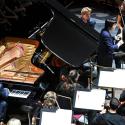
Feinstein leads his eponymous ensemble from the flute. That can lead to curious ensemble dynamics, with many of the movements being led from the (essentially decorative) obbligato flute line. Generally, though, the ensemble is small enough to be guided by the continuo section – chamber organ, cello and bass – who provided solid but supple support. The upper strings and woodwinds were reliable, although the vibrato-less tone and long phrases sometimes exposed poor ensemble and tuning, especially in the violins. No such problems from the brass and timpani, though. The trumpets were led by the excellent David Blackadder, who often came close to stealing the show. An impressive performance, too, from hornist Anneke Scott (pictured below left, by John Croft), playing without valves, without hand in bell and even without music. Her brief cameo in the Quoniam was a highlight.
 If the choruses succeeded better than the arias, the casting of the singers may have been the cause. Ten singers adds up to two to a part (with one male and one female alto), and as an ensemble they worked well together. But few of the soloists had the star quality to carry their solo arias. The sheer difficulty of Bach’s vocal writing here was repeatedly driven home by the soloists’ struggles with the long, winding phrases. There were exceptions: bass Ben Davies has real authority as a soloist, commanding the stage and the ensemble. The countertenor arias from Tim Travers-Brown were also impressive, his tone focused but not too nasal, his delivery satisfyingly emotive while always appropriately liturgical.
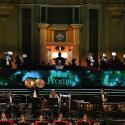
But the real strength of this performance lay in the big choruses. Despite the small numbers of performers, the ensemble easily filled the hall (the Kings Hall acoustic yet again proving ideal for almost anything presented there). Balance was always well judged, with the trumpets clear but never overpowering.
Feinstein occasionally seemed to be battling against the odds to rallentando at movement ends, and the coda of the Crucifixus almost came unstuck. But the way that he knitted together the various tempos of the Osanna-Benedictus-Agnus Dei sequence was masterful. The more reflective choruses, the Et incarnatus est and the final Dona nobis pacem, were well-paced and supported by the singers, the tone full and rich, even at quieter dynamics. But the joyous choruses were the real highlights, the Cum Sancto Spiritu that ended the first half, and in the second, the Et resurrexit and, best of all, the Sanctus. All were rendered lithe and agile, but with no lack of power or passion, and each proved a compelling vindication for Feinstein’s small-scale approach.