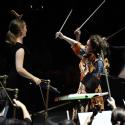
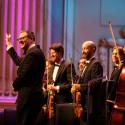
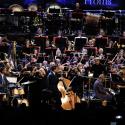
Even given the peerless standards already set by Sakari Oramo and the BBC Symphony Orchestra in their Sibelius cycle, this instalment was always going to be the toughest, featuring the most elusive of the symphonies, the Sixth, and the sparest, the Fourth. As it turned out, all challenges were met with Oramo's characteristic mix of energy and sophistication, and the interloper, Swedish composer Anders Hillborg's Second Violin Concerto in its UK premiere, saw to it that Lisa Batiashvili carried the flame.
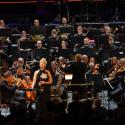
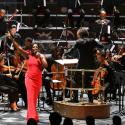
Was it going to be generic contemporary? The skeetering strings at the beginning suggested as much. But their headlong collision with a chorus of sustained chords proved arresting: what sounded like a pre-recorded ambience turned out to be those same strings turned to calm seas. In effect much of the one-movement concerto was searing cadenza from the compellingly intense Batiashvili (pictured below with Hillborg, Oramo and members of the BBC Symphony Orchestra by Mark Allen), mostly accompanied until close to the end and punctuated by two wild eastern dances – part Turkish sanat, part Bollywood, with Hillborg making and needing no apologies for the populism.
The intensity held; the ear was led through ever-unexpected harmonic shifts, and where the work might have sagged, the two oboes and cor anglais introduced a mesmerising new hook. Filmic in effect, but never merely film music. Given the echo of Bach's D minor Sarabande near the start, the ethereal encore was entirely appropriate – Hillborg's arrangement for violin and strings of the organ prelude on the chorale "Ich ruf zu Dir".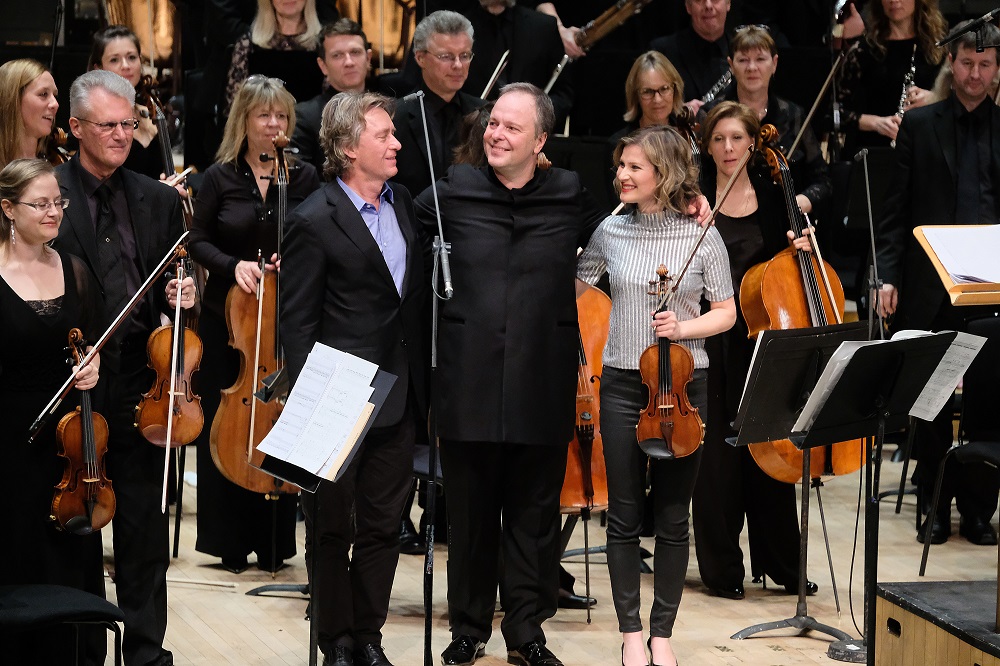 Well might any contemporary composer quake about sharing a programme with Sibelius, whose originality in the best performances always makes his music sound as if were composed yesterday. And these interpretations were indeed the best. Oramo knew he could draw maximum, dynamically nuanced soulfulness from the BBCSO strings in the profoundly beautiful hymns which frame the work – the last, dying out on a single note, is as convincing an ending as Sibelius ever wrote, making this more than ever a candidate for the end rather than the beginning of the programme (as usual, alas, it appeared in the first half). So did the muscular energy of the outer movement's strange adventures and the Beethoven-like primal charge of the scherzo, bursting straight out of the Allegretto moderato's twilight zone. The sudden flautato semiquavers which quicken its pulse with quiet intensity, backing quirky snatches of birdsong, are a test for any conductor; all credit to Oramo and the BBCSO that those forest murmurs have never sounded more compelling.
Though the Fourth could hardly be further away in its slow-evolving dark power, the hallmarks of these interpretations remained: the powerfully-vocalised wind solos (flautist Michael Cox especially impressive), the simultaneous projection of upper, middle and bass layers, all doing their own distinctive thing, and the way Oramo sustains a line or an argument even when it's punctuated by long silences. The high watershed both of Sibelius's unique tragedy among his symphonies and of the playing came in the great slow movement, heroically trying to piece itself together out of numb, depressive fragments. It's the cellos who finally, gradually manage to give full voice to a cathartic lament. That climb of theirs out of the darkness last night will stay with me for ever.
- Listen to this concert for the next month on the BBC iPlayer
- Read more classical reviews on theartsdesk
Next page: watch Lisa Batiashvili with Sakari Oramo conducting the Royal Stockholm Philharmonic in the 2016 premiere of Hillborg's Second Violin Concerto