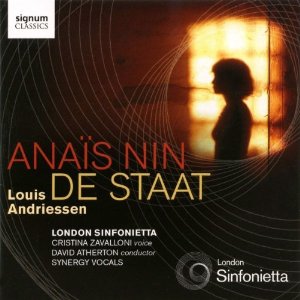
 Louis Andriessen: Anaïs Nin, De Staat London Sinfonietta and soloists/Atherton (Signum)
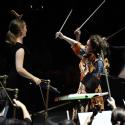
A friend of mine studied with the Dutch composer Louis Andriessen in the 1980s. He sent me a cassette (remember those?) of De Staat, and I can remember being bowled over by the music’s stark majesty and rhythmic punchiness, Andriessen’s repetitive vocal lines soaring over minimalist riffs, more redolent of Stravinsky than Glass. Written in the mid-1970s, Andriessen wrote of one early performance that he “had to sing every note for them (the musicians), because they articulated the piece like Bruckner or Mahler. And it should be articulated like Count Basie and Stan Kenton!” There’s a thrilling 1990s recording of the work by Reinbert de Leeuw’s Schoenberg Ensemble which is now unavailable. David Atherton’s London Sinfonietta live performance isn’t as viscerally exciting, but it does have the amplified Synergy Vocals’ immaculate delivery of the Plato text. Don’t get too bogged down in trying to comprehend Andriessen’s long-winded attempts to explain what the piece is about – just enjoy the noise. It’s fantastic.
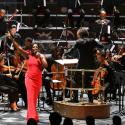
De Staat is the coupling for the more recent monodrama Anaïs Nin. Completed in 2010 and setting words drawn from the author’s diaries, it doesn’t excite in the same way, despite the occasionally salacious text and Cristina Zavalloni’s virtuoso delivery. Andriessen’s music recalls Eisler, Weill and 1930s jazz, often brilliantly evocative, spare and haunting in places. But it lacks the compelling, edgy oomph of the earlier work.
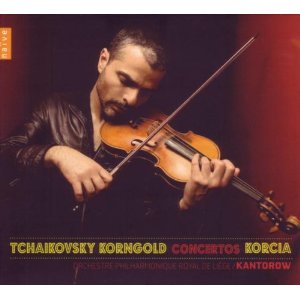
Not to everyone’s taste, Korngold’s 1947 Violin Concerto skilfully recycles themes written for Hollywood film soundtracks. It was dedicated to Alma Mahler and famously taken up by the great Jascha Heifetz. As befits this Austrian prodigy who became a successful émigré film composer, Korngold was a master manipulator of listeners’ emotions – here, flattering the audience into thinking they’re hearing something dangerously modern and sophisticated, when beneath the veneer it’s basically 19th-century schmaltz. Accept that, enjoy it, and this is a stunner of a concerto – beautifully proportioned and with several staggering moments. Laurent Korcia’s delivery of the solo line is stunning, but you’ll be knocked sideways by the glorious passage in the last movement where massed horns suddenly thrust upwards. It’s never sounded fruitier. And yes, it doesn’t sound particularly original until you realise that the motif and its treatment have been ripped off by countless subsequent film scores.
Korcia’s coupling is a boldly drawn, affectionate performance of the Tchaikovsky Concerto. It’s refreshing to hear Korcia’s unforced lyrical gift in the Andante, but even more impressive is the alarming speed and impetuosity of the closing movement. Your jaw drops. The disc is affectionately conducted by Jean-Jacques Kantorow (another former violin prodigy) who draws tight, affectionate playing from his Belgian forces. This is the most entertaining violin concerto disc I’ve heard in months.
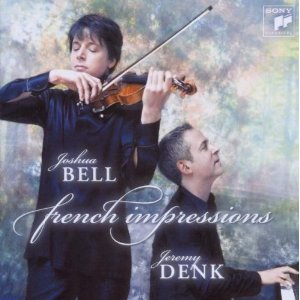
Move beyond the glossy packaging and swish typography and you find a really decent, well-planned recital. Pianist Jeremy Denk argues in his sleeve notes that French repertoire requires a very particular approach – one which revels in the music’s colours, sensuality and humour. You’d be hard pressed to find a version of Ravel’s Sonata which offers as much fun as this one; you can visualise Joshua Bell winking as he negotiates the second movement’s insouciant smears and pizzicato notes. And the last movement’s perpetuum mobile is so brilliant you’ll want to immediately play it again, Bell’s frenetic scrapings finally underpinned by some of juicy piano harmonies. I struggle with Ravel at times; his music can too often seem over-fussy and emotionally cold, but he always sounds engaged in this compact, miraculous piece.
The most expansive work here is Franck’s Sonata. I like Denk’s lightness of touch in the equivocal opening bars, and the softening of tone he manages after Bell’s quietly ecstatic entry. This is a great performance, especially in the steady Allegretto of the last movement. Franck’s genius here lies in his avoidance of conventional musical rhetoric; there’s no big Beethovenian drama in the usual sense. Saint-Saëns’s Sonata No 1 can’t help feeling a little more stuffy in its first movement, but Bell and Denk rightly emphasise this still underrated composer’s brilliant gifts as an entertainer. The manic finale isn’t a resolution at all, but it’s a life-enhancing ride. Sony’s sound is immaculate.
Bell and Denk play excerpts from French Impressions