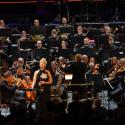
At this year’s Aldeburgh Festival, I watched Lise Davidsen take a young singer through Mahler’s “Liebst du um Schönheit” in a riveting public masterclass. Go big on feeling and meaning, urged the great Norwegian operatic soprano, but drop the beefy “opera” voice. Impeccable advice, of course, but how does a singer of Mahler’s five achingly personal Rückert-Lieder project inwardness and intimacy across the Royal Albert Hall? Especially when, as with Joyce DiDonato last night, behind her sits The Met Orchestra, released from its New York pit to unleash its gloriously blended sound – praised here by David Nice on its first outing – in a pair of Proms.
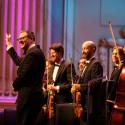
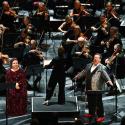
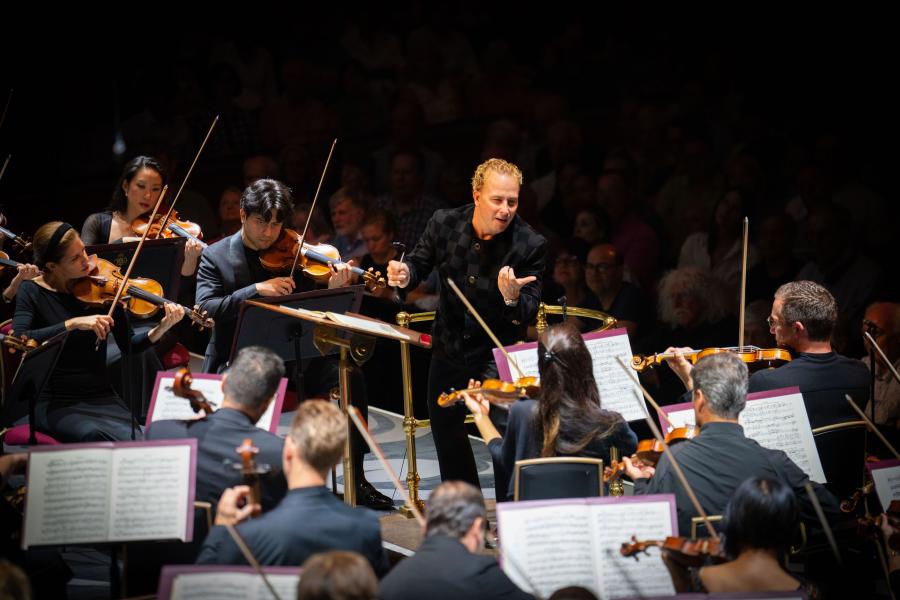
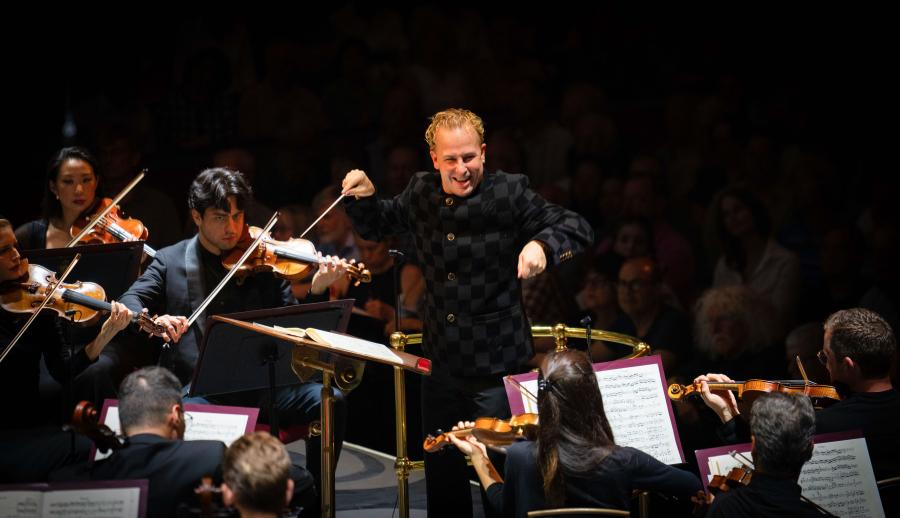
A couple of moments aside, she more than held her own, supported by conducting from Yannick Nézet-Séguin (pictured below) that mostly took care to respect the venue’s aural peculiarities. Even a decade ago, “DiDonato sings Mahler” (rather than Mozart, Rossini or maybe Handel) might have sounded like a contradiction in terms. But here the Kansas diva stood, regal but never chilly, not only commanding the Rückert sequence but evoking the child’s vision of heaven that concludes Mahler’s Fourth Symphony and finally – in an encore to make the packed house swoon – bidding us farewell with “Urlicht”. To aficionados of mellow, smoky near-contralto colouring in Mahler songs, DiDonato’s coloratura mezzo will still sound on the light side, but she effectively reached down into the emotional depths and, in “Urlicht”, touched the heights.
Nézet-Séguin and the Met players began with Lumière et Pesanteur by Kaija Saariaho. The late Finnish composer had a close partnership with the Met, and this orchestral extract from her opera-oratorio about the philosopher-martyr Simone Weil became a kind of elegy. From the early conjunction of eerie, otherworldly percussion and haunting solo trumpet, Nézet-Séguin underlined the Mahlerian sonoroties in Saariaho’s writing, as orchestral qualities of “light” and “weight” converse, strive and, ultimately, merge. Harp and celeste add to the angelic overtones, and the brass sounds untethered from the earth. The Met players relished every textural nuance but this enigmatic sound-world makes you hunger for the dramatic context, lacking here, that will push it forward.
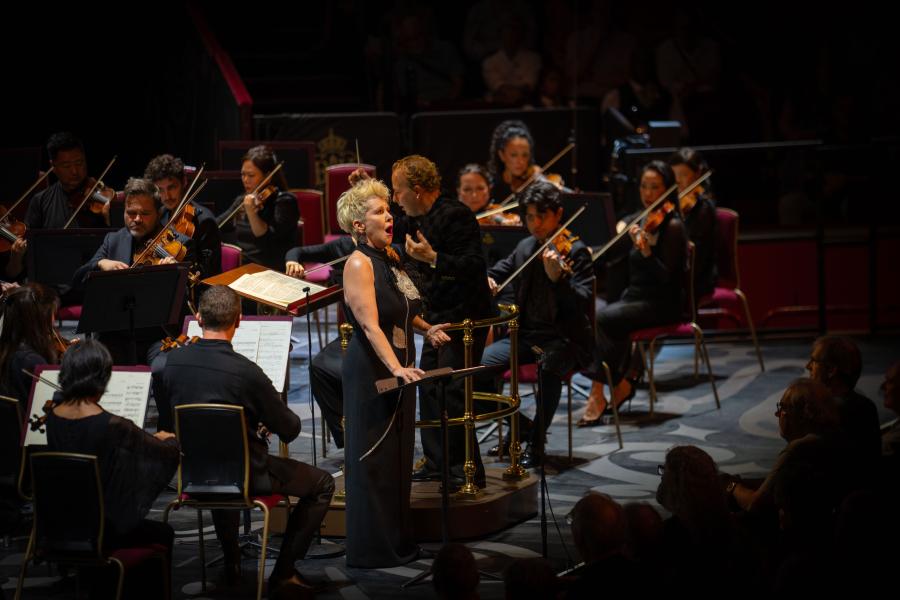
With the Rückert songs, I sometimes feared that DiDonato’s deliberately unshowy, confidential and involving delivery might find itself at odds with the sumptuous sheen of the ensemble behind her. By and large, that didn’t happen, although the climax of “Um Mitternacht” proved that two very good things – this radiant voice and the Met’s mighty brass section – can on occasions cancel each other out.
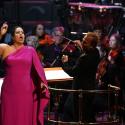
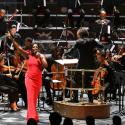
For the most part, DiDonato (pictured below) unrolled her golden vocal carpet in long, well-shaped phrases over accompaniment that made the ears perk up with each deftly-etched solo flourish from horn, flute and oboe and others. Her rmezzo started light, airy, even skittish, but by the time we reached “Um Mitternacht” had perceptibly thickened into brooding intensity. Then came the resigned release of “Ich bin der Welt abhanden gekommen”, the voice compellingly quiet and the thinned orchestration discreet and sensitive enough to match. Here, DiDonato truly found her Mahlerian stride as a confessional storyteller in song, abetted by a lovely cor anglais solo (Pedro R Díaz) and super-subtle strings.
After this dreamy, even ethereal, first half, Mahler’s Fourth began with more jaunty briskness from Nézet-Séguin than I had expected. Mahler says “don’t hurry”: he didn’t, quite, but the Met had a lilting spring in its step that only accentuated the contrasts when it all slows down. Could you tell that this is, for most of the year, an opera-house ensemble? To be frank, I would have found it tough to point to any single reveal – although the sheer relish and flavour of bar-by-bar characterisation from the woods and brass showed us players steeped in ever-changing musical drama. Horns and piccolos, bassoons and flutes: they sang, they squabbled, above all they performed. And the strings wrapped them all in plush velvet that, from time to time, disclosed a properly abrasive edge.
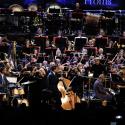
In the Scherzo, leader Benjamin Bowman gave the unsettling, tuned-up scordatura passages a sinister bite. Nézet-Séguin (pictured below) sometimes made fairly free with tempi – again, a theatrical inclination, if you like – but then Mahler never lacks for surprises and somersaults. Vulgar and soulful, trite and tender: this was full-spectrum playing that (if you wanted to find fault) tore stylishly into every contrast but didn’t always give an impression of coherent architecture. The adagio, although beautifully, softly expressive at key piano points, had dawdling moments when “serene” almost slipped into “becalmed”. But the orchestral voices rang out pure and strong (not least terrific cellos and basses) and, when required, Nézet-Séguin injected bracing adrenaline jolts of pace and power.
For the finale, DiDonato stood at the back between harp and horns. A high-risk strategy, in this hall? If so, she made light of the challenge, cutting through the massed Met ranks before her with limpid diction and a piquant, pointed rendition of the bittersweet humour of the text. With its bizarre scenes of animal terror and slaughter, this is the paradise of a pretty odd child. The obvious maturity of DiDonato’s tone and timbre did not feel so out of place. In any case, she glided, floated – and sometimes bounced – over the orchestra and right across the hall, aided by sensitive, responsive playing from the nearby brass.
As they had with the Rückert songs, the Proms audience payed her the compliment of genuine silence at the close. She returned the favour with that “Urlicht” that sent us, transfigured for a while, out into the Kensington night.