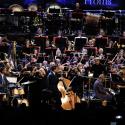
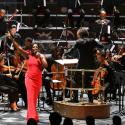
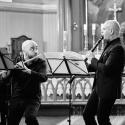
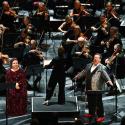
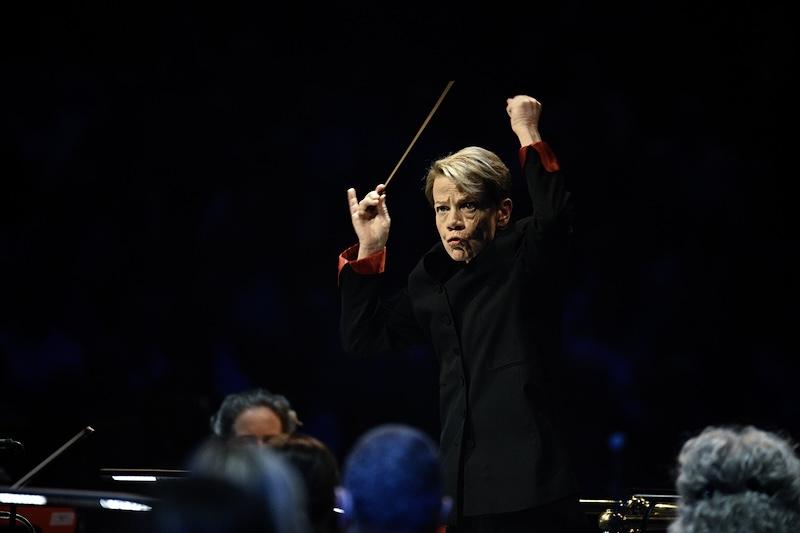
Where the US President chose to mark the 250th anniversary of the founding of his country with a cage fight, the BBC stuck to music in this Prom of 20th century Americana. Featuring Marin Alsop and the Philharmonia, it ticked lots of boxes – but slightly fell over itself in the process.
The box-ticking included the programming of a woman – Joan Tower – but only for a three-minute piece, her first Fanfare for the Uncommon Woman. Its title is striking, but only draws attention to the fact the music is no more than a pale shadow of the Copland original, albeit with the Philharmonia brass and percussion sounding crisp and punchy. In the second half we had music by William Grant Still, the first successful Black American symphonist, but he was granted just five minutes for the second of his Three Visions, a dreamy, filmic but ultimately lightweight meditation featuring leader Zsolt-Tihamér Visontay as soloist.
Copland’s Appalachian Spring is an undoubted classic of the orchestral repertoire, with its evocation of a spacious landscape and traditional ways of life. This performance was much better in the recurring slow passages than it was in the faster interludes, where the pace flagged, forward momentum was absent and it all felt strangely flat-footed. The beautiful final chorale rescued things a bit, but this was Appalachia without much spring.
The last item before the interval was Rhapsody in Blue. It was billed as “orch. Ferde Grofé, arr. Marcus Roberts”, although the programme note – presumably recycled – made no reference to Roberts’s contribution. The Grofé arrangement is the standard orchestral version and Marcus Roberts’s further embellishment, which he has been playing since 1995, puts his jazz trio out front of the orchestra, adding yards of jazz improvisation to, and sometimes in place of, the Gershwin. It was in practice not really Rhapsody in Blue but something else – and something not as good.
In principle, I have no problem with monkeying with Gershwin, who was himself an inveterate monkeyer, who rarely played his own pieces the same twice and indeed improvised his way through the premiere of the Rhapsody. My problem was with the realisation. Marcus Roberts’s improvisations were a stylistic hodge-podge, often seemed to have little to do with the source material, and were disproportionately long, throwing the whole thing out of balance.
Rhapsody in Blue has a famously sectional structure, and this was only exacerbated here, where for long passages the jazz trio played away while Alsop stood and watched, until the signal to rejoin. Hence the second problem: the sectional structure, with its many joins, is full of bear traps for pianist and conductor alike, and the transitions were distinctly nerve-racking, at least one wobbling quite badly, Alsop making desperate eye contact with the drummer.
I can’t deny the piece went down very well in the hall, which threw me. I pretty much hated it, but what do I know? The encore was much better, James Price Johnson’s Victory Stride turning the Philharmonia into a big and ballsy big band. They swung and grooved, Maura Marinucci gave a knockout clarinet solo, and the entire string section stood for their spot. It was a palate cleanser after the Rhapsody.
The second half was an improvement on the first: Jerome Moross’s theme from The Big Country had sweep and pizzazz, the William Grant Still was touching and Bernstein’s Symphonic Dances from West Side Story richly textured. It is surprising that Grofé was credited in the programme as arranger of Rhapsody in Blue, but there was no listing of Sid Ramin and Irwin Kostal, whose work on the West Side Story suite shows them revelling in the rare opportunity to work with a massive orchestra, like kids in a sweet-shop making the very most of the eight percussionists and large string section. The tunes are Bernstein’s of course, but the triumph of this extended fantasia lies in the orchestration by these unsung heroes.