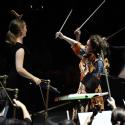
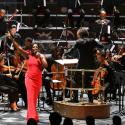
There are few more joyful sights in classical music than violinist Patricia Kopatchinskaja diving into a performance, impishly whimsical, completely physically engaged, almost assaulting her violin with the ferocity of her attack. And few pieces suit her better than Stravinsky’s violin concerto, each movement of which starts with a violent chord, Stravinsky’s “passport” to the concerto, before veering off into chugging motor rhythms or anguished melodies. Her performance at this Prom was thoroughly engaging, although marred by some issues of balance.
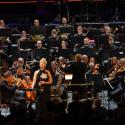
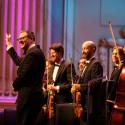
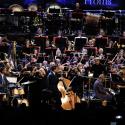
The orchestra was the Oslo Philharmonic, conducted by Mirga Gražinytė-Tyla, in the week of the death of the Norwegian king – the concert started with a rendition of the national anthem. They followed with Symphonic Poem No.1 “Forest Morning” by Øyvind Torvund, which I first got to know reviewing his 2024 album A Walk into the Future, one of my picks of the year. Torvund comes from a rock background and uses electronica as part of his orchestral compositions – although here, apart from a synthesiser, the “electronic” sounding elements were all produced by the percussion section. These sounds conjured the forest sounds of the title, in music that, while nodding to Grieg and Ravel, is something entirely his own. There is an underlying Romantic sweep to the strings’ music that is undercut by ironic gestures in woodwind and percussion. I think this is music Stravinsky would have enjoyed.
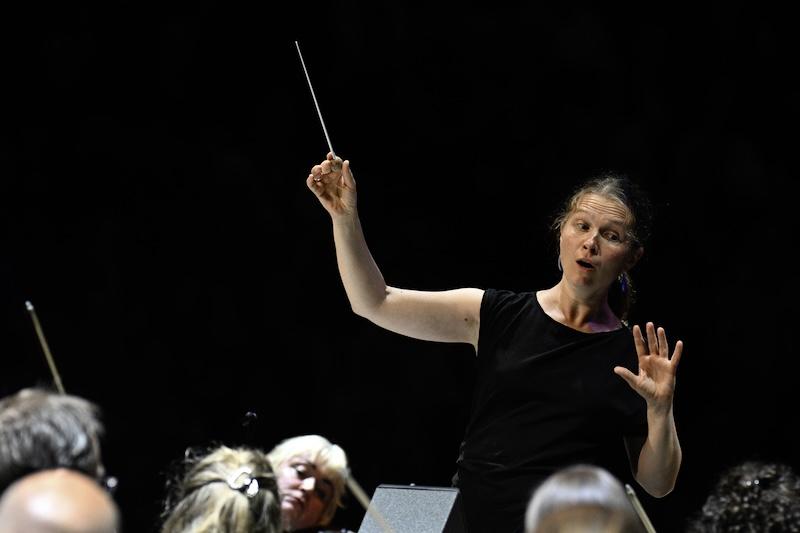
The Stravinsky followed. If it is the perfect piece for Kopatchinskaja, it not the perfect piece for the Albert Hall. With its scoring for a large orchestra with full brass section, it was not always easy to hear the solo violin. In particular, the trumpets’ and trombones’ punctuating chords in the first movement slightly trod on Kopatchinskaja’s toes. The middle two movements, designated as “Arias” are Stravinsky’s nods to Bach, although Tchaikovsky is also very much present. I was really aware of how these movement pre-echo The Rake’s Progress, Kopatchinskaja singing them out like opera. Gražinytė-Tyla was very flexible and sensitive in her accompaniment, and the sparer scoring helped Kopatchinskaja’s audibility. Her encore was fascinating: she had constructed, she said, the cadenza Stravinsky’s didn’t write for the concerto. Weaving together fragments from throughout the piece, it was a quite delightful and unique idea for an encore.
After the interval, the orchestra came into their own in a gripping selection from Prokofiev’s ballet Romeo and Juliet. Here the heavy brass could take flight, but there was also an array of superb woodwind solos. The sequence worked well straight from the opening numbers: the chilling chords that announce the Montagues and the Capulets segueing into the flighty innocence of the young Juliet. My own highlights were “The Death of Tybalt” – merciless percussion, soaring brass and biting string chords – and the touching and infinitely sad final funeral scene. Throughout, Gražinytė-Tyla was in stately control of proceedings, her gestures combining weight and grace, and the orchestra clearly loving playing with her.