There was excellent music making in the Hallé concert in Manchester last night, and there was self-admitted “noise”. Briefly, the two coincided in one work.
The outstanding music making of the evening came from pianist Giorgi Gigashvili, winner of the 2024-25 Terence Judd-Hallé Award, now fulfilling the opportunities that success gave him. Together with the orchestra and conductor Roderick Cox, he gave a beautiful and stylish performance of Mozart’s Piano Concerto No. 21 (in C major – the one they used to bill as “the Elvira Madigan concerto”, if your memory goes back that far).
His playing was limpid and fluent, with appropriately in-period incipits to his solo entries in the first and final movements and discreet embellishments throughout, and enhanced by pointed articulation of the phrasing, with thoroughly classical contrasts, from the orchestra. He brought a suitable touch of lyricism to his playing of the second melodic subject and an individual way of dispatching the closing themes. For the slow movement (the dreamy one they used in the film), the muted strings were both gentle and expressive, and in the finale the solo playing was again thoroughly intellectual and stimulating.
Gigashvili also clearly has a sense of humour, as his cadenzas for the outer movements were anything but Mozartian – the suavity of the playing concealed the fun to some extent, but in one there was an episode of seeming high Romanticism, and in the other even a touch of the blues. I have no complaints: it all added to the kaleidoscope of colour he brought.
Back to the “noise”. The concert opened with Christopher Cerrone’s The Insects Became Magnetic – premiered in Los Angeles by the LA Philharmonic under the baton of Roderick Cox in 2018. In his 12-minute piece, Cerrone has made noise into music, starting with the feedback he once recorded, by accident, when attempting to hook his laptop up to his sound system.
The title is taken from a poem by Adam Clay containing the line “It might even be a collage”, which points to the method he used, beginning with his accidental 30 seconds of “screech”. He then took its pitch down several octaves, slowed it, and undertook to blend the playing of an orchestra with his found material (the piece is for orchestra and electronics). There are the almost oscillator-like effects of bowed vibraphones and crotales from the start, and string tremolos soon join in. Later we hear breathy sounds from the brass, more standard use of percussion as punctuation (cow bells at one point), and a section where the brass adopt harmonicas (mouth organs) instead of their usual instruments – that effect was rather lost on me, as unamplified mouth organs aren’t very loud at all.
The curious thing is that it all sounds remarkably musical, rather than being mere noise. There are crescendos and climaxes, recognizable pitches and intervals, and, in the central part which Cerrone calls a Lullaby, two alternating chords which sway gently. Indeed, there’s a kind of thematic use of two-tones which predominates towards the end. Clever, but what’s it all mean, you might ask. I’m still asking.
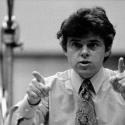
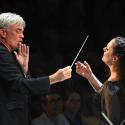
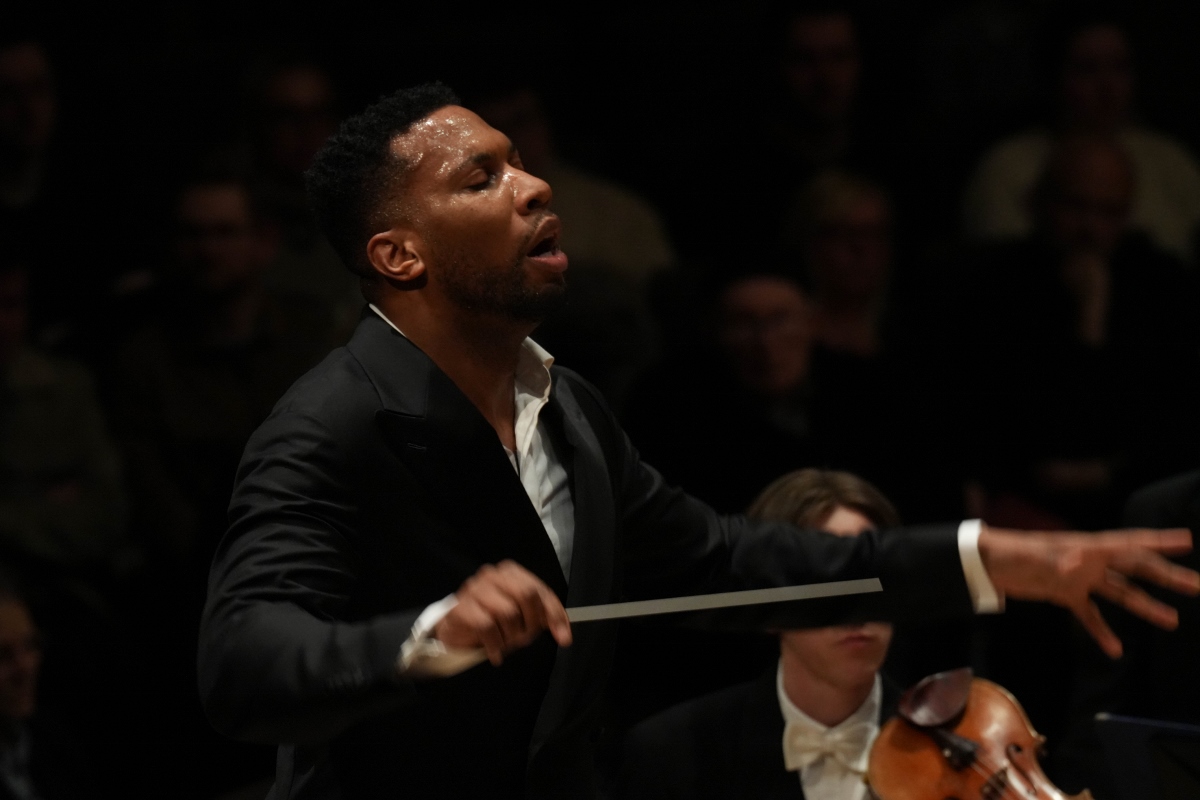 Tchaikovsky’s Symphony No. 4, the remainder of the programme, seemed more like terra firma, despite its often hysterical outbursts and the grim foreboding of its motto theme. This was the chance for Roderick Cox (pictured left), conducting from memory, to show what he is made of. That probably reveals that he’s an instinctive classicist. He obtains clean articulation, he doesn’t want exaggeration or violent contrast, but he wants climaxes to be obvious. The stringendo passage of the first movement was very slow to gather momentum the first time, but worked well second time round. To those of us brought up on Barbirolli’s Tchaikovsky, it seemed a little worthy.
But the second movement’s folksong-like tunes came over as unaffected and truly plaintive, and the pizzicato strings of the third were precise – its faster speeds proving (as so often) the nemesis of the piccolo… but that’s a tricky business for anyone. The finale was a good romp and Cox cranked it up with enthusiasm at the end, which, as always, worked a treat.
- Repeated on Sunday 26 January
- More classical reviews on theartsdesk