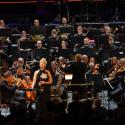
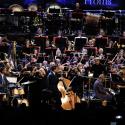
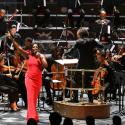
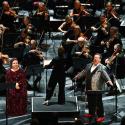
Boléro and Scheherazade may be popular Sunday afternoon fare, but both are masterpieces and need the most sophisticated handling. High hopes that the new principal conductor the Philharmonia players seem to love so much, Santtu-Matias Rouvali, would do Ravel and Rimsky-Korsakov justice were exceeded in a dream of a concert.
It's the first time I’ve seen a packed audience at the Royal Festival Hall since lockdown. Young people were very much in evidence: even if there were special or free offers, the fact is they came. And what was the overall lure? Those popular classics? Or perhaps the 2019 winner of the International Tchaikovsky Competition in Moscow, Alexander Kantorow (pictured below by Sasha Gusov)? He deserves the fanfares; the virtuosity is breathtaking, the dynamics very fine-tuned, the luminous sound not far off that of the current sensation, Daniil Trifonov.
The choice itself was only half satisfying. We’ll be hearing a lot of Saint-Saëns 100 years on from the composer’s death, and the Second Piano Concerto is high on the list. Its central scherzo is a hit, a fine-spun descendent of Mendelssohn’s Midsummer Night’s Dream world with a dash of boulevard striding. It scintillated here in perfect rapport between soloist, conductor and orchestra (though Kantorow presents as rather inward – a little more smiling visual engagement wouldn’t go amiss).
Yet Saint-Saëns is a more convincing fairy and flâneur than he is the melancholy aristocrat of the first movement or the slightly aggressive country dancer of the finale. Here we had to be content with gorgeous sonorities rather than substance. That returned in the encore, Brahms’s Op 10 Ballade, spellbindingly solemn. 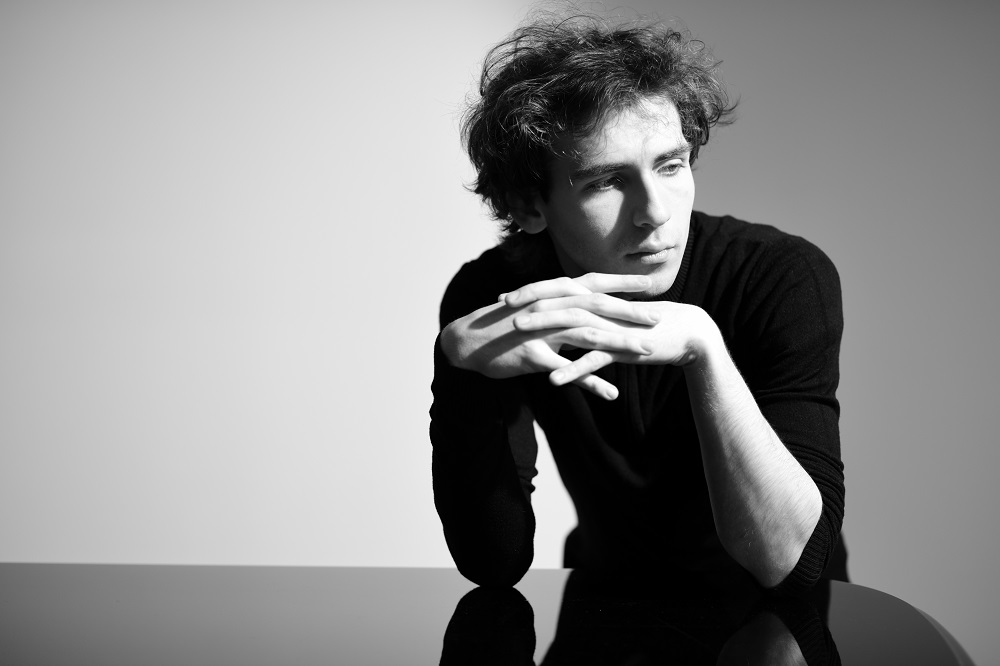 Can there be a better introduction to the instruments of the orchestra – at least one that doesn’t advertise itself as such, like Britten’s Young Person’s Guide – than Ravel’s Boléro? A few note and entry slips could be forgiven in the many spotlit solos which mark the tantalizing early stages, all of them done with plenty of nuance and character. But with the woodwind ensemble in harmony, it all became overtly emotional: there’s a magic that Santtu creates with bright uplift, and that extended to strings, brass and an unorthodox finishing flourish.
So much stood out in higher, more sensual relief than I’ve ever heard in a live performance of Rimsky-Korsakov’s Scheherazade: there’s potential here for the Philharmonia under its new principal conductor to develop a full and glorious voice of its own, not always a quality one associates with London orchestras. Not only does Benjamin Marquise Gilmore, one of the Philharmonia’s two regular leaders, give an impassioned cue to his colleagues; here he was also in charge of the sweet, refined introductions and interjections of Scheherazade in her tale-spinning. Exquisite work, and Rouvali was right to bend towards him as the siren song faded into nothingness at the end before immediately stepping down to embrace him.
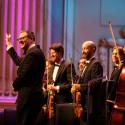
He's such a compelling conductor to watch: no apparent ego, so much grace, such careful cues and directed emphases, not always where you might expect them. The more inward mysteries of this symphonically well-wrought gem had ideal magic; the Sultan’s threats, the terrifying brass interruption of “The Tale of the Kalendar Prince” and the quick-witted switch of the storyteller back to the sea and Sinbad’s ship at the height of a dazzling finale were all masterfully projected.
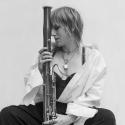
What a reversion, too, to the solo magic of Boléro: a reminder that Rimsky-Korsakov led the way in a kind of concerto for orchestra. Whom to credit? Certainly the arabesques of flautist Samuel Coles, oboist Tom Blomfield, clarinettist Mark van de Wiel and bassoonist Emily Hultmark, the dreaminess of first horn Diego Incertis Sanchez and some remarkable work from the entire horn ensemble. Many of the Philharmonia programmes are going to play safer than under the previous guidance of Esa-Pekka Salonen, but with his successor making the classics sound so brilliantly fresh, who’s complaining?