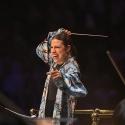
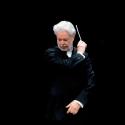
What would you imagine the composer John Adams might choose to conduct – apart, that is, from a little something he himself made earlier? Well, the first of two London Symphony Orchestra concerts this week brought no big surprises: Sibelius’ Sixth Symphony was in essence a little like returning to his minimalist roots – a bunch of insistent melodic cells and dancing ostinati. Flanking it, as if to reassert that everything Adams writes is essentially operatic, was orchestral music born of opera: Adams’ own Doctor Atomic Symphony and the “Four Sea Interludes” from Britten’s Peter Grimes. Adams, the conductor, had his work cut out.
On a day when the sadly premature death was announced of a truly great Peter Grimes – the remarkable Philip Langridge – this astonishing music might have unfolded with an added poignancy. But as dawn broke over the Suffolk coastline and upper strings cast their first glinting reflections of early light, it was plain that Adams’ composerly precision was going to mark out too many barlines for the music to “evolve” in any meaningfully evocative way.
This is technically treacherous music for any and everybody performing it and the light only catches the water convincingly when the time-beating becomes unobtrusive. Adams spent too much energy ensuring that the devilish syncopations of “Sunday Morning” or the flecks of “Moonlight” landed where they should. He and the orchestra did not make light of anything. It was like someone said of Toscanini in Beethoven’s Pastoral Symphony – Adams was just waiting for that storm. And when it came it was pretty full-on – until that glorious moment just before the final squall where the violins recall Grimes’ haunting phrase “What harbour shelters peace?” Adams really opened this out and in so doing at last made music.
He and the orchestra were much happier surfing Sibelius’ Sixth Symphony. There isn’t a composer alive who doesn’t think that the opening measures of this marvellous piece constitute the most beautiful polyphony we have. It is like turning the pages of some ancient illuminated manuscript – nothing, but nothing, prepares you for the dancing allegro molto which follows. Adams had a ball with it, locking into those motoric repetitions (or doing what comes naturally) and really making rhythm sing. Composers love the gamesmanship and intrigue of Sibelius’ music and Adams revelled in the obliqueness of the first movement’s strange closing measures, its indecision about how to end punctuated with gaping silences. And was there ever a bigger question mark hovering over the final diminuendo in violins and violas?
Adams’ own Doctor Atomic Symphony has slimmed down by 20 minutes since its Proms premiere in 2007. Its continuous one-movement span (echoes of Sibelius’ Seventh) is truly an attempt to make something convincingly symphonic of the opera’s “innards”, opening like the main title of some 1940s sci-fi movie – all gothic rhetoric and master-the-universe brassiness – and ending with the most beautiful music Adams has ever penned: his quasi-baroque setting of John Donne’s “Batter My Heart” which is about as memorable an act one curtain as anything written since Peter Grimes.
- John Adams' second concert with the LSO is on 11 March.
- Book tickets for the rest of the London Symphony Orchestra season.
- Check out the rest of the Barbican season.