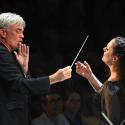
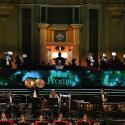
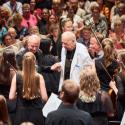
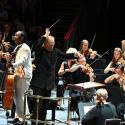
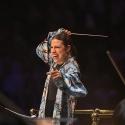
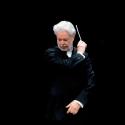
Shuffling about the podium like a cha-cha-chaing Jack Lemmon, slam-dunking his first beats, kicking out his heels for second beats, épéeing the trombone entries like a toy toreador, it wasn't hard to see why Lorin Maazel gets such a regular critical roasting. During The Rite of Spring he was almost playing up the vulgarian tag. "You want vulgar? I'll give you vulgar. Take that ridiculously elongated glissando! And that totally out-of-place ritardando! And that gob-smackingly inappropriate sforzando!" That Maazel is a showman has never been in question. What is more problematic is discerning whether this actually mattered? Eyes away now if you're averse to a bit of heresy but might Stravinsky's Rite and Bruckner's Third actually not both benefit from a bit of vulgarity?
Don't get me wrong. Neither The Rite of Spring nor Bruckner's Third (in the tightened up 1889 revision) need propping up. They are both masterpieces. And as with most masterpieces they will flower brightest at the hands of a conductor who has an understanding of the need for clarity of structure and natural momentum. However, if both these qualities are absent - as last night - and the gaudy is all that's on offer, might these pieces still not, through some strange breaking of the space-time continuum, actually work?
I began to think the unthinkable as I realised that I was neither enjoying Maazel's The Rite of Spring, nor becoming stupefyingly bored by it either. After a notably unfussed start came some drama. As did an almost physical discomfort. Was that the result of the three-dimensional punch of the Viennese strings and brass, so pungent when on the attack? Or was it the result of Maazel's musical grotesquery? Not sure. Either way, this Rite - by no means a great or even a very good Rite - did what Rites should perhaps do more often: disgust.
When it comes to Bruckner's Third Symphony we should perhaps talk about naivety rather than vulgarity. For what Maazel encouraged the orchestra to do is to excavate an echt-Austrian wholesomeness lying at the core of this symphony that only this orchestra (which gave the symphony's premiere in 1877) and this conductor, with his ringmaster's eye for bold theatrics, could unlock. They slapped the mud back onto those dirndls and rung out those sweet, nostalgic, open air melodies with irrepressible relish. Smells of home-baked apple strudel wafted through the stalls.
With such vivid playing, one began to realise how little love is normally shown towards these Austrian tchotchkes by other orchestras, who often seem to be embarrassed by the naivety and tenderness. Just to take one example - and perhaps the best - no one has made the Polka in the fourth movement sound so convincing a part of that huge final tapestry. And the roaring fires that the strings are able to achieve in the second movement - emanating from the hottest of viola and cello coals - make all other string sections sound like feeble Agas by comparison.
Ultimately, this performance was not about Bruckner the great architect. This was about Bruckner the summoner of sweet Austrian scenes: photo-album Bruckner. Kitsch? For sure. Naive? Hugely. Charming? Very. Crowned by a very special brass peroration. Final photo: Maazel in front of the Schönbrunn Palace, thumbs up, big grin.
But then came a last-minute visit to the circus: an encore performance of two of Brahms's most over-played Hungarian Dances, numbers one and five. When it comes to pieces that are already verging on self-parodical musical extinction, smothering them in yet another layer of comical exaggeration is terribly unwise. Maazel flogged these two dances left, right and centre like performing bears. The result was pretty revolting.
- Tonight at the Barbican the Labèque sisters perform Gershwin and Bernstein with the London Symphony Orchestra.
- Check out the Vienna Philharmonic's schedule.
- Check out what's on at the Barbican this season.