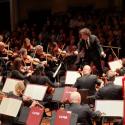
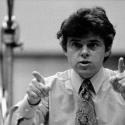
There is, of course, a long tradition in this country of Christmas Messiah performances – but it’s not one I’ve ever previously participated in. This was the first time I’ve ever heard Messiah live, despite being quite long in the tooth – and it was terrific. I can see what I’ve been missing out on all these years. Handel really knew what he was doing – as do the Philharmonia Chorus, the Orchestra of the Age of Enlightenment and four excellent soloists, all under the leadership of Eamonn Dougan.
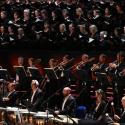
I am no expert on the scholarship behind performance practice of Messiah, although the piece is clearly robust enough to work in any number of types of presentation. What we had last night was something of a hybrid approach: small period-instrument band but large choir (numbering around a hundred). But no weighty choral-society warbling here. Eamonn Dougan encouraged a lightness of approach in his pithy, agile gestures, and the Philharmonia Chorus responded in kind, the sopranos in particular flying fluently through their many melodic runs. The basses, if lacking the athleticism of the sopranos, packed a punch in the “king of kings” from “Hallelujah” – and the final chorus saw the entire choir in glorious, summatory voice. Elsewhere, they were feisty in “He trusted in God” and generous in “wonderful… counsellor” from “For unto us a child is born”.
There were also some great moments in the orchestral playing, both the truly spectacular natural trumpet playing of Paul Sharp in “The trumpet shall sound” and the anguished, hushed string accompaniment of “He was despised”. Also worth a mention is the spry playing of bassist Kate Brooke, who lived every note in her delightful recitative continuo playing.
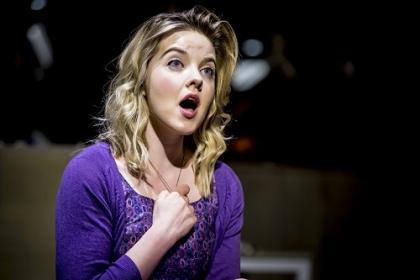
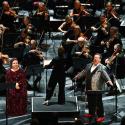
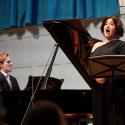
The soloists were good but quite varied in their sounds. Tenor Robert Murray wrung every ounce of pathos from “Comfort ye, comfort ye my people” at the start, and contralto Jess Dandy had a dark-coloured, unworldly sound, heard to best effect in “He was despised”. Bass-baritone Dingle Yandell, with a wonderful stage presence, moved from a Mozartian characterfulness in “Thus saith the Lord” to a darkness-to-light revelation in “The people that walked in darkness” and a vigorous “Why do the nations so furiously rage together”. But perhaps the best of the bunch was soprano Rowan Pierce (pictured above), whose “I know that my Redeemer liveth” was sublime, both singer and players daring to be intimate in a big space.
It was great to see a full Festival Hall – although if you can’t sell tickets for Messiah at Christmas in London, you’d be in a pickle – and I very much enjoyed my first experience of the piece live. Although ostensibly a religious work, it is really an act of pure showmanship on Handel’s part, which provides all the raw material needed by performers such as these to make an evening to lift the spirits.