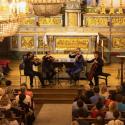
There were moments during the starry, two-evening Beare’s Chamber Music Festival when the quality of the playing reached such heights, it was tempting to ask if a higher level of chamber music-making can or even could exist anywhere. So, although London already has an incredibly rich and vibrant chamber music scene, this event – in its second edition and planned to take place every two years - is clearly additive to it. The two concerts were vociferously applauded, especially the second, Wigmore Hall concert, in which there were standing ovations at the end of each half.
The two evening concerts of the festival both culminated in the performance of a major work with Janine Jansen in the first violin chair. One hesitates to say ‘leader’s chair’ in a chamber music setting, but her sheer presence - among committed chamber music players - does seem to bring a beneficial alchemy. At the first night’s concert in Cadogan Hall it was the sextet version of Schoenberg’s Verklärte Nacht of 1899, and for the second night it was the 1900 Octet by the teenage Enescu, musician whom Yehudi Menuhin called “the inspiration that bore me aloft…the absolute by which I judge all others.”
In each case the combination of Jansen with a group of other top-flight players was palpable. The Schoenberg on the first night had rich drama, and above all a veneration for the diaphanously quiet. The ending in which the work disappears into silence was unforgettable, and the audience (thankfully) held back for what seemed an age before breaking out in thunderous applause.
Enescu’s octet is an astonishing work, demanding of virtuosity, study, listening and a genuine chamber music instinct from every player. It is a vast and complex work with linked movements, but always with a palpable logic and forward flow, tension and release. The first movement was remarkable for local hero Timothy Ridout’s contribution either with beautifully shaped solo melodies or dovetailing with Janine Jansen with irresistible countermelody. Another remarkable player is Kian Soltani, who has that rare gift of being able to make the tiniest melodic fragment impactful, eloquent and memorable.
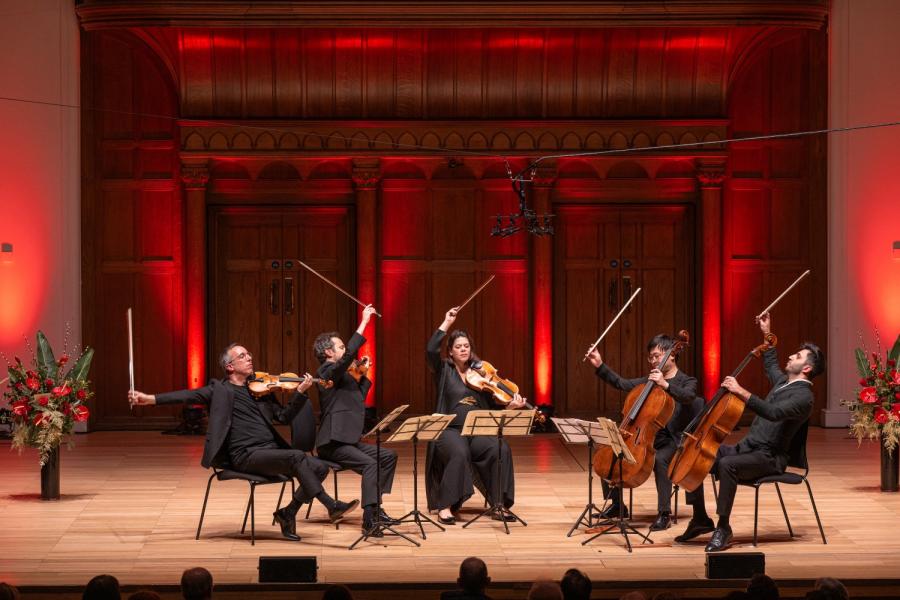
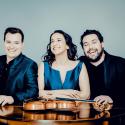
The two concerts also put a focus on the characterful excellence of Quatuor Ébène. Violinists Pierre Colombet and Gabriel Le Magadure have now worked alongside each other for more than a quarter of a century, and their intuitive brotherly understanding and complementarity are constantly jaw-dropping. On the first night we heard a gloriously poised, balanced and thought-through account of the Schubert C Major String Quintet. In Kian Soltani we had the opportunity to hear perhaps the ideal second cello in this work. That skill to say very little but to make it count every time is like gold. The final piu presto section was played not just upliftingly but also at fearless speed.
The second night brought a vivid in a performance of the Franck Piano Quintet with pianist Sunwook Kim. The strongest movement was a deeply felt central ‘lento’, a welcome retreat from the theatricality of the outer movements. I was probably in a minority with that opinion. The ovation at the end of the first half was perhaps the most deafening I have ever heard from a Wigmore Hall audience
Of the other works performed, the Sextet from Richard Strauss’s Capriccio Sextet brought to the for the spirit of the audience eavesdropping on a series of always-interesting conversations between the inner parts (Nina Feng, Timothy Ridout and Amihai Grosz in particular). The Dvořák Terzetto which opened the second night’s concert was a rare example of witnessing the perils rather than the joys of supergroups. The performance never really settled, and balance issues seemed to have been left unresolved.
This festival is a part of an interesting two-pronged new initiative from the string instrument dealership J & A Beare. While businesses focused on violins have existed in the Beare family name in London since the mid nineteenth century, the company has clearly been re-appraising what it wants to do, and change is happening, notably with the adoption of a philanthropic and educational mission. A cultural Trust with UK charitable status was very recently set up, with the objective to support around sixty top-level emerging string players. This (public) festival coincided with daytime masterclasses and other sessions, essentially private, but with patrons welcome, in which the internationally renowned players who have been performing in the festival worked with the younger players.
Those are issues for the very long term; what stays in the mind is to have partaken in a feast of glorious string instrument playing.