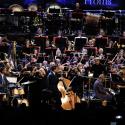
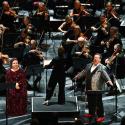
With the Albert Dock just a few hundred yards down the road, and Liverpool the launchpad for two centuries of Atlantic crossings, it’s perhaps not too shocking to hear Wagner’s intercontinental Ride of the Valkyries resound round Philharmonic Hall.
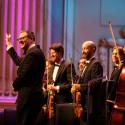
Though perhaps that was the problem: in the first half of this Scouse tribute to the bicentennial Saxon, under an (initially) slightly deferential Vasily Petrenko, the first half somehow failed to shock. One problem is those naffly abrupt cut-offs, which even Stokowski couldn’t sidestep: common chords snatched at, like rounding off Schoenberg in C major. Maazel conducted the whole of the Ring without any words at all. That works. Better on all counts.
Berkeley-Steele's Tristan should beckon to top promoters on both sides of the Atlantic
In The Entry of the Gods into Valhalla, a slightly dotty start, the first few bars sounded hesitant. Soon Wotan’s airborne daughters spread stolid wings, lacking their usual bump and bounce. True, in the last third (of both) the RLPO brass was as galvanising as its inspired woodwind. But there were no question-marks: might a bomb go off as Wotan totters up the rainbow? Might the horse-demons just possibly not make it? These both seemed blasé; there was less than expected dynamic finesse.
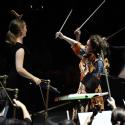
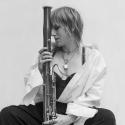
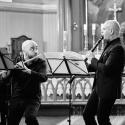
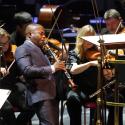
We gained more from a bleeding chunk of Siegfried’s funeral: four clarinets in chorus, led by the almost fiercely expressive Michael Whight. Tutti were increasingly noble, and a massively plangent, Chopin Funeral March-quality cor anglais (crucial introducing Tristan) from Jess Mogridge set the tone. Terrifying tympani (Neil Hitt) utterly eclipsed a breathtakingly feeble anvil. Where the pure refinery of Petrenko’s beat, and the sectional playing, scored best was in that epitome of woodland beauty, Forest Murmurs, from Siegfried. From the Vltava-like opening eddies (cellos and basses, terrific), the ultra-dark clarinets, and the mesmerising pass-the-parcel - violin to flute, oboe, glockenspiel - this music was as alluring as Petrenko’s sensitive left hand. With both, he cleaned up textures to wondrous results.
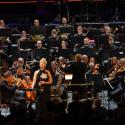
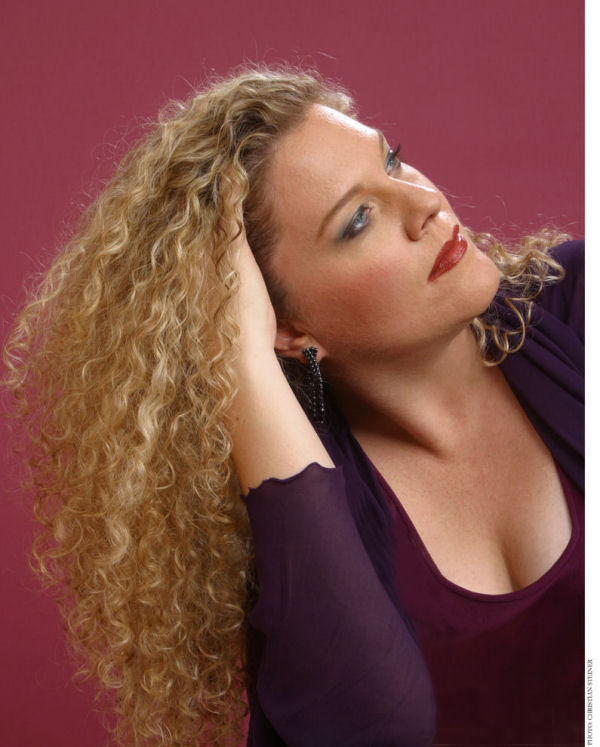 It might sound as if there was no big event. But what followed knocked even Waldmusik for six. The RLPO management had amassed a vocal team of breathtaking talent for Act 3 of Tristan and Isolde. Witness the toings and froings of Kurwenal, the passionate Philip Joll, note also the Shepherd, Tristan Llŷr Griffiths, a wonderful find, and briefly a fine Melot, too.
Include, too, the panicky shifting moods of a beautiful Brangäne (mezzo Leah Marian Jones, stamping herself on this score in a few short lines); or the befuddlement of a sensationally headstrong, young King Mark (baritone Paul Whelan, whose wondrous tone resounds from top to bottom of his register).
But this act – long after the fêted and fated love-duet - is about Tristan’s drawn-out expiry (just long enough for his geliebte to shriek hello) and Isolde’s tragic, ground-breaking Liebestod. Richard Berkeley-Steele is a hard act to follow; he too is a heavyweight across the full range, and his Tristan should beckon to top promoters on both sides of the Atlantic.
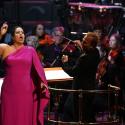
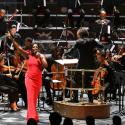
But nothing compared with the scintillating final punches of the revived Isolde, Michelle DeYoung (pictured above right), a favourite of Boulez as of Barenboim, and simply too stupendous a voice - and richly disconcerting a presence - to waste weasel words on. Tristan subsides with pure Wagner. But what precedes is pure, irresistable Strauss. With DeYoung we got Ariadne, Salome, Elektra, the lot. Was it worth being there? You bet it was.