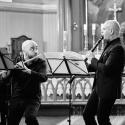
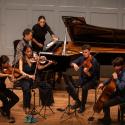
Zum Roten Igel – the “Red Hedgehog Tavern” – was a concert venue with pub attached in 19th century Vienna, frequented by the like of Schubert and Brahms. It is also the name of an ensemble committed to exploring the connections between these “classical” composers and the Volkisch music that would have been heard in the next-door room. In this case it means re-scoring Schubert’s String Quintet and garlanding it with wild interstitial dance jams, recreating an imaginary historical mash-up.
It is a Marmite project, with a full Purcell Room seeing several people leave during proceedings but others on their feet at the end. I tended to side more with the sceptical crowd. Re-working the Schubert for violin, cello, clarinet, accordion and santour (a Persian chromatic hammered dulcimer) is not so much gilding the lily as dragging the lily through a cowpat, and your attitude towards the result dependent on whether you are excited by a reframing that emphasises Schubert’s low-culture influences, or think it sacrilegious to mess with an immortal masterpiece.
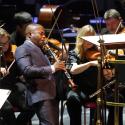
I am not instinctively against the idea of reworking great music of the past – I am certainly no fan of putting the canon in a glass-fronted museum case. And there were certainly pleasures to be had, with the Schubert emerging at the beginning from an improvisational warmup, and the santour (Iris Pissaride) sounding like a honky-tonk pub piano, fitting the overall conceit. And the use of Gypsy and Hungarian tunes within the flow of the Schubert seems a fair enough idea – although I have no idea if the specific tunes used were authentic, or sought to be. In these moments of frenzy, clarinettist Ben Harlan took to his feet in cadenzas of wild whirling, a symphony of squeaks and squeals and scales. Refined and elegant it wasn’t, but it had an elemental energy. Of more concern were the moments of smudgy ensemble and intonation, which I might be charitable and suggest were a stylistic decision, but certainly distracted.
The approach worked best in the third movement – already a rustic roast in the original, with cellist Matthew Sharp both playing and singing in the central Trio, calling Schubert’s “Der Leiermann” from Winterreise into the mix. It was a virtuoso moment, but didn’t quite seem to gel. The last movement likewise had a gallop that accommodated the Hungarian interpolations. Less successful was the sublime Adagio second movement, Harlan transposing the cello’s delicate pizzicatos to a parping bass clarinet which was, according to taste, either an intriguing change of perspective or an unforgivable impertinence.