Graeme Murphy's 2002 Swan Lake for Australian Ballet stitches together plot elements from Swan Lake, Giselle and Lucia di Lammermoor, among other things. No bad thing, that; such mash-ups can work well (see Moulin Rouge), and Matthew Bourne proved way back in 1995 that Swan Lake's story can be totally reconfigured and still work gloriously (we do not talk about the 2011 film Black Swan). But last night's peformance at the Coliseum places Murphy's work for me in the category of might-have-been; lacking either Bourne's mastery of storytelling or Moulin Rouge's campy extravagance, his Swan Lake is only a decent ballet, not a great one.
Despite having got to the theatre too late to read the synopsis, I could easily follow the story of the Prince who marries one fragile young woman, of whom his mother disapproves, but is secretly having hot sex with an older, married courtier. I mean, to be fair it's not an unfamiliar scenario (the facial resemblance of the Queen, played by Shane Carroll, to senior women of the House of Windsor drives it home for those with short memories) but it's executed with verve by the cast.
The Baroness proves to be a useless substitute for a real villain
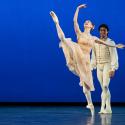
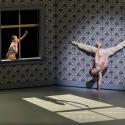
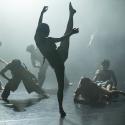
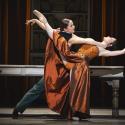
Amber Scott of the delicate arms plays Odette with an ingratiating girlishness à la Marianela Nuñez overlaid with a Kristin Scott Thomas-alike pale brittleness, and the chemistry between Prince Siegfried (Adam Bull) and his lover Baroness von Rothbart (Dimity Azoury) is undeniable, both during the wedding party scene and in the rather startling full-on sexual encounter that takes place during the Prologue, all of about two minutes after curtain up. The whole Act I party scene thrums with carefully choreographed but naturalistically acted interactions, so that though the choreography is workaday rather than inspired, there is still plenty to rivet your attention on the stage, which ripples with more clandestine currents of emotion than a Downton Abbey dinner party. 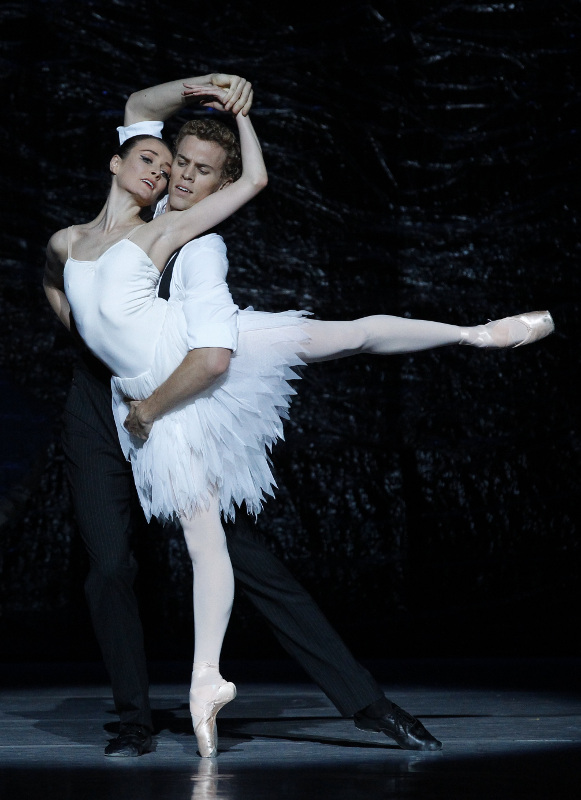 When Odette interrupts a caress between the adulterers it has the momentary thrill of high drama, but in the ensuing "oh, I am so confused because there are two women here for me" solo for the Prince, the character problems besetting this scenario become un-ignorable. Why is the prince so apparently oblivious to the consequences of his actions? What do these two women see in him apart from his tall good looks and goofy smile? The Baroness is not played as an incarnation of evil like Odile, and sweet Odette is not in peril of her life from the prince's infidelity, but only – hoary old cliché – of her mind. Yes indeed, she goes mad, and with Lucia di Lammermoor gusto, but unlike either Giselle (at least in Peter Wright's production) or Lucia (particularly in Katie Mitchell's new Royal Opera production) she doesn't scale the tragic heights of killing herself or anyone else, being instead gently ushered to a lunatic asylum, where nothing bad happens to her, and she can be allowed to have a full swan-spangled white act – cliché again – inside her head for Act II. Referencing but not actually reproducing the original choreography, the swans swirl vapidly around like so many brain cells under dendrite-like silver tree flats, and an imaginary Prince appears to dance a dilute homage to the White Swan pas de deux with Odette (pictured above right).
In its tame prettiness and plot pointlessness, this dream sequence is offensive to people with mental illness, to actual swans (flipping scary birds), to Ivanov's original choreography, and to the conventions of tragic drama. And Act III only supplies more of the same, as Odette returns from the loony bin, reconquers the Prince with her innocence, and then goes mad again and rushes off to die in the wilderness (cf Manon). The Baroness proves to be a useless substitute for a real villain; I kept hoping she was about to rush off, come back with a gun and shoot the pair of them, but instead she just goes all wobbly and sad when the Prince's change of heart becomes clear. Even poor Odette doesn't get to expire with any drama, but fades away, only bobbing up briefly to wave from the black pool which does service as a lake, but is in fact – the cerebellum-like white disc at the end suggests – actually just the empty inside of her skull.
It's a huge come-down from the excitement and tension of Act I, and doesn't do justice to what I suspect are the company's, and the choreographer's, considerable talents: there is plenty of heartfelt acting and characterful dancing to be seen, and Murphy's skill in inventive balletic narration puts him above many choreographers working today. But re-write a fairy tale plot at your peril: yes, Swan Lake can be psychologized if that's your bag, but without either evil (as in the original plot) or real terror (the psychodrama equivalent) this is just a depressing story about a man who can't make his mind up and two women too spineless to ditch him.
I record that it is lushly designed and lit, that the orchestra of English National Opera sound fabulous under the baton of Australian Ballet's conductor, Nicolette Faillon, that the reordered score is surprisingly slick and coherent, that the dancers are committed and likeable. Those who can ignore the plot holes will have a fine, fun evening at the ballet, as indeed last night's enthuasiastic audience appeared to do.
- The Australian Ballet perform Swan Lake at the London Coliseum until 16 July and Alexei Ratmansky's Cinderella 20-23 July. Three of the company's fairy tale ballets will be broadcast live to cinemas worldwide, including in the UK, in October 2016.
- Read more dance reviews on theartsdesk