Sam Mendes assembled most of the ingredients necessary to make Empire of Light a wrenching English melodrama with a potent social theme. The stars are Olivia Colman, Colin Firth, Micheal Ward and Toby Jones. Mendes teamed with his usual cinematographer Roger Deakins, whose elegant panoramic images lend a grandeur to Margate’s faded glory. The town’s art deco Dreamland Cinema provided the main location of a movie admirably modest in scale.
Fatefully, what the production didn’t have was a screenplay that ensured a consistent tang of verisimilitude. Though a heartfelt and well-meaning personal project, the first film written solely by the director feels inauthentic, a simulacrum of the lived-in experience it should be.
Set in 1981, it draws on Mendes’ memories of teenage moviegoing and growing up with a bipolar mother capable of erratic behaviour. (The 82-year-old novelist and poet Valerie Mendes likes the film, her son told The Guardian.) Not every development in the characters’ changing relationships feels earned. Mendes is on stronger ground anticipating and delivering horrific National Front-stoked racist violence, which explodes in the foyer of the no-longer plush Empire Cinema.
‘
The superficiality ranges from the routine psychological rationale for the manic depressiveness of Colman’s Hilary Small, the Empire’s duty manager, to the tepid use of two-tone music. Hilary’s discovery she can dance to the reggae-punk hybrid springs from her falling for and dating the new worker Stephen (Ward), who has a Jamaican background and a mum roughly Hilary’s age.
Just back from a stay in a psychiatric hospital, lithium-dependent Hilary supervises with brittle cheer the cinema’s staff: Stephen; irritable aging projectionist Norman (Jones), who has a tender appreciation of his job and a family skeleton in his closet; nerdy but responsible assistant manager Neil (Tom Brooke); and 17-ish ticket collector Janine (Hannah Onslow), a gregarious punk. Their motleyness suggests the influence of the Basil Dearden charmer The Smallest Show on Earth (1957), in which a couple played by Virginia McKenna and Bill Travers inherit a decrepit fleapit along with its cashier (Margaret Rutherford), commissionaire (Bernard Miles), and alcoholic projectionist (Peter Sellers).
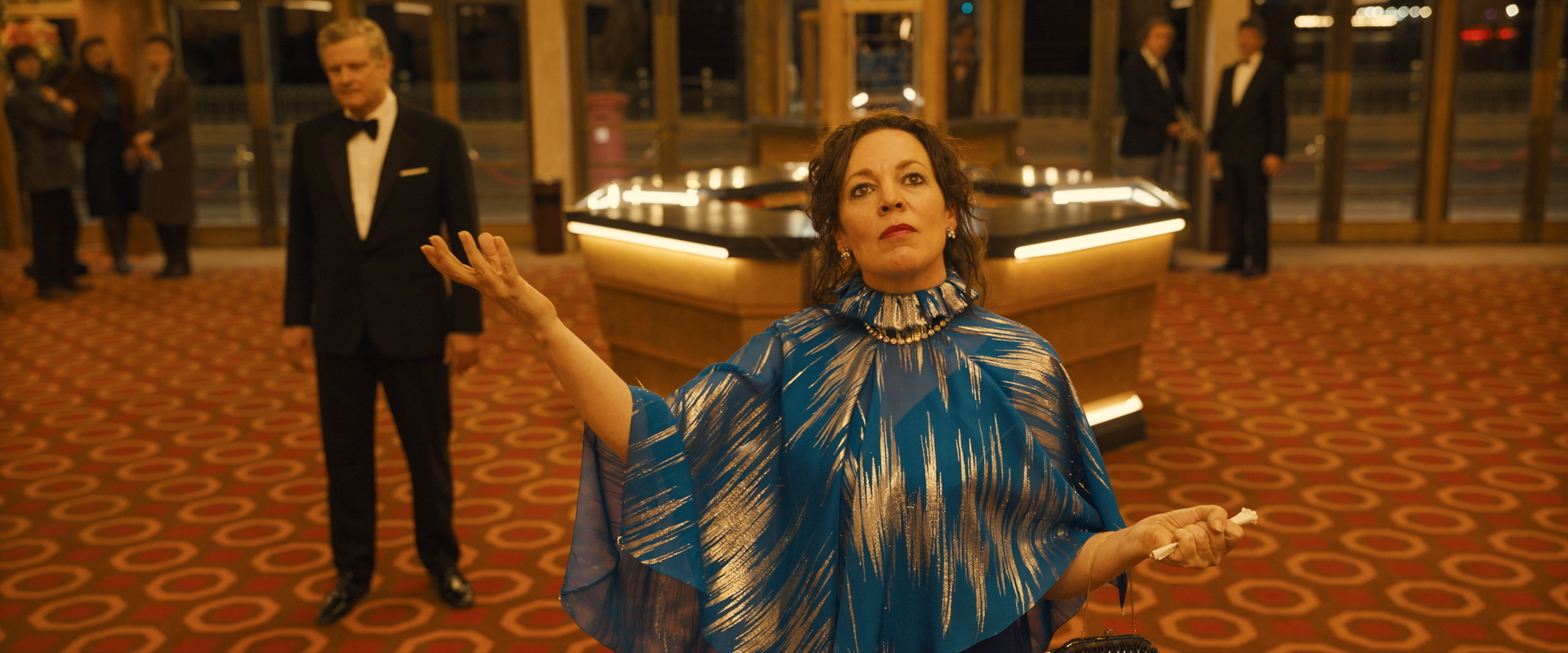 The Empire’s loss of lustre is personified in the boredom of its general manager, Donald Ellis, sharply portrayed by Firth as a tetchy middle-class failure, who might as well be running a supermarket as a theatre of dreams. Mr. Ellis' adulterous sexual harassment of Hilary (whose complicity in their grubby affair is irrelevant) feels like a modish attempt to shoehorn in a #MeToo consciousness. (Pictured above: Firth and Colman)
During the sequence in which Mr. Ellis gets his public comeuppance, he blurts out that despite Hilary’s instability he has continually rehired her, which wouldn’t have been incumbent on him at the time. It’s ambiguous if he’s done this in order to continue exploiting her or because he has a grain of decency.
Willing front-of-house assistant Stephen, who attracts Janine as well as Hilary, sticks out from his colleagues not because he’s black but because he’s centered and ambitious, an aspiring architect. The pall he and his single mother (Tanya Moodie) live under is embodied in the hatred of a cinema patron (Ron Cook) who, scoffing chips in the queue, humiliates Stephen in his workplace, and by the NF, whose bovver-booted thugs attack him in the shattering climax. But Empire of Light says nothing about racism that wasn’t said in Burning an Illusion (1981), My Beautiful Laundrette (1985), and Young Soul Rebels (1991), among other films.
Like Stephen – and unlike the soulless Mr. Ellis – Hilary has a taste for poetry, which (as well as inscribing Valerie Mendes in the film) hints she may have wanted more from life than a dreary service job. Yet Hilary’s quoting of WH Auden in a key moment comes across as arch; snatches of poems seldom work in dialogue.
Notwithstanding that Stephen isn’t fully available, Hilary begins to destroy their relationship when, without warning, she tramples on a sandcastle they’ve built during a day at the beach. She reveals she can’t maintain an intimate relationship with a man thanks to her crushing interactions with her despotic father when she was young. In contrast to Colman’s controlled disintegration as the older Leda in The Lost Daughter (2021), as Hilary she veers into shrillness from which Mendes and a tighter script might have protected her.
Atop a shadowy staircase, the Empire’s second floor is forbidden for entry, so Hilary and Stephen enter it. They find a dilapidated coffee bar, probably appointed in vinyl, next to the remnants of disused theatres; they're the beautiful work of Mark Tyldesley, designer also of The Banshees of Inisherin.
More powerfully than does Mendes’ sentimental invoking of the Sellers vehicle Being There (1979), this forgotten realm captures nostalgia for the showing and watching of what used to be called the pictures. Symbolically, Stephen and Hilary tend a wounded pigeon and set it free from the space, the site also of their daytime trysts. Amid the dust and debris, among the ghosts of Margate punters having a pre-film nosh, Empire of Light achieves a poetic grace it struggles to find elsewhere.