Here's another small gem of a film graced with a fine central performance by Jim Broadbent, after his lovely turn in The Duke. The Unlikely Pilgrimage of Harold Fry is, like the earlier film, the story of an eccentric older man who embarks on a risky enterprise, though it’s less comic and twice as affecting.
Broadbent has another grumpy wife here: after Helen Mirren in The Duke, Penelope Wilton (pictured below with Broadbent) plays Maureen, a sour woman with little to bring joy to her days. His Harold is a quiet man, living modestly in retirement in south Devon, who is suddenly galvanised into changing his life by a letter from an old friend and colleague, Queenie (Linda Bassett), now dying of cancer in a hospice in Berwick-on-Tweed.
The extent of Harold’s inadequacies as a sentient human being are made very clear when he pens a letter to Queenie of the briefest, most desultory kind, even crossing out the word “Love” and putting “Best wishes” instead. Harold realises this is a totally inadequate response, as his four attempts at posting the letter show. Then a chance remark from a young woman at the till of a petrol station, about the healing power of hope, triggers his belief that if he doesn’t go home, but walks to Berwick on Tweed, instead, it will give Queenie something to live for. So he sets off, right there and then, with no proper clothing, not even a mobile phone.
This promises to be a long, samey trip of trudging through lanes and fields, so director Hettie Macdonald breaks it up with flashbacks to Harold’s memories – his family life, his time at the brewery where he and Queenie had worked 25 years earlier. Slowly the pieces fall into place: what Queenie means to him, why his marriage is so unhappy, how much he is to blame for that unhappiness, and how much he is not.
His wife, Maureen, meanwhile, is going on a journey of her own, mostly a stationary one. Once she realises Harold is missing, she cleans every inch of the house, pretends he is ill in bed to her neighbour Rex (Joseph Rydell) and works her way through various stages of anger, resentment, and regret. It’s a “journey” as significant as Harold’s, as she, too, is forced to stare the past in the face, for lack of an irritatingly placid husband to berate.
We follow Harold through the back roads of southern England (though he seems to go through a time warp somewhere northeast of Bath and is suddenly in Derbyshire). But no matter, as the journey is often highly picturesque, apart from sudden irruptions of noisy dual carriageways that make Harold, and by now the audience, flinch. His walk becomes an encounter with the natural world, with the locals who farm the land he is crossing, with total strangers of all ages and ethnic origins who respond to him with kindness. One, an emigre Slovakian woman who is a qualified doctor at home but reduced to cleaning toilets, rather meaningfully gives him a compass.
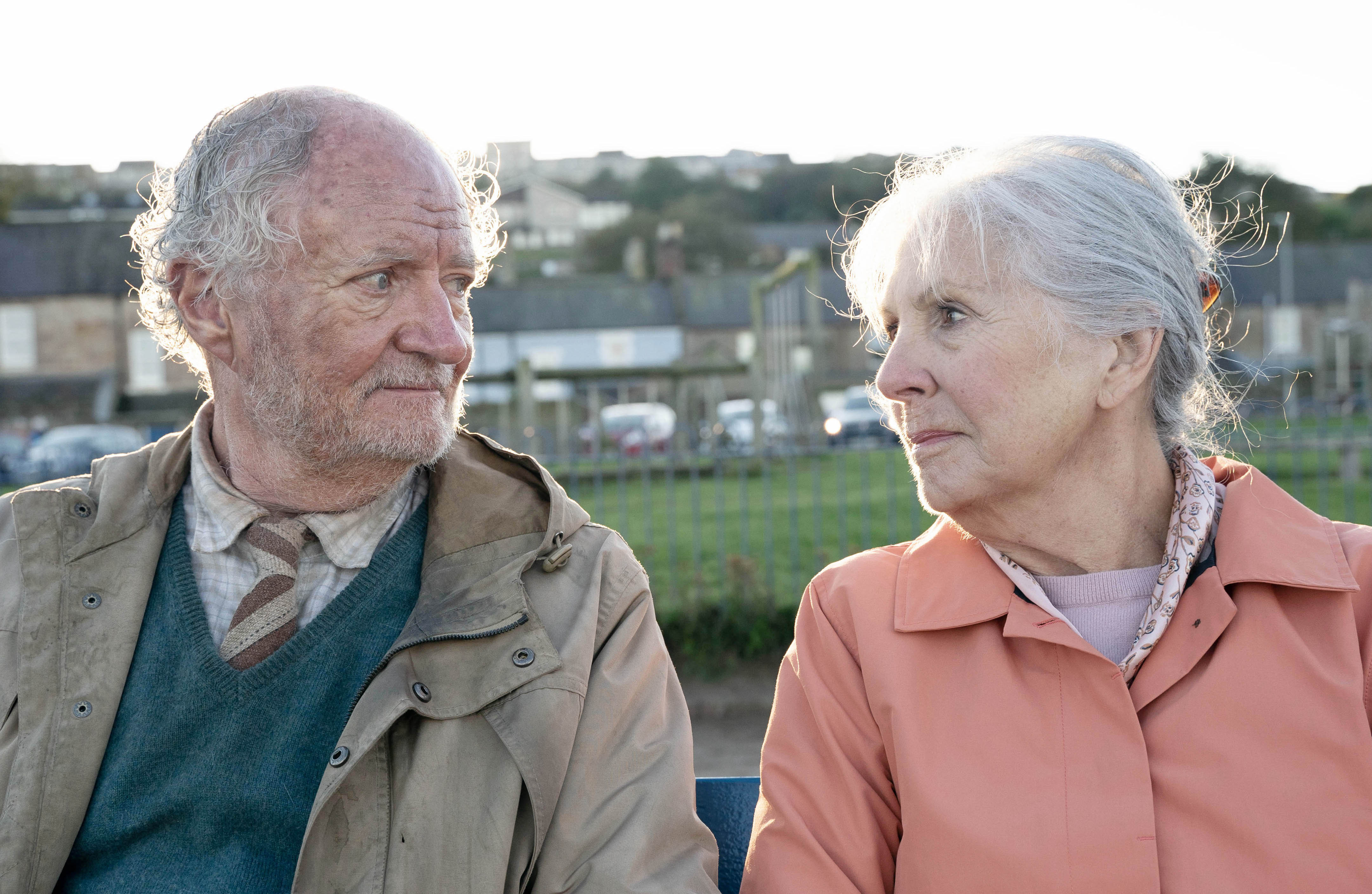 The encounter is also Harold’s with his inner life, which seems to be dead. Broadbent’s face, increasingly weatherbeaten as outdoor living leaves its mark, is a mask of sorrow, his blue eyes staring out in confusion and amazement at the world he is encountering, peopled with generous types who want to help him more than he wants to be helped.
He refuses all offers of lifts, though does sleep at B&Bs here and there. But as the journey proceeds, he dispenses with all the trappings of his modest former life, sending home to Maureen his credit cards and watch, and only making the occasional phonecall to her about his progress.
Inevitably, the modern world catches up with his pilgrimage, thanks to a man who posts a picture of him on social media, impressed by his selflessness. But Harold doesn’t feel selfless, and the posse of followers he attracts weighs increasingly heavily on him. Finally, he encounters a jobsworth unmoved by his circumstances, and his reaction to this coldness is immediate and overwhelming. Broadbent has never been better than in this scene; you start asking yourself, he's played Gloucester, but why has he never played Lear?
Weaving in and out of the narrative is the story of David, Harold and Maureen’s only child, strikingly played by Earl Cave, son of Nick, who appeared as a similarly disaffected goth in Simon Bird’s Days of the Bagnold Summer. Cave has a talent for mixing the sweet and the sour in a seamless blend. He has real presence and easily holds his own against old pros Broadbent and Wilton.
As the finale of the story, adapted by Rachel Joyce from her 2012 novel, arrives, things get predictably softer-centred, but overall the potential whimsy of the plot is sidestepped, even though the kindness of strangers seems to stretch credibility when Harold is trespassing on farmland. But as a study of buried emotions and the paralysing hold of grief, it works well. You also get to go on a walking trip of some insanely beautiful English countryside, minus the blisters.