

A slow tracking shot over the gassed corpses of soldiers, their masks having failed the ecstasy of fumbling, opens The Guardians. This French art house film would perhaps have been better served by the English title The Caretakers; it's closer to the original French meaning and would have made it less likely to be confused with a superhero movie.
film reviews
Adam Sweeting

So far Jon Hamm has had trouble finding himself movie roles which fit him quite as impeccably as Mad Men’s Don Draper – though he could do worse than throw his hat in the ring for James Bond – but his role here as an American diplomat in Beirut plays obligingly to his strengths.
Owen Richards

Childhood is an inimitable experience – the laws of the world are less certain, imagination and reality meld together, and no event feels fixed. A Sicilian Ghost Story recreates this sensation in the context of real world trauma, producing a unique and sometimes unsettling cinematic experience.
Luna (Julia Jedlikowska, pictured below) is a rather typical 12-year-old girl: precocious, imaginative, and very much infatuated with her classmate Giuseppe. Although they don’t have the same interests, they share something deeper, a comfort and belonging in each other’s company. On the walk home from school, the two dance around their attraction, Luna carrying a love letter for Giuseppe but denying it’s really for him. They’re chased by a dog, share a scooter ride, and he demonstrates his show horse; it’s a perfect day that ends in a kiss. Then, as if by magic, Giuseppe is gone.
Days and weeks pass, and no-one but Luna seems to care that Giuseppe’s not in school. At his house, no-one answers the door; his stone-faced mother stares hauntingly from the window. The adults of the village refuse to answer Luna’s questioning. Always prone to daydreaming, her imagination starts to run wild as she follows his ghost through the puzzle-like woods and deep lakes.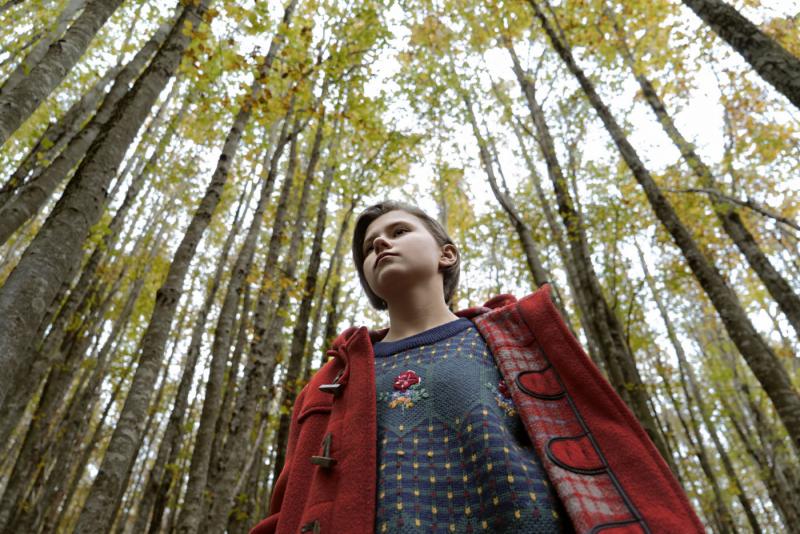 Sicilian Ghost Story is dedicated to Giuseppe Di Matteo, an 11-year-old boy kidnapped by the Mafia after his father turned informant. Rather than a straight adaptation of this tragic story, writer/directors Fabio Grassadonia and Antonio Piazza bring a dark, fairytale quality to the film. Luna’s imagination becomes both her guide and her sanctuary as she tries to come to terms with the grim reality, hinting at a deeper, supernatural connection between the two.
It’s an unusual watch: memories are revisited with different outcomes, dream sequences are often presented as reality, and the internal logic is stretched to breaking point. It is, really, how we remember our childhood – we can recollect the feelings, but not always separate the fact from fiction. This makes for a film that is a pleasure to experience but sometimes frustrating to follow.
The cinematography and sound design create a woozy, hallucinogenic experience
It bares a passing resemblance to recent British indie release Pin Cushion. Both have a young female lead inclined to fantasy, but where Pin Cushion is quirky, Sicilian Ghost Story is something more elemental. The characters are at once dwarfed by and connected with the spectacular landscapes of Sicily. Animals are a constant, and countryside literally hisses and rattles around the humans. It’s at times pagan-like: there’s a deeper spiritual connection with nature that lasts longer than the temporary, evil actions of man.
Visually, the film is stunning. The cinematography and sound design create a woozy, hallucinogenic experience. A variety of wide lenses and low angles add a surrealness to Luna’s journey, drawing a clear line between her world and the standard shots deployed for adults. As the camera focuses on her determined vulnerability, there’s an element of Millie Bobby Brown in Julia Jedlikowska’s performance, only emphasised when her head is shaven. It is a complicated and heavy film to lead, and she does so with ease.
While Sicilian Ghost Story offers some interesting narrative devices, powerful visuals and strong performances, it’s too tonally confused to be considered a complete success. It creaks when toeing the line between fantasy and reality, never quite committing to either to the detriment of both. At times, it feels like Pan’s Labyrinth without the visual effects, or Twin Peaks without embracing the surreal – tons of potential, almost realised.
Overleaf: watch the trailer for Sicilian Ghost Story
Nick Hasted

Adam Sweeting

This is the second Mission: Impossible movie written and directed by Christopher McQuarrie, the first time any director has been called back for an encore on the series. He did a smart job on 2015’s Rogue Nation, but this time he has pulled out every stop to deliver an escalating frenzy of action sequences that frequently leave you wondering how the hell they did that.
Matt Wolf

Mamma Mia! has a habit of bursting upon us at crucially restorative moments. The Broadway production opened just after 9/11 and provided necessary balm to a city in shock. Now comes the celluloid prequel of sorts and, lo and behold, what could have been merely a crassly commercial exercise has exactly the right innocence and heart to act as a giddy summer corrective to our coarsened times.
Owen Richards

When director Jenny Lu graduated from university, the promise of a big city career quickly turned into a series of rejections. Around this time, a close friend of hers committed suicide by jumping off a bridge – unbeknownst to their circle of friends, this girl was working in the sex industry.
Nick Hasted

Father Ernst Toller (Ethan Hawke) calls himself one of God’s lonely men. The term given to Paul Schrader’s anti-heroes since Taxi Driver’s Travis Bickle is usefully explained by the priest: his loneliness is a divine attribute letting him sympathise with fellow sufferers. Take one look at Hawke’s face, though, which seems sucked into hollow-cheeked, unnatural nobility, and it’s clear few need help more than him.
Tom Birchenough

Carla Simón’s debut feature Summer 1993 is a gem of a film by any standards, but when you learn that its story is based closely on the thirtysomething Catalan director’s own early life, its intimacy becomes almost overwhelming.
Saskia Baron

Age cannot wither her nor custom stale her infinite stretchiness… Time has been kind to Elastigirl, the superhero mom voiced by Holly Hunter and dreamed up by Brad Bird. Fourteen years have passed since The Incredibles seduced adult critics and children alike, but it might as well be yesterday for Elastigirl. She’s as bodacious as ever, nary a wrinkle on her animated face nor a sag to her ample posterior. And Elastigirl is still eager to fully extend herself and catch the bad guys.