It's over-egging it a bit to equate Krautrock with the entire rebirth of Germany. It's also slightly jarring to entitle the film Krautrock when its narrator then blames the World War Two-obsessed British music press for inventing such a disparaging term (cue supplementary evidence of Spike Milligan and John Cleese pretending to be Nazis.)
Nonetheless, I liked this film so much I watched it twice. There were loads of insightful and entertaining interviews, and most of the music was great, though the extracts weren't long enough. In fact the whole film wasn't long enough, and how often do critics say that? It was conceived as a companion piece to last week’s Synth Britannia and that got 90 minutes, so why was this a mere hour?
The film itself made the point that the K-rockers were never part of a coherent scene, so a one-size tabloid label could never fit them all. Quite often Krautrock wasn’t even rock, and another theme was how the German bands of the late Sixties and Seventies consciously set about devising a music rooted neither in Anglo-American blues and rock, nor in Germany’s tooth-rotting Schlager music, a genre unpleasantly redolent of the sentimental slop with which Josef Goebbels had saturated the Third Reich.
The protagonists were some of the most eccentric and creative characters ever assembled on one stretch of videotape. There was Hans-Joachim Roedelius, founder of ambient electronicists Cluster. He'd been drafted into the Hitler Youth during the war, and was taught how to fire a Panzerfaust at Russian tanks before the war fortuitously ended.
Edgar Froese of Tangerine Dream used to resemble a Yeti in flared jeans, but now wears a raffish cowboy hat and shades and talks in a gravelly undertone like Jason Robards. The members of Can spotted Damo Suzuki behaving strangely in the street and promptly hired him to be their vocalist, shoving him onstage the same evening with no rehearsals. Incredibly, actor David Niven came to hear them play, and they asked him what he thought of the music. "It was great," he said, "but I didn't know it was music." Suzuki doesn't remember, "because at the time I was quite stoned."
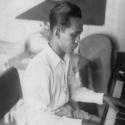
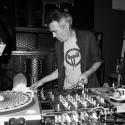
 These free-thinking experimentalists aspired to develop a new music freed from the traditions which they considered to have died in the smoking ruins of Berlin in 1945. Can's Holger Czukay discovered primitive electronic gadgets as used by Karlheinz Stockhausen in the basement of a Cologne undertaker's parlour. Electronic composer Klaus Schulze (picture right) recalled how a Berlin concert by John Cage, using 35 reel-to-reel tape recorders, had stimulated feverish activity within the new-music crowd at the city’s Zodiak Free Arts lab.
In Munich, erstwhile cradle of Nazism, Amon Duul were concocting “acid-drenched apocalyptic music” in a communal environment frequented by Andreas Baader and Ulrike Meinhof, albeit before their names became synonymous with terrorist atrocities. Film-makers Wenders, Fassbinder and Herzog were likewise Munich-based, Herzog regularly enlisting Popol Vuh (including his school friend Florian Fricke) to create his movie soundtracks.
All this was made possible by the ferment of 1968, with protesters skirmishing with police across Europe while art, music, history, film and politics were flung together in a combustible mix. The dividing lines were never clear, and the consequences were diffuse and hard to quantify.
But trust David Bowie and Brian Eno to spot a smart commercial opportunity amid the glorious chaos of Germany's electronic underground. Eno paid an ostensibly social visit to the rural retreat of the trio Harmonia, then slipped away with tapes of their loose musical collaborations and helped create Bowie's Low album. When Bowie was planning a follow-up, he didn't hire guitarist Michael Rother to work on it as he'd hinted he would, but did confess he was a big fan of the track "Hero", by Rother's former band Neu! Bowie's new album was "Heroes".
Only Kraftwerk became a household name outside Germany, and their reward for developing their uniquely streamlined, hypnotic cyber-music was to become one of the formative influences on British synth-pop. You'd have to conclude that the German model was better engineered and offered almost limitless mileage.
Krautrock is repeated on BBC Four tonight at 11.30pm and tomorrow at 1.30am. Watch it on the BBC iPlayer here.