Lizz Wright’s exquisite singing breaks all boundaries between soul, gospel and jazz. In so doing she channels many interwoven strands of the African-American experience. Wright thrives on singing to an audience: her recorded output is wonderful enough, but, a child of the church, the sacred ceremony of raising the spirit in myriad ways is undeniably her home ground.
There’s a majesty here, and spiritual authority. Not just her stature, but the full-length blue dress, hand and arm movements nourished by the music, as well as leading it on - all of these evoke and reinforce a tradition of the black singer as healer and preacher that goes back to pre-slavery day, and has kept community whole throughout the centuries. Her contralto voice, which she modulates with a magic touch - never excessive and yet expressing passion with great force - is reminiscent of some of the great West African jelimuso’s, and most particularly the late sublime exponent of the Manding tradition, the deep-voiced griotte Bako Dagnon. Women whose role was to embody history and shared memory in song. When Wright sings “Grace”, the emotion in her voice, and the love that pours through her embody an act of humble surrender. She sings of the deepest inner truth and it’s impossible, as a participant in this age-old collective ritual, not to feel those goose-bumps that are a surefire physical expression of grace.
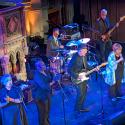
No diva histrionics for Lizz Wright. She knows better: less is more. And while she’s most definitely the focus of attention, her relationship with the musicians is essential to the bewitching mix. She has a refined ear for the band’s musical eloquence, one that matches the perfectly nuanced and understated quality of her singing. Their different personalities mirror the facets of her own. They are visibly listening to each other, and to Lizz, in a kind of sync that possesses the natural quality of simple breathing. Adam Levy on guitars never places a chord or a note wrong. He can do gentleness, with more space than playing, or fury when he slices chords that drive the music forward. Kenny Banks on piano and organ, a regular collaborator, can support with exquisite jazzy instincts, and fill in with gospel-tinged chords on the organ.
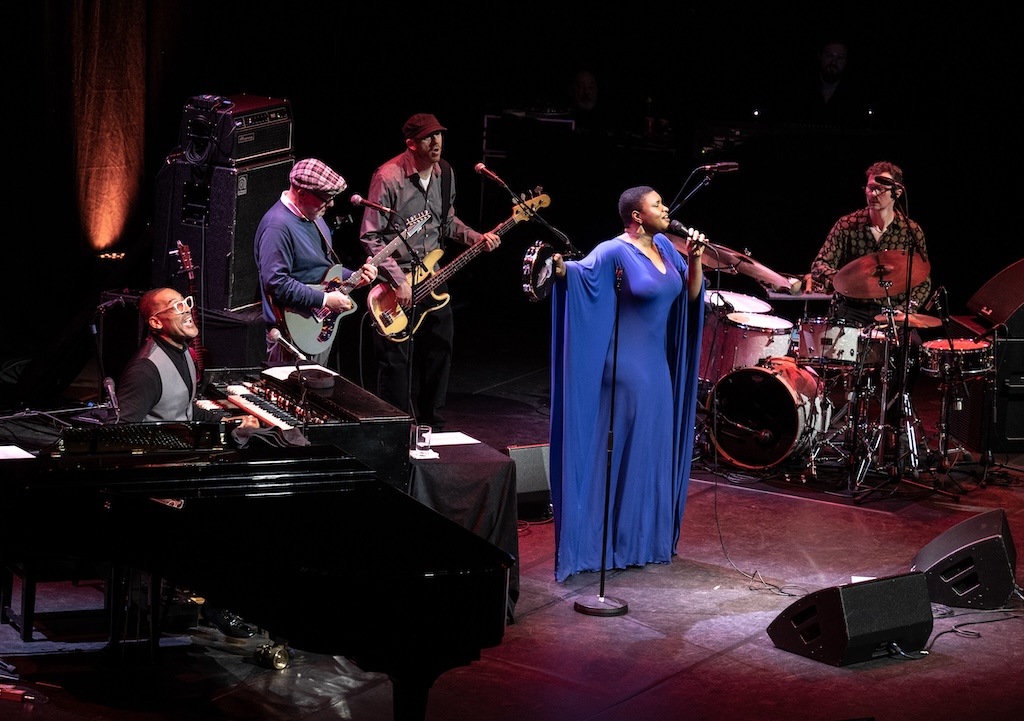
Marlon Patton is the perfect drummer, alert to every change of mood, and offering a solo that manages to be surprisingly inventive, the complete opposite to the often predictable drummer’s ‘moment’. Bass-player, Ben Zwerin In many ways the backbone of the band, with a fluency and sense of constant surprise, should probably not have been asked to solo, as he was clearly less comfortable being in the limelight than providing an extraordinarily subtle and sensitive bass line, that sustains the music’s magic at every moment.
Lizz Wright has a great nose for the covers to which she can bring her own stamp, those that suit her innermost character, whether it’s Neil Young’s “Old Man”, or Cole Porter’s "I Concentrate On You “ As she launched into the standard, she made a low-key joke about needing to please the jazz fans in the audience, or those who’d presumably pigeon-hole her in that supposedly more serious category. And she does it beautifully - her honey-tinged voice floating through this sweet song of loving surrender. She sings “Amazing Grace: as a spine-tingling encore: just her wondrous voice, with gentle acoustic guitar from Levy. On “Lost in the Valley”, she sings of the trials and tribulations of all spiritual journeys, and the ultimate rewards that come to those who strive ever upwards. She can take off with great verve on lively tracks like “Freedom” a rousing celebration of the power to choose liberation, social and personal. Wright’s strength lies in an ability to transcend genre and confound expectations – she's not alone in that, as many musicians today refused to be categorised. The band too move seamless from the gentle swing of jazz to the ecstasy of a gospel programme, from the rawness of hard rock to the sumptuous organ-fuelled sensuality of soul.
Lizz Wright grew up in church, and it shows. The power and influence of the African-American church, which is tangible in John Coltrane’s wildest solos and Charlie Mingus’s collective improvisations, to name two obvious examples, was a fundamental cultural constant in the American black experience. the purpose of music and singing was to inspire a connection with the sacred, and the power of love. At the heart of this essential current, there isn't just a capacity for surrender (found in non-violence resistance) but an understanding as well of the necessity for forgiveness. Lizz Wright made references to the current crisis in US politics, - nothing new if you are black and American - she made it clear in a few brief words, but above all in her music, that transcendence is possible at every moment, amplified by being shared live – a force that enables healing and renewal in ways that make it possible to overcome depression or despair.