Having long been immersed in folk and world music and acoustically-oriented singer-songwriters, it’s a surprise to be given a CD of music by someone who’s never crossed your radar, especially when the artist concerned turns out to have sold some 14 million albums, though mostly in Europe and North America. It’s probably the case that Loreena McKennitt’s considerable following owes to word-of-mouth, for the music-loving friend who gifted me her 1994 album The Mask and The Mirror had been put on to her by a friend in Europe. Instantly hooked, I explored further, giving her live 2006 CD/DVD set Nights at The Alhambra to three people that Christmas of 2017.
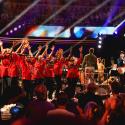
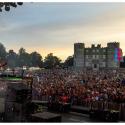
Last year, McKennitt released her tenth album, Lost Souls, and this week she’s been on a rare tour in Britain, where she played four gigs before boarding her tour bus and heading through the tunnel for a score of dates, from Amsterdam to Zabrze. There was no discernible pre-tour fanfare yet on Wednesday at the Royal Albert Hall – not completely sold out, Choir and Balcony deemed surplus to requirements – the audience was ecstatic.
The lighting was beautifully atmospheric, dark blue and green with a touch of purple and red. The back projections conjured up a forest (unsurprisingly, given McKennitt’s pre-occupation with trees) on to which was projected flaming candles. Ten musicians were arrayed around the semi-circular stage: Brian Hughes on acoustic and electric guitars, bouzouki and oud; Caroline Lavelle on cello, recorder and vocals; Hugh March on violin; Dudley Phillips on electric and double bass; and Robert Brian and drums. Guest musicians comprised Ana Alcaide on nyckelharpa, or viola de claves; Daniel Casares on Spanish guitar; Ben Grossman on hurdy gurdy; Ian Harper on the Turkish clarinet, flutes, whistles and Uilleann pipes; and Hossam Ramzy, on handheld percussion and cajon, or box drum. McKennitt herself sang and played harp, piano and piano accordion, standing to play the latter and occasionally breaking into a little Irish jig as she did so.
The set was built around Lost Souls but opened with “All Souls”, from her fourth album, The Visit (1991). It included “A Hundred Wishes”, enhanced by beautiful cello and acoustic guitar solos; “The Ballad of the Fox Hunter” and “The Two Trees”, settings of Yeats, and another of Tennyson’s “The Lady of Shalott“; “The Stolen Child”; “The Star of County Down”; “The Bonny Swans”; and “As I Roved Out”. The tempo changes and multi-layered textures in “The Old Ways” were exquisite and arresting, drums (“thundering hooves”) and fiddle propelling the song forward as the pipe conjured up a banshee’s wail, McKennitt’s evocative voice floating over it all as she sings of encountering the ghost of her lost love, her life “at the crossroads of time”.
McKennitt recalled her first appearance on the Albert Hall’s stage, in 1998 as the warm-up for Mike Oldfield. Her mother and aunt surprised her by arriving unannounced from Canada and together they distributed handbills across its thousands of seats. Sadly, it was the year in which her life came crashing down, a boating accident stealing the lives of her fiancé, his brother and a friend. The tragedy led to her founding the Cook-Rees Memorial Fund for Water Search and Safety, a cause for which she remains very active. In the following years, McKennitt’s music was used in films but she was largely silent until 2006, when she performed in Granada.
All that goes some way to explaining why I and so many other people have only recently become acquainted with her remarkable body of work which, at its heart, is about her life-long search for Celtic roots, a journey that has taken her not just to Ireland and Scotland, lands of her forebears, and to Spain and France, but to Turkey, Siberia, China and many other seemingly unlikely countries a long way from the Manitoba prairies where she grew up.
McKennitt describes what she does as “musical travel writing” and the result, on disc and on stage, is a remarkable and beguiling fusion. It is Celtic yet also Arabic, the modalities and metrics of each music perhaps more similar than is at first apparent. What marks them out is the instrumentation, the sounds of oud and Uilleann pipes distinctive in the final mix while the hurdy-gurdy, its origins in the Middle East, produces a drone not dissimilar to bagpipes. World music indeed – but music which shows that the world is indeed small and that there is, as always, more that links us than sets us apart.
It was a wonderful concert, and a pleasure to experience it with the friend responsible for my making McKennitt’s musical acquaintance. The facile, short-hand description of her would be Enya meets Kate Bush, with a touch of Mary O’Hara thrown in but that is to undersell a singular talent. Check her out – there's a whole back catalogue to explore.
* I'm reliably informed that she misspoke at the concert: the Mike Oldfield support gig was 1993.