

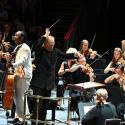
A packed Festival Hall and a cheering, stamping, standing ovation – hardly the usual welcome for an evening of contemporary music. Sitting, wizened and waistcoat-clad, at the centre of the front row was the reason: Ravi Shankar. Framed by the mathematical minimalism of John Adams’ Shaker Loops and Philip Glass’s Violin Concerto No. 1, Shankar’s first-ever symphony was last night given its world premiere by the London Philharmonic Orchestra.
At 90 years old – an age at which few composers are working, let alone breaking new ground – Shankar has produced Symphony, the culmination of decades of East-West fusion writing. Working with the conventional forces of a symphony orchestra, with the sole addition of a solo sitar (played by daughter Anoushka), Shankar’s work translates the aural sensibilities and sound-worlds of Indian music into a Western structural and textural framework.
By way of warm-up to the East-meets-West premiere we were treated to West-meets-East in works by Adams and Glass. Of the two – both much-performed contemporary classics – it is the Adams that still feels fresh and unusual in performance, its insistent refusal to develop no less disturbing and mesmeric than it ever was. Relying on subtlety and delicacy of gesture, the work was well-suited to the LPO under Murphy’s direction. Theirs was a comfortably warm sound, but one occasionally the lacked a little edge, the slight attack that would have raised an elegant performance to a thrilling one. Throughout the evening (and particularly during the Shankar) I found myself wondering what a Dudamel or Kristjan Jarvi would have achieved within such tightly-controlled rhythmic patterns.
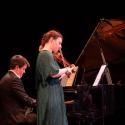
Thrills were never really on the cards for the Glass concerto – a work whose endless arpeggios always provoke the question of when the warming-up will cease and the actual music begin. It is a work however whose facile abstraction can be redeemed by a good soloist; unfortunately habitual Glass-collaborator Robert McDuffie (who gave the European premiere of Glass’s latest concerto earlier this year) was once again a disappointment – thin and lightweight in his tone, and intrusively wayward both in his intonation and his jerky vibrato. His is a technique that seems more suited to the more forgiving lyricism of the Romantic concertos – the occasional melodic passages of the middle movements were lovely – than the exacting control required by Glass’s repetition.
A more complex and ambitious task than any of his previous Western-influenced compositions, Shankar’s Symphony takes the inherently non-developing structures of Indian music – the melodic ragas and rhythmic talas – and explores them within that most organic and developmentally sophisticated of Western forms, the four-movement symphony. The result is a potently rhythmic, contagiously tuneful and surprisingly Western work. Stressing the commonalities between Western and Eastern melodic traditions rather than their differences, Shankar gives his listeners plenty of familiar structural scaffolding to guide them, re-framing the Indian content in a way both accessible and genuinely new.
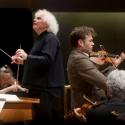
Conducted by David Murphy – himself a pupil of Shankar’s, and a regular champion of Indian musical traditions – the work never once slipped the leash of absolute control and precision. Orchestral textures were warmly translucent, allowing the flashes of percussion or woodwind to pierce clearly through. Denying listeners the brashly colourful palate we tend to associate with world music, Shankar instead presented us with an elegantly muted work, whose delicate textural shiftings would occasionally yield up a bold passage of syncopated brass, or a grainy moment of pizzicato strings and percussion.
Providing lyrical contrast to the rhythmic orchestra-driven passages, Anoushka Shankar’s sitar playing introduced a joyous element of dialogue. Sensitive to every harmonic and rhythmic transition, her musicality – even within a relatively unfamiliar idiom – was overwhelmingly evident, bringing humour, humanity and a beautifully uncomplicated directness to proceedings.
The contemporary vogue for fusion in music has led too often to the lazy and jarring juxtaposition of disparate musical cultures – Frankenstein genres, whose lumpen forms and crass gestures toward mysticism belie the beauty and complexity of their origins. In Shankar’s Symphony we have a much-needed reminder of what is possible with 90 years of research, study and understanding, a fusion that is more than the sum of its musical parts.
By way of warm-up to the East-meets-West premiere we were treated to West-meets-East in works by Adams and Glass. Of the two – both much-performed contemporary classics – it is the Adams that still feels fresh and unusual in performance, its insistent refusal to develop no less disturbing and mesmeric than it ever was. Relying on subtlety and delicacy of gesture, the work was well-suited to the LPO under Murphy’s direction. Theirs was a comfortably warm sound, but one occasionally the lacked a little edge, the slight attack that would have raised an elegant performance to a thrilling one. Throughout the evening (and particularly during the Shankar) I found myself wondering what a Dudamel or Kristjan Jarvi would have achieved within such tightly-controlled rhythmic patterns.
Thrills were never really on the cards for the Glass concerto – a work whose endless arpeggios always provoke the question of when the warming-up will cease and the actual music begin. It is a work however whose facile abstraction can be redeemed by a good soloist; unfortunately habitual Glass-collaborator Robert McDuffie (who gave the European premiere of Glass’s latest concerto earlier this year) was once again a disappointment – thin and lightweight in his tone, and intrusively wayward both in his intonation and his jerky vibrato. His is a technique that seems more suited to the more forgiving lyricism of the Romantic concertos – the occasional melodic passages of the middle movements were lovely – than the exacting control required by Glass’s repetition.
A more complex and ambitious task than any of his previous Western-influenced compositions, Shankar’s Symphony takes the inherently non-developing structures of Indian music – the melodic ragas and rhythmic talas – and explores them within that most organic and developmentally sophisticated of Western forms, the four-movement symphony. The result is a potently rhythmic, contagiously tuneful and surprisingly Western work. Stressing the commonalities between Western and Eastern melodic traditions rather than their differences, Shankar gives his listeners plenty of familiar structural scaffolding to guide them, re-framing the Indian content in a way both accessible and genuinely new.
Conducted by David Murphy – himself a pupil of Shankar’s, and a regular champion of Indian musical traditions – the work never once slipped the leash of absolute control and precision. Orchestral textures were warmly translucent, allowing the flashes of percussion or woodwind to pierce clearly through. Denying listeners the brashly colourful palate we tend to associate with world music, Shankar instead presented us with an elegantly muted work, whose delicate textural shiftings would occasionally yield up a bold passage of syncopated brass, or a grainy moment of pizzicato strings and percussion.
Providing lyrical contrast to the rhythmic orchestra-driven passages, Anoushka Shankar’s sitar playing introduced a joyous element of dialogue. Sensitive to every harmonic and rhythmic transition, her musicality – even within a relatively unfamiliar idiom – was overwhelmingly evident, bringing humour, humanity and a beautifully uncomplicated directness to proceedings.
The contemporary vogue for fusion in music has led too often to the lazy and jarring juxtaposition of disparate musical cultures – Frankenstein genres, whose lumpen forms and crass gestures toward mysticism belie the beauty and complexity of their origins. In Shankar’s Symphony we have a much-needed reminder of what is possible with 90 years of research, study and understanding, a fusion that is more than the sum of its musical parts.
- Check out what's on at the Southbank Centre this season
- Find Ravi Shankar's music on Amazon
- Read about the LPO's 2010 season






Add comment