

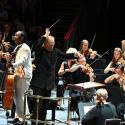
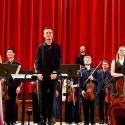
The stage of the Royal Albert Hall has a rather unfortunate habit of making orchestras seem incidental. Stretching endlessly across, one of the world’s largest organs by way of backdrop, even the most generous conventional ensembles take on Lilliputian proportions. Youth orchestras, with their Romantic scale and do-or-die attack, often emerge best from this encounter, as the Simón Bolívar and Gustav Mahler ensembles have recently proved. Framed by eight double basses and five horns, the Royal Albert Hall finally starts to make sense as a performance space. In the hands (and lips) of the Australian Youth Orchestra last night, it not only made sense, it made music.
A programme that opened with a tone poem from Australian composer Brett Dean and ended with Shostakovich’s Tenth Symphony (by way of Mahler’s orchestral cycle Des Knaben Wunderhorn) was designed to showcase the full gamut of orchestral skills, with musicians becoming by turn the colours in a pointillist sound-scape, accompanists and collective symphonic soloists.
Currently making waves with his new operatic adaptation of Peter Carey’s Bliss (premiering in Europe at the Edinburgh Festival in September), Brett Dean is set to join Peter Sculthorpe and Carl Vine among the small number of Australian composers successfully assimilated into international programming. An atmospheric opener, the primordial motivic stirrings and imaginative scoring of Ampitheatre – gong, marimba and harp trio, anyone? – gauzily shrouded the order of its structural foundations. Hollow raspings and rumblings of muted brass eased into the warm mossiness of the lower strings, with occasional fragmentary shafts of wind and percussion colour balancing out a sustained rhythmic impetus.
Impressively alive to internal textural dialogue, the forces of the AYO proved intelligent tour-guides to a piece they evidently know well. Theirs was the mature delivery of an absolutely secure ensemble – both in terms of the music itself, and their own performance – lacking the ingratiating, self-reflexive edge that can sometimes colour youth orchestra performances.
The Mahler that followed was frankly a waste. With Elder coaxing the most delicate and sensitive of accompanying sounds from his band, it remained to soloist Ekaterina Gubanova only to match them, both for focused projection and musicality. As it was, I spent most of the cycle wishing for rather less of the straining soloist and rather more of the orchestra who were so decorously holding back.
Even allowing for the leaping lines and marathon phrases of Mahler’s songs, Gubanova’s performance was weak, struggling to fill the space and compensating with breathy anxiety that distorted both pitch and melodic shape. In a story-based cycle that includes both first and third person narratives as well as dialogue songs, it is crucial that these distinctions come across; Gubanova managed the playful interchanges of "Verlorne Müh" with great charm – her diction throughout was exemplary – but failed with the more direct intensity of "Wer hat dies Liedlein erdacht", its ecstatic throw-away ending becoming leaden and effortful.
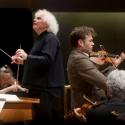
The Shostakovich that closed the concert was a different story. Under Elder’s loose-limbed direction, an orchestra who not only knew their notes but understood their meaning recounted Shostakovich’s tragic legend. No verbal paraphrase was needed as they drew the apocalyptic landscape into view – the numb string onlookers clinging to their single pedal note, eventually giving way to the shrill screams of high woodwind and brass. The musical language of the Tenth Symphony urges emotion, commitment and excess from its performers, yet it is in denying this release, resisting the urge to add to an immaculately balanced work that can make the difference between vulgar banality and devastating sincerity.
Neither the Brett nor the Mahler offered much opportunity for loud, sustained playing, and with the Shostakovich starting in a similarly muted vein, it was with greedy anticipation that we waited for the full force of the engine to kick in. To persuade so eager and young (not to mention large) an ensemble to sustain this degree of control is miraculous, and the pianissimos Elder drew from his players would have been the highlight were it not for the primal and urgent fortissimos that eventually followed.
A nation does not produce an ensemble like the Australian Chamber Orchestra – for my money one of the very best in the business – out of nowhere. The training of young musicians bears direct relation to the quality of the professionals who will become a nation’s orchestras, particularly if that nation is as distant from European and North American cross-pollination as Australia. If the mature, exciting musicianship on display last night is anything to go by, Australia’s music scene looks securely endowed for the next generation.
Currently making waves with his new operatic adaptation of Peter Carey’s Bliss (premiering in Europe at the Edinburgh Festival in September), Brett Dean is set to join Peter Sculthorpe and Carl Vine among the small number of Australian composers successfully assimilated into international programming. An atmospheric opener, the primordial motivic stirrings and imaginative scoring of Ampitheatre – gong, marimba and harp trio, anyone? – gauzily shrouded the order of its structural foundations. Hollow raspings and rumblings of muted brass eased into the warm mossiness of the lower strings, with occasional fragmentary shafts of wind and percussion colour balancing out a sustained rhythmic impetus.
Impressively alive to internal textural dialogue, the forces of the AYO proved intelligent tour-guides to a piece they evidently know well. Theirs was the mature delivery of an absolutely secure ensemble – both in terms of the music itself, and their own performance – lacking the ingratiating, self-reflexive edge that can sometimes colour youth orchestra performances.
The Mahler that followed was frankly a waste. With Elder coaxing the most delicate and sensitive of accompanying sounds from his band, it remained to soloist Ekaterina Gubanova only to match them, both for focused projection and musicality. As it was, I spent most of the cycle wishing for rather less of the straining soloist and rather more of the orchestra who were so decorously holding back.
Even allowing for the leaping lines and marathon phrases of Mahler’s songs, Gubanova’s performance was weak, struggling to fill the space and compensating with breathy anxiety that distorted both pitch and melodic shape. In a story-based cycle that includes both first and third person narratives as well as dialogue songs, it is crucial that these distinctions come across; Gubanova managed the playful interchanges of "Verlorne Müh" with great charm – her diction throughout was exemplary – but failed with the more direct intensity of "Wer hat dies Liedlein erdacht", its ecstatic throw-away ending becoming leaden and effortful.
The Shostakovich that closed the concert was a different story. Under Elder’s loose-limbed direction, an orchestra who not only knew their notes but understood their meaning recounted Shostakovich’s tragic legend. No verbal paraphrase was needed as they drew the apocalyptic landscape into view – the numb string onlookers clinging to their single pedal note, eventually giving way to the shrill screams of high woodwind and brass. The musical language of the Tenth Symphony urges emotion, commitment and excess from its performers, yet it is in denying this release, resisting the urge to add to an immaculately balanced work that can make the difference between vulgar banality and devastating sincerity.
Neither the Brett nor the Mahler offered much opportunity for loud, sustained playing, and with the Shostakovich starting in a similarly muted vein, it was with greedy anticipation that we waited for the full force of the engine to kick in. To persuade so eager and young (not to mention large) an ensemble to sustain this degree of control is miraculous, and the pianissimos Elder drew from his players would have been the highlight were it not for the primal and urgent fortissimos that eventually followed.
A nation does not produce an ensemble like the Australian Chamber Orchestra – for my money one of the very best in the business – out of nowhere. The training of young musicians bears direct relation to the quality of the professionals who will become a nation’s orchestras, particularly if that nation is as distant from European and North American cross-pollination as Australia. If the mature, exciting musicianship on display last night is anything to go by, Australia’s music scene looks securely endowed for the next generation.
- Read theartsdesk's recommendations for the 2010 BBC Proms
- Learn more about the Australian Youth Orchestra
- Find Mark Elder on Amazon





Add comment