

Meditative experiences are hard to come by in the Royal Albert Hall. The twitching, scratching, fidgeting ticks of over 5000 people conspire to break your focus, to draw attention from the musical middle-distance back to the here and now. Last night’s two Proms – whether through programming, performance or just a happy chance of circumstances – both glanced into this distant space, briefly achieving that sense of communion peculiar to Proms audiences. As a birthday tribute to composer-mystic Arvo Pärt, it was fitting indeed.
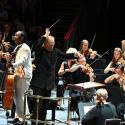
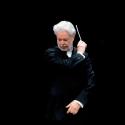
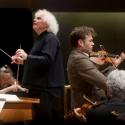
As he has already proved at ENO, Ed Gardner is a master of intelligent programming. An evening exploring contemporary orchestral lyricism in all its guises opened with Pärt’s minimalist miniature, Cantus in memoriam Benjamin Britten, moving through the distinctively English textures of Britten’s own Four Sea Interludes and Huw Watkins’s Violin Concerto, to culminate in Shostakovich’s charged Symphony No 5.
It was a beautifully balanced programme, but sadly the intention to segue straight from the distant tolling of the Pärt into the Britten was foiled by the enthusiasm of the audience, destroying the wash of colour the orchestra had so painstakingly prepared as background for the sharply drawn images of the Britten. With the memory of ENO’s recent Grimes still in my ears, I was delighted to find, if anything, more attack in this performance. Tempos were business-like – a sensible decision given the lack of opera context and the Royal Albert Hall space – and it was the combination of blended string unison and raw brass that most compelled, drawing a steel-tipped sweetness from that sound that the LSO’s Firebird lacked earlier this week.
The Shostakovich was another showcase for string and brass sections, but with the additional delight of the third-movement solos from flute and oboe – as poised in their rhythmic liberties as any Viennese ballroom belle. Gardner’s sense of large-scale form produced a real sense of pace and control, with emotional and dynamic trajectories marked out with equal precision. For my taste the final movement’s swirling intensity was a little on the slow side (Bernstein’s definition of Allegro non troppo may be less accurate, but has a frenzy that matches the mercurial shifts of this movement), but it brought a doggedness to proceedings that was key to Gardner’s reading of this enigmatic conclusion.
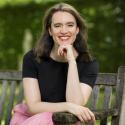
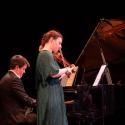
Proms commissions are always uncertain territory, but Huw Watkin’s Violin Concerto may well be one that sticks in the repertoire. Premiered by his sometime fellow-recitalist and young violinist du jour Alina Ibragimova, its bittersweet English lyricism and brutal chromatic rebellions had a persuasive champion. There’s no questioning the commitment Ibragimova brings to a performance, and it was an approach well suited to the work’s elegiac intensity.
Opening with a battle of snatched exchanges between soloist and orchestra (which continued to stalk the later movements – finally transfigured in the concerto’s Coda into a harmless whimpering flutter), the music soon gave way to higher, lyrical gestures, parried by remorseless grunting from the brass. The central slow movement, a fragile almost Howellsian melody in the solo violin, was daringly simple, its melodic certainly only entertaining the possibility of doubt in its closing moments. Favouring allusion and suggestion over absolute certainty, this delicate and elegantly structured work is the natural heir to the English traditions of Howells, Rubbra, Bax and even Britten.
Continuing the Pärt theme, the Late Night Prom saw the BBC Singers and Endymion present the composer’s St John Passion – a 70-minute work both narrating and meditating on the familiar Passion story. Archetypal Pärt, its chant-inspired lines and harmonic stasis represent the core of his "tintinnabuli" style, recalling the chiming of small bells. Eschewing drama and event in place of contemplation, the work has a ritual quality and simplicity well suited to the unique environment of the Late Night Prom.
Aside from its massed choral forces (the impeccably projected BBC Singers, directed by David Hill), the work employs an SATB vocal quartet – the Evangelist Quartet – as narrators, as well as two soloists in the roles of Pilate and Jesus. Pärt’s vocal lines (for melodies they are certainly not) are deliberately disjunct, designed to sound like the simplest and most natural thing in the world while being emphatically neither.
It was Andrew Kennedy as Pilate who showed up his fellows, drawing an expressive flexibility from his music that made light of its awkward curves. Although suffering from issues of both intonation and projection in its soprano (Micaela Haslam), the Evangelist Quartet provided a convincing core to the work, led by countertenor David Allsopp’s controlled purity of tone.
As with so much Pärt, Passio is about a listening experience that goes beyond the practical business of music-making. When you at last escape the cloying A minor at the moment of D major climax it should feel like the most emphatic of arrivals, an affirmation that has little to do with tonality and everything to do with spirituality. Last night’s was not a perfect performance, but it was one that led its audience to this place – an achievement greater than any feat of vocal or instrumental technique.
- Listen to this concert on BBC iPlayer for the next six days
- Read theartsdesk's recommendation's for the 2010 BBC Proms
- Full listings for the 2010 BBC Proms




Add comment