

You can see why the BBC's drama gurus wanted to have a go at remaking South Riding, which last came around in 1974's hit version from Yorkshire Television. It has drama, romance, social conflict, lofty ideals and looks a bit like a parable for our cash-strapped times. Processed through the screenwriting circuitry of Andrew Davies, TV's novel-adapter par excellence, it has emerged as a superior soap tailored with mercenary expertise for that demographic sweet spot that is 9pm on a Sunday night.
Winifred Holtby's 1936 novel, which was published the year after its author's death, is a story of Yorkshire folk at several levels of society, from the poor living in a collection of squalid shacks on a cliff-top to the gallery of rogues and idealists who comprise the local council, and a middle-class landowner struggling to survive without having to sell his home. The nation is in the throes of recession, but some local councilmen want to spend their way out of it with a programme of works for the public good. By 'eck, I bet that Mr Osborne can feel his ears burning.
Into the midst of all this comes Sarah Burton (Anna Maxwell Martin), the daughter of a local blacksmith who has spent the last 20 years teaching in London and around assorted outposts of Empire. She's applying for the post of headmistress at the local Kiplington High School for Girls. She has breathtakingly "progressive" ideas about the education of young women, including the extraordinary notion that marriage needn't be their life's sole ambition. Echoing the author's own experiences of the First World War, and Ms Burton's own wartime bereavement, she deplores any notions of sending the menfolk out again to be mown down in droves.
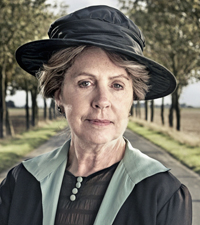 It's terribly easy to watch, and the characters are virtually colour-coded for ease of identification. Ms Burton is the kind of teacher everybody wishes they'd had. She mixes discipline with spontaneity, is able to inspire with a well-chosen reading from D H Lawrence, and exhorts her pupils to express themselves freely on the page (heart-warmingly, it's Lydia Holly, a poor girl from the shacks, who displays the greatest creative ability). Burton finds some female solidarity with alderwoman Mrs Beddows (a firm yet sympathetic Penelope Wilton, pictured right), who champions her energy and imagination, though has to cool her ardour for spending pots of dosh on refurbishing the school.
At first, Robert Carne (the aforesaid landowner with the cashflow problem, played by David Morrissey) greets Burton's lofty ambitions with scowls and gruffness, though we know immediately that the bristling tension between them can only mean a wild love affair by, ooh, let's say the end of episode two. There are only three episodes, incidentally. Though Morrissey's performance runs the gamut from brown to beige, he manages to convey effectively the Powerful Man Who Has Known Sorrow, and is silently crying out for the love of a good woman (Mr Rochester, is that really you?). His tragic marriage to Muriel, the daughter of Lord Sedgemire whose portrait still gazes down haughtily in his hallway, has left him with a dark secret and a neurotic daughter called Midge.
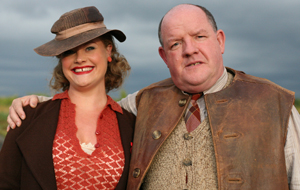 Still, it looks as though Carne may have a love rival in Joe Astell (Douglas Henshall), a former Glasgow communist now trying to convince his fellow councillors to fling money at an idealistic Bauhaus-style housing project. Carne objects that they're skint and now isn't the right time, but Anthony Snaith (Peter Firth) not only wants to make poverty history, but detects a splendid opportunity to profit from land speculation. Meanwhile Alfred Huggins (John Henshaw), a Methodist minister plagued by a weakness of the flesh, looks as if he's going to come unstuck over his knee-trembling relationship with Bessy Warbuckle (Janine Mellor), who looks as if she stepped out of a Donald McGill postcard from Scarborough (Mellor and Henshaw, pictured above).
It all tumbles along at breakneck speed, and you can't help feeling that three episodes isn't going to be nearly enough.










Add comment