

Mark O’Rowe is one of Ireland’s leading contemporary playwrights, and Terminus was first produced in 2007 by the Abbey Theatre in Dublin. It transferred to the Edinburgh Fringe in 2008 and is now being revived by the Abbey in an international tour. His play charts another ordinary night in Dublin city, but as this captivating triptych unfolds the events his characters - simply named A, B and C - describe are anything but. A man and two women deliver a series of overlapping monologues about love, sex, loss, regret and acts of shocking violence, but also of angels transporting souls to the afterlife, a demon made of worms and a pact made with the devil. The language - sparkling, funny and heightened - is poetic and fantastical, Molière meets magic realism.
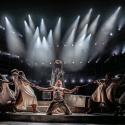
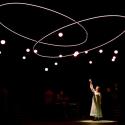
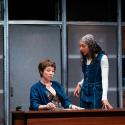
A darkened stage is framed by a huge broken mirror, three shards of which supply the discreet platforms on which A, B and C tell their tales. We start with A (Olwen Fouéré), a fortysomething Samaritan (pictured below) who recognises a caller as Helen, one of her ex-pupils. For no apparent reason she decides to save this young woman from her fate as she is in a relationship with a violent woman who wishes to kill the baby Helen is carrying. Next to speak is B (Catherine Walker), a lonely twentysomething who decides on a whim to join her best friend and her creepy husband on a night out, while C (Declan Conlon) is a shy man in his thirties looking for love.
As the seemingly unconnected stories start to intertwine, we learn that A, in her desire to help Helen, may be projecting all sorts of feelings from her relationship with her estranged adult daughter, B has been horribly duped by her best friend and C, not as placid as he appears, has entered into a Faustian pact to make him more attractive to the ladies, a young blade in more ways than one.
There is much black humour in Terminus - A tells us Helen wanted an abortion when nine, no eight months pregnant and she responds, “Jesus, either way, that’s way too late” - and lots of graphic language describing various couplings and acts of violence; the weapons wielded include a knife, a hurley stick, a penis and a box of Pringles. The language is brimming with such invention that it sometimes threatens to overwhelm the narrative as O’Rowe throws in a host of poetic devices - rhyming couplets, allusion, internal rhymes, jarring rhythms and alliteration, sometimes several in the space of one line - “We go see the slo-mo ebb and flow; the mill, the babble, the rabble of wobbling waywards, exiled and aimless, unlike us as, purposeful and double-file, like kids on a dare, we head who the hell knows where.”
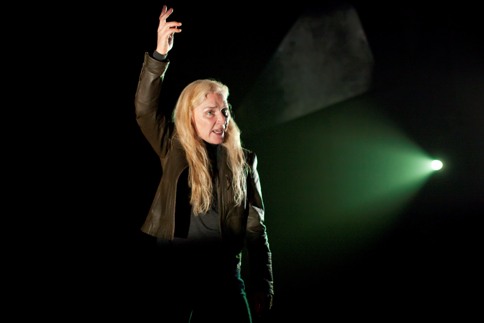
Whereas Alan Bennett’s monologues are conversational and lend themselves to naturalistic productions,Terminus is static, which highlights even more the engrossing power of language and the compelling nature of good acting. With no props, physical movement or interaction, the actors convey emotion with just a look, a small hand gesture or tone of voice, telling tales that have more than a touch of the metaphysical and which echo Irish myths and legends. The style may be austere, but the effect is strangely expressive.
The striking design is by Jon Bausor with lighting by Philip Gladwell, and the author directs the superb cast, which brings me to my only cavil about a work of great linguistic achievement. A theatre producer friend recently remarked, à propos of Neil LaBute’s production of his latest work In a Forest, Dark and Deep, that playwrights shouldn’t direct their own work, unless that bloke William Shakespeare happened to be available, because they may not have the emotional distance to see any weaknesses. I tend to agree, as here another director may have suggested cutting by 10 or 15 minutes, as 90 minutes into Terminus (it runs straight through at one hour 45) we have worked out the relationship between A, B and C and have joined the dots in the story.

 F
F


Add comment