

There’s a lovely moment in A Midsummer Night’s Dream where Peter Quince assigns roles to his company of rude mechanicals. Unsatisfied with the part of the hero, Bottom interrupts, insisting he be allowed to play not only Pyramus but heroine Thisbe too, as well of course as the murderous lion. It’s hard not to see just a little of Bottom’s eagerness in Simon Callow’s Being Shakespeare – a one-man show penned by Jonathan Bate that casts Callow as Romeo and Juliet, Macbeth and Lear, Falstaff and Puck.
Originally conceived and performed as The Man From Stratford, Bate’s play has now been reworked and snappily retitled to reflect its central question: what was it like being Shakespeare? Taking Jacques’s seven ages of man speech from As You Like It as too good a structure to pass up, Callow and Bate walk us through Shakespeare’s life from his “mewling and puking” childhood as the son of a Stratford glove-maker through his shotgun marriage to older woman Anne Hathaway, his move to London, and finally his return to the country and quiet, unmarked funeral.
Balancing social history (a brief exposition on Elizabethan property laws), biography (Shakespeare’s crucial position as the eldest surviving child in his family) and drama (quotations, monologues and indeed entire scenes are recreated by Callow), the whole has the effect of really excellent BBC documentary, or perhaps a guest lecture at a prominent university. While there are few academics writing better on Shakespeare than Jonathan Bate, and few actors with whom one would more willingly spend two hours than Simon Callow, their collaboration here somehow fails to equal the talent of either contributing party.
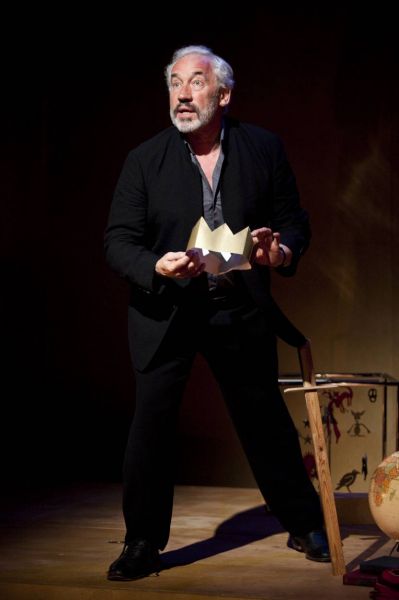 While tantalising fragments from King John, Venus and Adonis and Henry VI do make an appearance, for the most part the show is happy to navigate the major Shakespearean landmarks. We get the balcony scene from Romeo and Juliet, Macbeth’s “Tomorrow and tomorrow” (unwisely prefaced by a Hammer Horror-style sound-effect scream), Henry V’s speech to his troops at Harfleur, all carefully woven out of the experiences of Shakespeare the man. This insistence on the biographical, on life as the source for all Shakespeare’s art, feels at times a little forced, bringing the man to life at the expense of the creative genius.
Bate’s fluent and surprisingly relaxed writing, describing Shakespeare as amassing “a nice buy-to-rent property portfolio”, or claiming that had he lived today he would be “valet parking your car”, translates naturally into Callow’s genial, conversational tones, and if there were rather more moments of extemporising on opening night than usual it didn’t interfere too strikingly. This is material Callow is clearly passionate about, yet in stretching himself across the entire dramatic span of the author he inevitably exposes his own weaknesses as well as his strengths.
His Falstaff is well honed after two outings, and blusters paunchily with the best of them. His breathless Rosalind is perhaps a more surprising success along with Lady Constance (King John) and a cameo of mad Margaret of Anjou. Less satisfying however was his Lear, which trod too lightly, exposing the rather pat tone of proceedings.
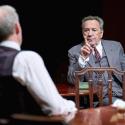
Under Tom Cairns’s direction Callow gets little more than a handful of props and some schoolroom chairs to share his stage, but thanks to the cleverly integrated sound designs of Ben and Max Ringham as well as Bruno Poet’s characteristically efficient lighting, there’s enough movement and stimulus to keep things animated.
Being Shakespeare is a solid show in its own right, yet perhaps the greatest achievement of this Shakespearean one-stop shoppe is to stir dusty school memories and enthusiasm, leaving its audience eager to get back to the plays themselves, to get to grips with a whole tragedy or comedy rather than the cherry-picked morsels offered up pre-washed and vacuum packed here.
-
 Book tickets for Being Shakespeare at Trafalgar Studios, London, until 23 July
  Find Simon Callow on Amazon
Simon Callow on Shakespeare


Add comment