

Last night’s Mozart and Haydn concert at the Barbican was billed as Magdalena Kožená with Les Violons du Roy. In practice it actually turned out to be Les Violons du Roy with Magdalena Kožená, which (barring a few die-hard fans of the Czech mezzo) was surely preferable for all concerned.
Even on a good day Kožená’s voice has a thinness to it. At its best this can translate to agile coloratura, but it’s the vocal opposite of an iceberg – there’s really nothing anchoring it beneath the surface – and the minute any kind of strain or illness threatens it can quickly go adrift. Sounding ragged and tired, she made a bit of a meal of the “modest virtuosity” (as the programme note had it) of Haydn’s dramatic cantata Arianna a Naxos, giving us little emotionally to compensate for the composer’s crudely non-programmatic orchestral writing. Arianna opines that she would like to die, while in the strings a merry oom-pah makes us doubt.
The aria smacked of sophistication and maturity when all should have been roughly and joyously innocent
The imperfections and imprecisions of the vocal tone continued into Mozart’s “Non più di fiori” from La clemenza di Tito, where difficulties at top and bottom of the voice were also exposed. Perhaps it was illness, but Kožená had particular problems transitioning from chest voice back to head voice at the bottom of her range, with an especially jangly gear-shift blotting the middle of a phrase, jolting us out of the drama. Warming up into the end of the programme she dispatched her final two La clemenza arias with more assurance, finding a lovely legato that hadn’t been on offer earlier in the evening. An encore however of “Voi che sapete” took us too far in the opposite direction. Though beautifully sung, it smacked of sophistication and maturity when all should have been roughly and joyously innocent.
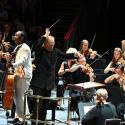
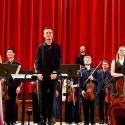
Bernard Labadie’s fine Québécois ensemble Les Violons du Roy (pictured below) are heard far too infrequently in the UK, and it was almost a shame to have them reduced to a supporting role for part of the evening. Even from this position however they managed to steal the show, not least a glorious cameo from a basset clarinet in “Parto, ma tu ben mio” from La clemenza – seeing Kožená’s dramatic histrionics and raising her a casually virtuoso sequence of runs and arpeggios.
 Their opener – Mozart’s Symphony No. 33 – was a miracle of long-form phrasing and architecture, never losing overall structural in the rhetorical cut and thrust of individual phrases. Labadie and his band achieved that tricky balance of lean-forward energy and lean-back relaxedness that the work needs if it isn’t to risk either overloading the music with pompous emphasis or running away with itself. The Finale with quietly riotous, powering through with extrovert directness, never giving a hint of the throwaway punchline of a final phrase.
Haydn’s Symphony No. 85 “La Reine” was just as good, the gently characterful opening morphing into something decidedly sturmy by the time we moved into the Vivace. This isn’t a group to overcook the material, and wind solos were restrained and elegant throughout, with the exception of the glorious excess of the bassoon in the trio section of the Menuetto – the elderly uncle determined to keep up with the lively young strings it doubles.
An odd choice of programme for a Saturday night Barbican Hall concert. Given a relaxed Sunday afternoon slot the slightness of this concert might have felt more charming and less lightweight. As it was, there was just a bit of me at all times that yearned to be at Richard II just across the foyer.





Add comment