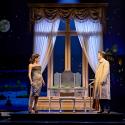
The devil gets the best lines, as usual. That may depend, of course, on whether we’re prepared to qualify David Cameron in that role, but in William Gaminara's rapid-firing farce The Three Lions, the PM (played with real brio by Dugald Bruce-Lockhart) certainly gets to show off his nefarious side, and then goes on to riff demonically as everything descends, gloriously, into chaos.
Gaminara tells his own acerbic version of what happened when Cameron, supported by David Beckham and Prince William, went to Switzerland in December 2010 to try and clinch Britain’s 2018 World Cup bid with FIFA. Their hotel room confabs comprise the action, with Colin Falconer’s design capturing the sterile bright anonymity of location. The joke is played up by the fact that the three guests have each been given a room supposedly reflecting their status (the palaver over Cameron’s room, or lack thereof, is another story), the only differences being the expanding walls and changing size of floral decorations. It's a loose metaphor for the rise, and collapse, of hopes as promised votes are counted before they're cast, and the UK bid loses ignominiously to Russia, which clearly understood one of the play’s nicely recurring jokes, the nebulous difference between "bribe" and "incentive", better than anyone.
Gaminara gives broad-stroke characterisation of his characters. Sean Browne as Beckham is as slow on the uptake as he must have been quick on the pitch – meaning, he’s at the thicker end of the proverbial brick wall (mixing up Putin with Palin, for starters). It delivers on the humour and the physical resemblance is striking, but it’s Browne’s ability to capture a certain mystified, vulnerable innocence in the superstar that really hits home.
 Lke Beckham, Tom Davey’s Prince William seems to be under the control of the spousal voice at the other end of the telephone, making it clear who gives the orders in their respective households (extra laughs over the invite list for Will and Kate's looming Big Day). The chuckling prince's preferred humour is the practical joke, which works well enough until he finds himself in a situation that isn't one, that old farce staple of the missing trousers no less.
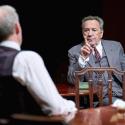
That leaves Cameron, who never leaves us in any doubt as to his sense of his own brilliance, to supposedly keep the show on the road, as he rehearses the other two through their FIFA pitches, and then in the following-day second half charts off-stage progress. He’s the smarmily unctuous mood-maker, convincing himself and the others that British chances are rising, giving way to predictable deflation and followed by a mood many degrees icier after denouement revelations. Cameron’s nemesis comes about through the other two characters, one his enjoyably clueless PA Penny (Antonia Kinlay, pictured with Dugald Bruce-Lockhart, above right), the other the wisecracking Ravi Aujla, who doubles the Indian waiter parts and proves in his main incarnation both a hilarious waffler and the only character who really knows what’s going on.
Gaminara’s writing is tight and hectic, drawing a gag from every possible allusion, and enjoying an absurdity that, in retrospect, probably seems close to that of real life events. Philip Wilson’s direction is no less nimble, keeping the action pirouetting energetically until it all ends with the “collapse of stout party” that is Dugald Bruce-Lockhart’s glorious take on Cameron.