

Genre mixing is a perilous business. Successful hybrids use duelling forms to re-contextualise or revolutionise; others wind up fatally diluting their disparate elements. Ayckbourn’s 1994 sci-fi comedy thriller – featuring, at its nadir, a farcical defenestration mistaken for a lesbian sex romp – falls into the latter camp.
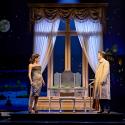
Dying magnate Reece (Robert Portal) suffers an attack of conscience after discovering the murderous methods of business partner Julian (David Bamber) for securing their financial success, and urges dominatrix for hire Poopay (Rachel Tucker, pictured below with Imogen Stubbs) to witness his written confession. When Julian violently attempts to silence her, Poopay flees through the London hotel suite’s connecting door, which takes her back 20 years to 2000 and the night Julian was preparing to bump off Reece’s second wife Ruella (Stubbs). The women hatch a plan to warn fellow murder victim, first wife Jessica (Lucy Briggs-Owen), on her wedding night in 1980 in order to change the course of history.
 Time travel fiction requires a watertight logic that Communicating Doors does not possess. Ruella discerns certain rules – you can only go backwards, in 20-year intervals; only Julian’s victims can travel; and only one can pass through at a time – but there are troubling paradoxes galore. Even setting aside thorny predestination issues and the unresolved question of what effect this meddling has on the wider world, there are niggling problems like the five-star hotel suite remaining unaltered for 40 years.
The main frustration stems from imbalance. The noir set-up is interminable, and Bamber’s common-or-garden psycho with mummy issues isn’t nearly enough of a threat to maintain suspense. More successful is the all-too-brief, giddily surreal take on comedy of manners, featuring careful navigation of the situation’s social awkwardness. There’s a hint of Blithe Spirit, but with more time spent on plot mechanics than character development, the dynamic between these three women of different eras remains hazy, and our female agents of change are largely defined by men. The gooey, convenient conclusion – with classist, patriarchal overtones – is positively Dickensian.
Tucker handles Poopay’s fearful bewilderment well, though the wailing grows tiresome. Ayckbourn’s joke is that the dominatrix is a pushover, but surely she’d have better survival instincts? Stubbs, playing in an entirely different register, relishes her dauntless character’s positive pragmatism and wry one-liners; reflecting on the mysterious appeal of S&M, she quips: “But then some people like listening to Schoenberg.” Briggs-Owen and Matthew Cottle have enjoyably quirky takes on the airhead aristo and dim detective respectively. Portal sells Reece’s fluctuating age, but this crucial catalyst, whose referenced Faustian pact is notable by its absence, remains a cypher.
Lindsay Posner’s production suffers the odd technical hitch and needs brisker pacing, but delivers this knotty piece with amiable clarity. If only the unravelling communicated more profound insight than the vague notion that good deeds and teamwork generate rewards, while the course of evil profiteering doesn’t always run smooth.











Add comment