Never use one word when you can get away with two: that seems to have been the maxim of Eugene O’Neill even in one of his shorter plays. After all, when is an ape not hairy, and why does stoker Robert “Yank” Smith, a natural hulk brought low by mechanised capital, have to bang home the title at every opportunity? Yes, this must have been an astonishing play to see on Broadway in 1922, and it still gives director Richard Jones a chance to throw every stylised trick in his very singular book at its eight diverse scenes. But masterpiece it isn’t.
Its ensemble is in some ways the opposite of the Old Vic’s almost unendurable The Iceman Cometh, in which Kevin Spacey was magnificent against a cast of British actors struggling with American accents. While this team is very much of a piece, Bertie Carvel as the furious, bewildered Yank doesn’t exactly struggle, but his Bronx manner makes the text difficult to understand at times. Yet if he can’t always talk the talk, he can walk the walk, raise himself to the ceiling, pace and bang and rattle in a superb physical embodiment of the biggest man on the stage. No wonder he endorses his personal fitness coach in the programme.
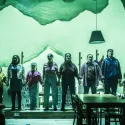
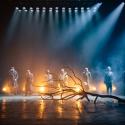
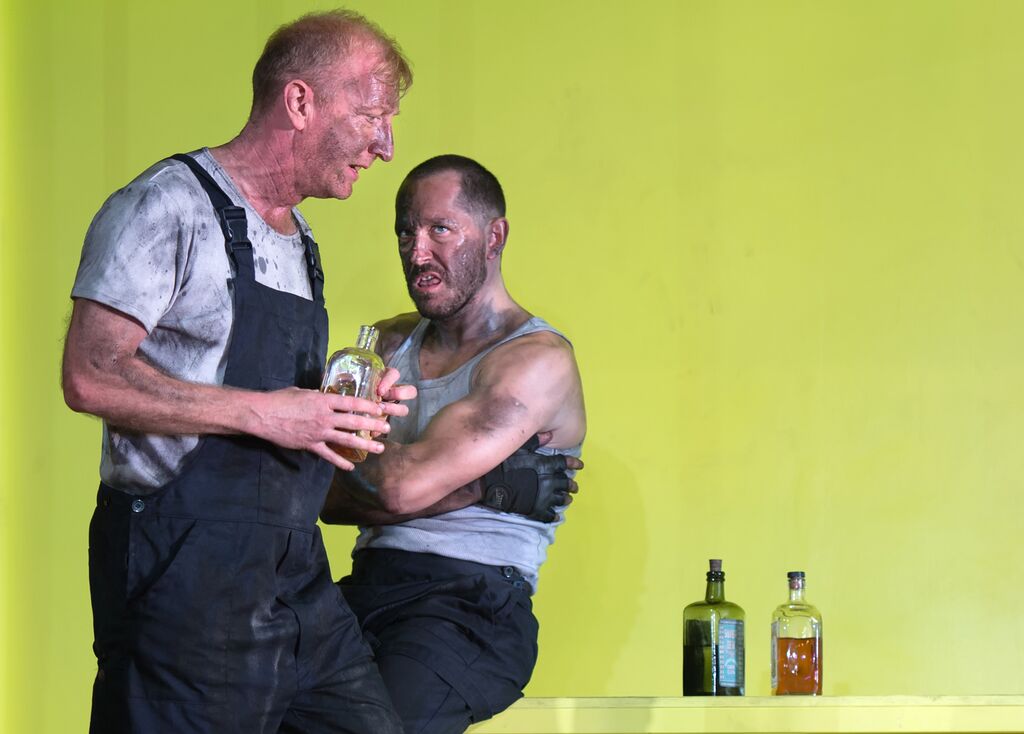 Compositions and movement are extraordinary throughout (the credit for choreography goes to Aletta Collins, but Jones would surely have had his ideas there too). The yellow belly of the transatlantic liner is subdivided by three strips; Carvel’s Yank sits in anguished apartness to the left while his eight colleagues often move and exclaim as one in the remaining two thirds, the choral herd. Tables are furiously bashed and recomposed. Every moment verges on dance; many contemporary ballets aren’t nearly as inventive.
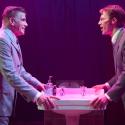
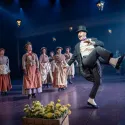
We get strong opposing views to Yank’s from Steffan Rhodri as clipper-nostalgic Paddy (pictured above wiith Carvel by Bill Knight) and Callum Dixon’s all-for-revolution Long, but this is company work executed at the highest level. Not since David Sawer’s score for Jones’s Government Inspector at the Young Vic have sound (here, often terrifying, by Sarah Angliss), design (with brilliantly malleable sets by Stewart Laing stunningly lit by Mimi Jordan Sherin) and action been so closely interwoven.
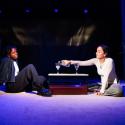
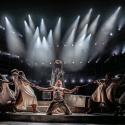
Change of scene to Mildred Douglas (Rosie Sheehy) and chaperone aunt (Buffy Davis) on deck – a drop curtain with daddy Douglas, steel magnate, hovering above (pictured below by Manuel Harlan). Sheehy, straight out of drama school, is perfect as the capricious heiress who wants to see the poor but can’t cope with the encounter as two ghosts from different worlds (she and Yank) meet down below.
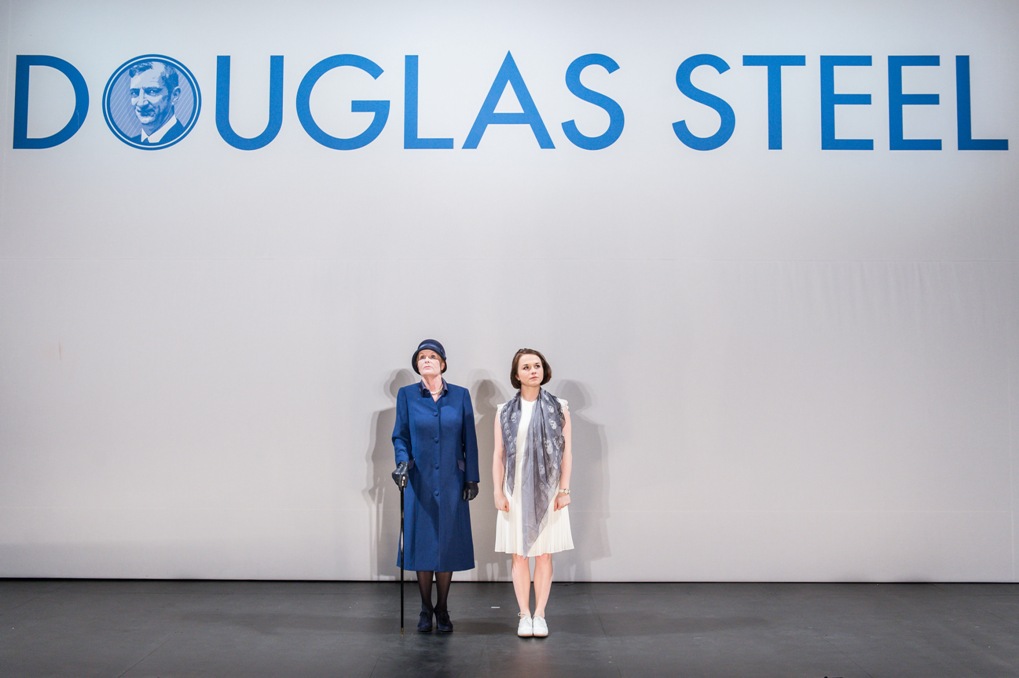
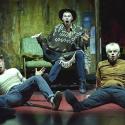
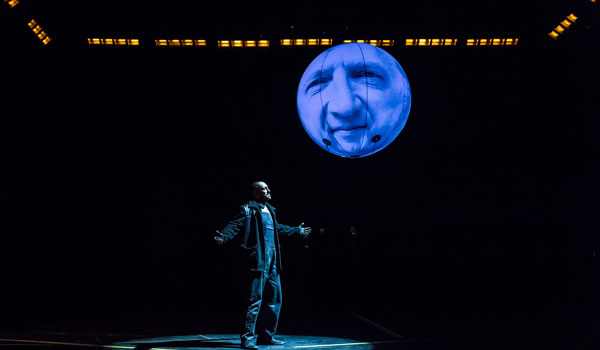
It's a pity we don't see more of this talented actress. Genre scenes in New York then take over in a dysfunctional foreshadowing of the three sailors onshore in Bernstein’s On the Town. Sinister masked society churchgoers – Jones and Collins did something similar with the Walmart drones in the Royal Opera’s Anna Nicole – are succeeded by a prison dialogue with eerie amplified voices, a superbly designed encounter at the International Workers of the World office, and a nightscape with posh partygoers and Douglas hovering as a moon-balloon (pictured below by Manuel Harlan). Jones has a disciplined field day throughout with references to 1920s American art and photography.
O’Neill’s final scene is predictable: Yank face-to-face with a gorilla in a Rousseau-esque cage at the zoo. Carvel doesn’t quite carry it off; perhaps no one could. For all The Hairy Ape's raging against inequality, which would be as potent today as it was then if O’Neill had engaged more poetic discipline, and the voice it gives to working men, this seems like a period piece as the plays of Brecht, just launching in 1922, rarely are: interesting, as they say, for the history of drama but less for drama itself. Still, kudos to Matthew Warchus's new regime at the Old Vic for the decision to stage it, and for bringing the great Richard Jones back into the picture, 27 years after he made his unforgettable debut here directing Alex Jennings in Ostrovsky's Too Clever By Half.