The exhibition starts promisingly. You can help yourself to an orange from Roelof Louw’s pyramid of golden fruit. Its a reminder that, for the conceptualists, art was a verb not a noun. Focusing on activity rather than outcome, these artists were committed to the creative process rather than the end product. The idea was what mattered, and if it led to an open-ended exploration, so much the better.
For centuries, the whole point of art had been its longevity; now mutability and destruction were welcomed as part of the creative process. Left intact, Louw’s pyramid of oranges (pictured below right) would slowly moulder and decay; if the fruit was removed however, the pyramid would quickly diminish. Either way the sculpture would disappear, leaving nothing but a photographic record and a memory.
 St Martin’s School of Art was a hotbed of unruly behaviour. The sculptor Anthony Caro taught there and, inspired by meetings in New York with American critic Clement Greenberg, he preached that art should be about nothing but itself. Pure, undiluted abstraction was the goal; everything else was a distraction.
Students like Bruce McLean, Barry Flanagan and Gilbert & George responded to this hermetic and self-referential view by throwing open the doors to embrace the element of time and the messy unpredictability of change. And John Latham, who also taught at the college, encouraged the dissenters. He borrowed Greenberg’s influential book Art and Culture from the college library and, during the summer of 1966, held a party; guests were invited to chew the pages and spit out the remains. Latham then fermented and distilled the pulp into a liquid. When asked to return the book, he gave the library a phial of the liquid and was promptly dismissed from his post.
It was de rigueur to use unorthodox media like photography, film, television and video, installation, performance and text, which had no art historical precedents and could reach large audiences. Richard Long and Hamish Fulton turned walking into an art form, while David Tremlett began travelling, making work on the hoof and sending postcards home to alert people to what he was doing. Putting up posters or sending cards, photos, letters and leaflets through the post were important ways of circumventing the gallery system and engaging directly with an audience.
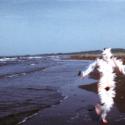
Humour, wit and parody were key elements of the new approach (pictured below left: Keith Arnatt eats his own words in Art as an Act of Retraction, (detail), 1971). John Latham did a one-second drawing and Bruce McLean reclined on plinths in poses mimicking Henry Moore sculptures (main picture). Artists began referring to their output as “pieces”, a concept parodied by Bruce McLean in a booklet from 1972 listing 1,000 ideas. Index Card piece commented on Ed Herring and Victor Burgin’s propensity for archiving and There’ll be a sculpture in the hillside piece referred to sculptures made in remote places by Richard Long.
 There is no business like art business piece (sung) satirised Gilbert & George, who had declared themselves living sculptures. They mimed to a recording of the Flanagan and Allen song Underneath the Arches and having done the rounds of the art schools, their table-top performance was taken up by museums and dealers, such as Nigel Greenwood. I remember sitting at their feet as, hands and faces painted bronze in accordance with their new status, they exchanged a rubber glove and a toy walking stick with a tip that squeaked, convinced I was witnessing a key moment in art history.
How, though, to encapsulate in an exhibition such a plethora of unruly ideas, and convey the energy and enthusiasm that fuelled these radical departures? In focusing on work that hangs nicely on the wall or fits neatly into vitrines, Conceptual Art in Britain doesn’t even attempt to convey the scope of these innovations. It favours photographic and written documentation over installation, performance and video and gives an inordinate amount of space to the group Art & Language who treated art as an offshoot of linguistic analysis.
In a play on the word “abstract”, Michael Baldwin silkscreened onto canvas a book review from the Review of Metaphysics. This was the beginning of a period of expropriation in which philosophical texts were reproduced as paintings, published in books and magazines, or hung directly on gallery walls for hapless viewers to plough through. I doubt that anyone read them, since they were incomprehensible to all but a few academics. Soon the group began generating their own material; described as performative writing, it transforms theory into practice. Various forms of analysis – lists, charts, propositions, scores – replace creative action; but the art establishment embraced the group with alacrity and they dominate this exhibition which, as a result, is much drier and more conventional than it need be.
- Conceptual Art in Britain 1964-1979 at Tate Britain until 29 August